
Wizard Recommends
-
 $11000 Welcome Bonus
 -
 $3000 Welcome Bonus
 -
 UP TO $777 BONUS
Non-Casino Games - FAQ
Specific Number Oddsin Liar's Poker
| Number | Probability |
|---|---|
| 8 | 0.00000001 |
| 7 | 0.00000072 |
| 6 | 0.00002268 |
| 5 | 0.00040824 |
| 4 | 0.00459270 |
| 3 | 0.03306744 |
| 2 | 0.14880348 |
| 1 | 0.38263752 |
| 0 | 0.43046721 |
| Total | 1.00000000 |
The next table shows the probability of every possible type of bill, categorized by the number of each n-of-a-kind. For example, the serial number 66847680 would have one three of a kind, one pair, and three singletons, for a probability of 0.1693440.
General Probabilities in Liar's Poker
| 8 o.a.k. | 7 o.a.k. | 6 o.a.k. | 5 o.a.k. | 4 o.a.k. | 3 o.a.k. | 2 o.a.k. | 1 o.a.k. | Probability |
|---|---|---|---|---|---|---|---|---|
| 1 | 0.0000001 | |||||||
| 1 | 1 | 0.0000072 | ||||||
| 1 | 1 | 0.0000252 | ||||||
| 1 | 2 | 0.0002016 | ||||||
| 1 | 1 | 0.0000504 | ||||||
| 1 | 1 | 1 | 0.0012096 | |||||
| 1 | 3 | 0.0028224 | ||||||
| 2 | 0.0000315 | |||||||
| 1 | 1 | 1 | 0.0020160 | |||||
| 1 | 2 | 0.0015120 | ||||||
| 1 | 1 | 2 | 0.0211680 | |||||
| 1 | 4 | 0.0211680 | ||||||
| 2 | 1 | 0.0020160 | ||||||
| 2 | 2 | 0.0141120 | ||||||
| 1 | 2 | 1 | 0.0423360 | |||||
| 1 | 1 | 3 | 0.1693440 | |||||
| 1 | 5 | 0.0846720 | ||||||
| 4 | 0.0052920 | |||||||
| 3 | 2 | 0.1270080 | ||||||
| 2 | 4 | 0.3175200 | ||||||
| 1 | 6 | 0.1693440 | ||||||
| 8 | 0.0181440 | |||||||
| Total | 1.0000000 | |||||||
o.a.k. = "of a kind"
For more information, see my page on liars poker.
These bets can be made in both sic bo and chuck a luck.
- Defender loses both: 37.17%
- Each loses one: 33.58%
- Attacker loses both: 29.26%
Last Roll Yahtzee Probabilities
| Needed | Probability of Success |
| 0 | 1 |
| 1 | 0.166667 |
| 2 | 0.027778 |
| 3 | 0.00463 |
| 4 | 0.000772 |
The next table shows the probabilities of improvement. The left column shows how many dice you need before any given roll and the top column shows how many you need after the roll. The body shows the probability of the given degree of improvement.
Probabilities of Improvement
| Need Before Roll | 0 | 1 | 2 | 3 | 4 | Total |
| 0 | 1 | 0 | 0 | 0 | 0 | 1 |
| 1 | 0.166667 | 0.833333 | 0 | 0 | 0 | 1 |
| 2 | 0.027778 | 0.277778 | 0.694444 | 0 | 0 | 1 |
| 3 | 0.00463 | 0.069444 | 0.37037 | 0.555556 | 0 | 1 |
| 4 | 0.000772 | 0.01929 | 0.192901 | 0.694444 | 0.092593 | 1 |
The next table shows the probability on the initial roll of needing 0 to 4 more dice to make a Yahtzee.
First Roll Yahtzee Probabilities
| Needed | Probability |
| 0 | 0.000772 |
| 1 | 0.019290 |
| 2 | 0.192901 |
| 3 | 0.694444 |
| 4 | 0.092593 |
The next table shows the probability of improvement and then eventual success according to the number needed after the first roll. For example, if the player needs 3 more dice to make a Yahtzee the probability of improving to needing 2 more after the second roll and making the Yahtzee on the third roll is 0.010288066.
Probabilities of Yahtzee after first roll according to number needed before and after second roll
| Need Before Roll | 0 | 1 | 2 | 3 | 4 | Total |
| 0 | 1 | 0 | 0 | 0 | 0 | 1 |
| 1 | 0.166667 | 0.138889 | 0 | 0 | 0 | 0.305556 |
| 2 | 0.027778 | 0.046296 | 0.01929 | 0 | 0 | 0.093364 |
| 3 | 0.00463 | 0.011574 | 0.010288 | 0.002572 | 0 | 0.029064 |
| 4 | 0.000772 | 0.003215 | 0.005358 | 0.003215 | 0.000071 | 0.012631 |
To get the final answer take the dot product of the number needed after the first roll two tables up and the probability of eventual success in the final column one table up. This is 0.092593*0.012631+ 0.694444*0.029064 + 0.192901*0.093364 + 0.019290*0.305556 + 0.000772*1 = 4.6028643%. To confirm this I did a 100,000,000 game simulation and the simulated probability was 4.60562%.
Lets call y the expected number of remaining flips if one side is one flip in the majority.
Lets call z the expected number of remaining flips if one side is two flips in the majority.
E(x) = 1 + E(y)
E(y) = 1 + 0.5*E(x) + 0.5*E(z)
E(z) = 1 + 0.5*E(y)
It is then easy matrix algebra to see that E(x) = 9, E(y) = 8, and E(z) = 5. So on average it will take 9 flips for the disparity between heads and tails to be 3. So at 8 rupees it is a good bet for the person collecting the one rupee per flip, because he will receive on average 9 rupees, but pay back only 8. The house edge for the gambler is 11.11%. At 9 rupees it is a fair bet, at 7 the house advantage is 22.22%.
A pattern to this table seems to be that you should force the opponent to a situation where the sum of the pearls in the smallest and greatest rows equals the sum of the two in the middle. This would include leaving zero in the row with the least number of pearls.
Pearls Before Swine II Strategy
| You Have | Leave |
| 1111 | 111 |
| 1112 | 111 |
| 1113 | 111 |
| 1114 | 111 |
| 1115 | 111 |
| 1116 | 111 |
| 1122 | Lose |
| 1123 | 1122 |
| 1124 | 1122 |
| 1125 | 1122 |
| 1126 | 1122 |
| 1133 | Lose |
| 1134 | 1133 |
| 1135 | 1133 |
| 1136 | 1133 |
| 1144 | Lose |
| 1145 | 1144 |
| 1146 | 1144 |
| 1155 | Lose |
| 1156 | 1155 |
| 1222 | 1122 |
| 1223 | 1122 |
| 1224 | 1122 |
| 1225 | 1122 |
| 1226 | 1122 |
| 1233 | 123 |
| 1234 | 123 |
| 1235 | 123 |
| 1236 | 123 |
| 1244 | 1144 |
| 1245 | 145 |
| 1246 | 246 |
| 1255 | 1155 |
| 1256 | Lose |
| 1333 | 1133 |
| 1334 | 1133 |
| 1335 | 1133 |
| 1336 | 1133 |
| 1344 | 1144 |
| 1345 | 145 |
| 1346 | Lose |
| 1355 | 1155 |
| 1356 | 1256 |
| 1444 | 1144 |
| 1445 | 1144 |
| 1446 | 1144 |
| 1455 | 1155 |
| 1456 | 1346 |
| 2222 | Lose |
| 2223 | 2222 |
| 2224 | 2222 |
| 2225 | 2222 |
| 2226 | 2222 |
| 2233 | Lose |
| 2234 | 2233 |
| 2235 | 2233 |
| 2236 | 2233 |
| 2244 | Lose |
| 2245 | 2244 |
| 2246 | 2244 |
| 2255 | Lose |
| 2256 | 2255 |
| 2333 | 2233 |
| 2334 | 2233 |
| 2335 | 2233 |
| 2336 | 2233 |
| 2344 | 2244 |
| 2345 | Lose |
| 2346 | 1346 |
| 2355 | 2255 |
| 2356 | 2345 |
| 2444 | 2244 |
| 2445 | 2244 |
| 2446 | 2244 |
| 2455 | 2255 |
| 2456 | 2345 |
| 3333 | Lose |
| 3334 | 3333 |
| 3335 | 3333 |
| 3335 | 3333 |
| 3336 | 3333 |
| 3344 | Lose |
| 3345 | 3344 |
| 3346 | 3344 |
| 3355 | Lose |
| 3356 | 3355 |
| 3444 | 3344 |
| 3445 | 3344 |
| 3446 | 3344 |
| 3455 | 3355 |
| 3456 | 1346 |
Brad S. wrote in to add a general strategy for any number of pearls and rows. First you break down each row into its binary components. For example the starting position of the Transcience game would be as follows.
- 3 = 2+1
- 4 = 4
- 5 = 4+1
- 6 = 4+2
Then you endeavor to leave an even number of each power of 2. For example in the above there are two 1’s, two 2’s, and three 4’s. So there is an extra 4. You then remove 4 from any of the rows with a 4 term. Keep doing this until you can get your opponent down to 2,2 or an odd number of 1’s.
Try this strategy on the Pearl 3 game, you’ll win every time. If you start with a losing scenario as I did on game 10 (4+7+8+11) you can click on "go" to make him go first.
Let’s look at an example. Suppose it is your turn with the following scenario.
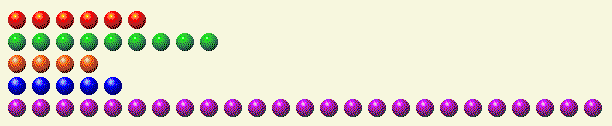
The following table breaks down each row into its binary components.
Player’s Turn 1
| Row | 1 | 2 | 4 | 8 | 16 |
| 6 | 0 | 1 | 1 | 0 | 0 |
| 9 | 1 | 0 | 0 | 1 | 0 |
| 4 | 0 | 0 | 1 | 0 | 0 |
| 5 | 1 | 0 | 1 | 0 | 0 |
| 25 | 1 | 0 | 0 | 1 | 1 |
| Total | 3 | 1 | 3 | 2 | 1 |
You can see that there is an odd number of ones, twos, fours, and sixteens. Clearly we need to get the row of 25 under 16 to eliminate the 16 unit. To keep the total of the binary components even we need to remove the 1, add a 2, add a 4, keep the 8, and remove the 16. That means the best play is 2+4+8=14 in the last row. Leaving 14 in the bottom row we have the following.
Computer’s Turn 1
| Row | 1 | 2 | 4 | 8 | 16 |
| 6 | 0 | 1 | 1 | 0 | 0 |
| 9 | 1 | 0 | 0 | 1 | 0 |
| 4 | 0 | 0 | 1 | 0 | 0 |
| 5 | 1 | 0 | 1 | 0 | 0 |
| 14 | 0 | 1 | 1 | 1 | 0 |
| Total | 2 | 2 | 4 | 2 | 0 |
The computer takes its turn, leaving us with this.
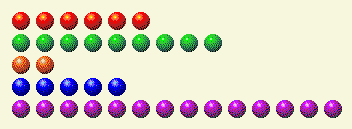
Here is the binary breakdown of that.
Player’s Turn 2
| Row | 1 | 2 | 4 | 8 | 16 |
| 6 | 0 | 1 | 1 | 0 | 0 |
| 9 | 1 | 0 | 0 | 1 | 0 |
| 2 | 0 | 1 | 0 | 0 | 0 |
| 5 | 1 | 0 | 1 | 0 | 0 |
| 14 | 0 | 1 | 1 | 1 | 0 |
| Total | 2 | 3 | 3 | 2 | 0 |
Here we need to remove a 2 and a 4, to get those totals even. There is only one row, the 14, which has both components. So remove 6 from that, leaving 8.
Computer’s Turn 2
| Row | 1 | 2 | 4 | 8 | 16 |
| 6 | 0 | 1 | 1 | 0 | 0 |
| 9 | 1 | 0 | 0 | 1 | 0 |
| 2 | 0 | 1 | 0 | 0 | 0 |
| 5 | 1 | 0 | 1 | 0 | 0 |
| 8 | 0 | 0 | 0 | 1 | 0 |
| Total | 2 | 2 | 2 | 2 | 0 |
The computer takes its turn, leaving us with this.
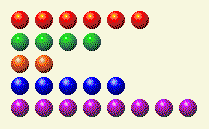
Now we need to change the 1, 4, and 8 columns.
Player’s Turn 3
| Row | 1 | 2 | 4 | 8 | 16 |
| 6 | 0 | 1 | 1 | 0 | 0 |
| 4 | 0 | 0 | 1 | 0 | 0 |
| 2 | 0 | 1 | 0 | 0 | 0 |
| 5 | 1 | 0 | 1 | 0 | 0 |
| 8 | 0 | 0 | 0 | 1 | 0 |
| Total | 1 | 2 | 3 | 1 | 0 |
That can be done by changing the row of 8 to 5 as follows.
Computer’s Turn 3
| Row | 1 | 2 | 4 | 8 | 16 |
| 6 | 0 | 1 | 1 | 0 | 0 |
| 4 | 0 | 0 | 1 | 0 | 0 |
| 2 | 0 | 1 | 0 | 0 | 0 |
| 5 | 1 | 0 | 1 | 0 | 0 |
| 5 | 1 | 0 | 1 | 0 | 0 |
| Total | 2 | 2 | 4 | 0 | 0 |
The computer takes its turn, leaving us with this.
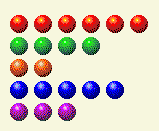
Now we need to change the 2 and 4 totals.
Player’s Turn 4
| Row | 1 | 2 | 4 | 8 | 16 |
| 6 | 0 | 1 | 1 | 0 | 0 |
| 4 | 0 | 0 | 1 | 0 | 0 |
| 2 | 0 | 1 | 0 | 0 | 0 |
| 5 | 1 | 0 | 1 | 0 | 0 |
| 3 | 1 | 1 | 0 | 0 | 0 |
| Total | 2 | 3 | 3 | 0 | 0 |
This can be done by changing the 6 to a 0.
Computer’s Turn 4
| Row | 1 | 2 | 4 | 8 | 16 |
| 0 | 0 | 0 | 0 | 0 | 0 |
| 4 | 0 | 0 | 1 | 0 | 0 |
| 2 | 0 | 1 | 0 | 0 | 0 |
| 5 | 1 | 0 | 1 | 0 | 0 |
| 3 | 1 | 1 | 0 | 0 | 0 |
| Total | 2 | 2 | 2 | 0 | 0 |
The computer takes its turn, leaving us with this.
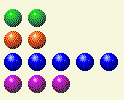
Now we need to change the 2s and 4s.
Player’s Turn 5
| Row | 1 | 2 | 4 | 8 | 16 |
| 0 | 0 | 0 | 0 | 0 | 0 |
| 2 | 0 | 1 | 0 | 0 | 0 |
| 2 | 0 | 1 | 0 | 0 | 0 |
| 5 | 1 | 0 | 1 | 0 | 0 |
| 3 | 1 | 1 | 0 | 0 | 0 |
| Total | 2 | 3 | 1 | 0 | 0 |
This can be accomplished by changing the row of 5 to 3. If you can ever get your opponent to an x,x,y,y situation you can’t help but win, if you can maintain the same situation until the end.
Computer’s Turn 5
| Row | 1 | 2 | 4 | 8 | 16 |
| 0 | 0 | 0 | 0 | 0 | 0 |
| 2 | 0 | 1 | 0 | 0 | 0 |
| 2 | 0 | 1 | 0 | 0 | 0 |
| 3 | 1 | 1 | 0 | 0 | 0 |
| 3 | 1 | 1 | 0 | 0 | 0 |
| Total | 2 | 4 | 0 | 0 | 0 |
The next few moves I keep the computer on x,x,y,y patterns. Here the computer leaves me with 2,2,3,2; so I leave it with 2,2,2,2.
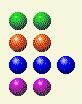
The computer then gives me 2,2,1,2. I leave it with 2,2,1,1.

The computer then leaves me with 2,2,1. I leave it with 2,2. If you can ever get your opponent to two equal rows you can’t help but win, just keep the rows equal.

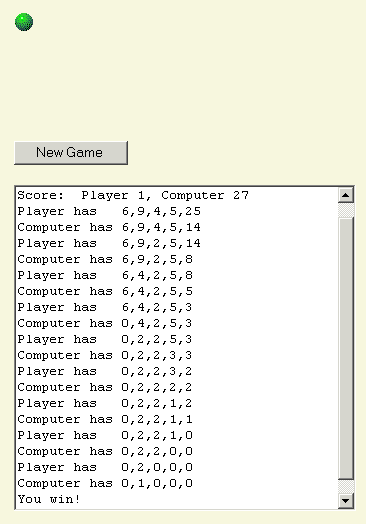
The computer then leaves me with a single pile of 2, and I remove 1.

Here is the end of the game.
I suggest paying 1 to 1 on red and black, 14 to 1 on green, and 60 to 1 on any individual number. One formula for the house edge is (t-a)/(t+1), where t is the true odds, and a is the actual odds. In this case the house edge on the red or black bet is (63-60)/(63+1) = 3/64 = 4.69%. On the green bet the house edge is (15-14)/(15+1) = 1/16 = 6.25%. On individual numbers the house edge is (63-60)/(63+1) = 3/64 = 4.69%.
A reader later added the following to this topic.
I have a comment on your February 14 "Ask the Wizard" column (No. 183). It’s doesn’t really have anything to do with the question you answered. It’s just something you might find interesting.
Prior to the passing of Proposition 1A, that allowed to have full class 3 gaming, we had a small installation of VLT style for a couple of years. In our system, which was run by SDG (now part of Bally), the prize pool started with 4 million draws. When the pool was reduced and 2 million remained, the next pool of 4 million was added for a total pool of 6 million draws. When the pool was reduced to 2 million again, the process repeated.
Yahtzee Experiment
| Rolls | Occurences | Probability |
| 1 | 63908 | 0.00077371 |
| 2 | 977954 | 0.0118396 |
| 3 | 2758635 | 0.0333975 |
| 4 | 4504806 | 0.0545376 |
| 5 | 5776444 | 0.0699327 |
| 6 | 6491538 | 0.0785901 |
| 7 | 6727992 | 0.0814527 |
| 8 | 6601612 | 0.0799227 |
| 9 | 6246388 | 0.0756221 |
| 10 | 5741778 | 0.0695131 |
| 11 | 5174553 | 0.0626459 |
| 12 | 4591986 | 0.0555931 |
| 13 | 4022755 | 0.0487016 |
| 14 | 3492745 | 0.042285 |
| 15 | 3008766 | 0.0364257 |
| 16 | 2577969 | 0.0312103 |
| 17 | 2193272 | 0.0265529 |
| 18 | 1864107 | 0.0225679 |
| 19 | 1575763 | 0.019077 |
| 20 | 1329971 | 0.0161013 |
| 21 | 1118788 | 0.0135446 |
| 22 | 940519 | 0.0113864 |
| 23 | 791107 | 0.00957757 |
| 24 | 661672 | 0.00801056 |
| 25 | 554937 | 0.00671837 |
| 26 | 463901 | 0.00561624 |
| 27 | 387339 | 0.00468933 |
| 28 | 324079 | 0.00392347 |
| 29 | 271321 | 0.00328476 |
| 30 | 225978 | 0.00273581 |
| 31 | 189012 | 0.00228828 |
| 32 | 157709 | 0.00190931 |
| 33 | 131845 | 0.00159619 |
| 34 | 109592 | 0.00132678 |
| 35 | 91327 | 0.00110565 |
| 36 | 76216 | 0.00092271 |
| 37 | 63433 | 0.00076795 |
| 38 | 52786 | 0.00063906 |
| 39 | 44122 | 0.00053417 |
| 40 | 36785 | 0.00044534 |
| 41 | 30834 | 0.00037329 |
| 42 | 25494 | 0.00030864 |
| 43 | 21170 | 0.0002563 |
| 44 | 17767 | 0.0002151 |
| 45 | 14657 | 0.00017745 |
| 46 | 12410 | 0.00015024 |
| 47 | 10299 | 0.00012469 |
| 48 | 8666 | 0.00010492 |
| 49 | 7355 | 0.00008904 |
| 50 | 5901 | 0.00007144 |
| 51 | 5017 | 0.00006074 |
| 52 | 4227 | 0.00005117 |
| 53 | 3452 | 0.00004179 |
| 54 | 2888 | 0.00003496 |
| 55 | 2470 | 0.0000299 |
| 56 | 2012 | 0.00002436 |
| 57 | 1626 | 0.00001969 |
| 58 | 1391 | 0.00001684 |
| 59 | 1135 | 0.00001374 |
| 60 | 924 | 0.00001119 |
| 61 | 840 | 0.00001017 |
| 62 | 694 | 0.0000084 |
| 63 | 534 | 0.00000646 |
| 64 | 498 | 0.00000603 |
| 65 | 372 | 0.0000045 |
| 66 | 316 | 0.00000383 |
| 67 | 286 | 0.00000346 |
| 68 | 224 | 0.00000271 |
| 69 | 197 | 0.00000238 |
| 70 | 160 | 0.00000194 |
| 71 | 125 | 0.00000151 |
| 72 | 86 | 0.00000104 |
| 73 | 79 | 0.00000096 |
| 74 | 94 | 0.00000114 |
| 75 | 70 | 0.00000085 |
| 76 | 64 | 0.00000077 |
| 77 | 38 | 0.00000046 |
| 78 | 42 | 0.00000051 |
| 79 | 27 | 0.00000033 |
| 80 | 33 | 0.0000004 |
| 81 | 16 | 0.00000019 |
| 82 | 18 | 0.00000022 |
| 83 | 19 | 0.00000023 |
| 84 | 14 | 0.00000017 |
| 85 | 6 | 0.00000007 |
| 86 | 4 | 0.00000005 |
| 87 | 9 | 0.00000011 |
| 88 | 4 | 0.00000005 |
| 89 | 5 | 0.00000006 |
| 90 | 5 | 0.00000006 |
| 91 | 1 | 0.00000001 |
| 92 | 6 | 0.00000007 |
| 93 | 1 | 0.00000001 |
| 94 | 3 | 0.00000004 |
| 95 | 1 | 0.00000001 |
| 96 | 1 | 0.00000001 |
| 97 | 2 | 0.00000002 |
| 102 | 1 | 0.00000001 |
| Total | 82600000 | 1 |
Backgammon by Paul Magriel: If there were a Bible to backgammon, this would be it. I’m a proud owner of an old hard-cover edition. This book would be a great place to start. Although it was written in 1976, the advice still holds up well.
501 Essential Backgammon Problems by Bill Robertie: I’ve been trying to get through this book for years, and I’m still only half way there. It is disheartening to get half the problems wrong, enough to make me think I’m as bad at backgammon as I am at golf. However, with every problem missed, there is a valuable lesson to be learned. For the intermediate to advanced player, this book is a valuable, and humbling, learning tool.
Snowie backgammon software: I play about 1000 games a year against this game. Snowie not only plays a near-perfect game, but tells you exactly how costly your errors are, when you make them. There are lots of other features that I have never explored. If there is one thing I’ve learned from Snowie, it’s that the biggest problem with my game is bone-headed mistakes of not seeing perfectly obvious plays sometimes. Much like chess, one bad move can wipe out 100 good ones.
Motif website: Before I purchased Snowie, I played countless games against Motif. The strategy employed by Motif is very solid, in my opinion. There is nothing like playing against a stronger opponent to improve your own game.
Probabilities in the Price is Right Showcase Showdown
| Spin 1 | Strategy | Player 1 | Player 2 | Player 3 |
| 0.05 | spin | 20.59% | 37.55% | 41.85% |
| 0.10 | spin | 20.59% | 37.55% | 41.86% |
| 0.15 | spin | 20.57% | 37.55% | 41.87% |
| 0.20 | spin | 20.55% | 37.55% | 41.9% |
| 0.25 | spin | 20.5% | 37.56% | 41.94% |
| 0.30 | spin | 20.43% | 37.56% | 42.01% |
| 0.35 | spin | 20.33% | 37.58% | 42.10% |
| 0.40 | spin | 20.18% | 37.60% | 42.22% |
| 0.45 | spin | 19.97% | 37.64% | 42.39% |
| 0.50 | spin | 19.68% | 37.71% | 42.61% |
| 0.55 | spin | 19.26% | 37.81% | 42.93% |
| 0.60 | spin | 18.67% | 37.96% | 43.36% |
| 0.65 | spin | 17.86% | 38.21% | 43.93% |
| 0.70 | stay | 21.56% | 38.28% | 40.16% |
| 0.75 | stay | 28.42% | 35.21% | 36.38% |
| 0.80 | stay | 36.82% | 31.26% | 31.92% |
| 0.85 | stay | 46.99% | 26.35% | 26.66% |
| 0.90 | stay | 59.17% | 20.36% | 20.47% |
| 0.95 | stay | 73.61% | 13.19% | 13.21% |
| 1.00 | stay | 90.57% | 4.72% | 4.72% |
| Average | 30.82% | 32.96% | 36.22% |
Here are the winning number of combinations out of the 6×206 possible.
Player 1: 118,331,250Player 2: 126,566,457
Player 3: 139,102,293
The following table shows the equivalent interest rate without the point, according to the interest rate with one point and the term.
Equivalent Interest Rate with No Points
| Interest Rate with One Point | 10 years | 15 years | 20 years | 30 years | 40 years |
| 4.00% | 4.212% | 4.147% | 4.115% | 4.083% | 4.067% |
| 4.25% | 4.463% | 4.398% | 4.366% | 4.334% | 4.318% |
| 4.50% | 4.714% | 4.649% | 4.617% | 4.585% | 4.570% |
| 4.75% | 4.965% | 4.900% | 4.868% | 4.836% | 4.821% |
| 5.00% | 5.216% | 5.151% | 5.119% | 5.088% | 5.073% |
| 5.25% | 5.467% | 5.402% | 5.370% | 5.339% | 5.324% |
| 5.50% | 5.718% | 5.654% | 5.621% | 5.590% | 5.576% |
| 5.75% | 5.969% | 5.905% | 5.873% | 5.842% | 5.827% |
| 6.00% | 6.220% | 6.156% | 6.124% | 6.093% | 6.079% |
| 6.25% | 6.471% | 6.407% | 6.375% | 6.344% | 6.330% |
| 6.50% | 6.723% | 6.658% | 6.626% | 6.596% | 6.582% |
| 6.75% | 6.974% | 6.909% | 6.878% | 6.847% | 6.834% |
| 7.00% | 7.225% | 7.160% | 7.129% | 7.099% | 7.085% |
| 7.25% | 7.476% | 7.412% | 7.380% | 7.350% | 7.337% |
| 7.50% | 7.727% | 7.663% | 7.631% | 7.602% | 7.589% |
| 7.75% | 7.978% | 7.914% | 7.883% | 7.853% | 7.841% |
| 8.00% | 8.229% | 8.165% | 8.134% | 8.105% | 8.093% |
| 8.25% | 8.480% | 8.416% | 8.385% | 8.357% | 8.344% |
| 8.50% | 8.731% | 8.668% | 8.637% | 8.608% | 8.596% |
| 8.75% | 8.982% | 8.919% | 8.888% | 8.860% | 8.848% |
| 9.00% | 9.233% | 9.170% | 9.140% | 9.112% | 9.100% |
| 9.25% | 9.485% | 9.421% | 9.391% | 9.363% | 9.352% |
| 9.50% | 9.736% | 9.673% | 9.642% | 9.615% | 9.604% |
| 9.75% | 9.987% | 9.924% | 9.894% | 9.867% | 9.856% |
| 10.00% | 10.238% | 10.175% | 10.145% | 10.119% | 10.108% |
This shows that a 5.75% interest rate with one point is equivalent to a 5.842% with no points. In other words the payment would be the same both ways, assuming the point charged is added to the principal balance. Your other offer was 5.875% with no points, which is higher than 5.842%, so I would take the 5.75% with the point.
P.S. For those of you wondering how I solved for i, I used the rate function in Excel.
According to Life: the Odds (and How to Improve Them) by Gregory Baer, the odds of a hole in one on a par 3 hole in the PGA tour is 1 in 2491. I believe those distances fall in the par 3 range.
A 1 handicap is darn good, so I'm not going to give much of a discount compared to PGA Tour players. Let's say your son's probability per par 3 hole is 1 in 3,000. A typical gold course will have about four par 3 holes. Let’s say your son plays every day. That would be 28 par 3 holes a week. The probability of making exactly two hole in ones would be combin(28,2)×(1/3000)2×(2999/3000)26 = 1 in 24,017.
Probabilities for Long Suit in Hearts
| Cards | Combinations | Probability |
| 4 | 222766089260 | 0.35080524800183 |
| 5 | 281562853572 | 0.44339660045899 |
| 6 | 105080049360 | 0.16547685914958 |
| 7 | 22394644272 | 0.03526640326564 |
| 8 | 2963997036 | 0.00466761219692 |
| 9 | 235237860 | 0.00037044541245 |
| 10 | 10455016 | 0.00001646424055 |
| 11 | 231192 | 0.00000036407412 |
| 12 | 2028 | 0.00000000319363 |
| 13 | 4 | 0.00000000000630 |
| Total | 635013559600 | 1 |
Rule of 72 — Years to Double Money
| Interest Rate | Rule of 72 | Exact | Difference |
|---|---|---|---|
| 0.01 | 72.00 | 69.66 | 2.34 |
| 0.02 | 36.00 | 35.00 | 1.00 |
| 0.03 | 24.00 | 23.45 | 0.55 |
| 0.04 | 18.00 | 17.67 | 0.33 |
| 0.05 | 14.40 | 14.21 | 0.19 |
| 0.06 | 12.00 | 11.90 | 0.10 |
| 0.07 | 10.29 | 10.24 | 0.04 |
| 0.08 | 9.00 | 9.01 | -0.01 |
| 0.09 | 8.00 | 8.04 | -0.04 |
| 0.10 | 7.20 | 7.27 | -0.07 |
| 0.11 | 6.55 | 6.64 | -0.10 |
| 0.12 | 6.00 | 6.12 | -0.12 |
| 0.13 | 5.54 | 5.67 | -0.13 |
| 0.14 | 5.14 | 5.29 | -0.15 |
| 0.15 | 4.80 | 4.96 | -0.16 |
| 0.16 | 4.50 | 4.67 | -0.17 |
| 0.17 | 4.24 | 4.41 | -0.18 |
| 0.18 | 4.00 | 4.19 | -0.19 |
| 0.19 | 3.79 | 3.98 | -0.20 |
| 0.20 | 3.60 | 3.80 | -0.20 |
Why 72? It doesn’t have to be exactly 72. That is just the number that works out well for realistic interest rates you’re likely to see on an investment. It works out almost exactly for an interest rate of 7.8469%. There is nothing special about 72, like there is about π or e. Why does any number work? If the interest rate is i, then let’s solve for the number of years (y) it takes to double an investment.
2 = (1+i)y
ln(2)= ln(1+i)y
ln(2)= y×ln(1+i)
y = ln(2)/ln(1+i)
This may not be my best answer ever, but try to follow this logic: let y=ln(x).
dy/dx=1/x.
1/x =~ x at values of x close to 1.
So the dy/dx =~ 1 for values of x close to 1.
So the slope of ln(x) is going to be close to 1 for values of x close 1.
So the slope of ln(1+x) is going to be close to 1 for values of x close 0.
The "rule of 72" is saying that .72/i =~ .6931/ln(1+i).
We’ve established that i and ln(1+i) are similar for values of i close to 0.
So 1/i and 1/ln(1+i) are similar for values of i close to 0.
Using 72 instead of 69.31 adjusts for differences between i and ln(1+i) for values of i around 8%.
I hope that makes some sense. My calculus is rather rusty; it took hours to explain this to myself.
This question was raised and discussed in the forum of my companion site Wizard of Vegas.
It is based on the same illusion as the field bet in craps. For those readers not familiar with the field bet, the player wins if the sum of the roll of two dice is 2, 3, 4, 9, 10, 11, or 12. Losing numbers are 5, 6, 7, and 8. Wins pay even money, except the 2 pays 2 to 1 and the 12 pays 3 to 1 (except at stingy Harrah’s casinos, where they pay 2 to 1 only on the 12). The mathematically challenged gambler may falsely reason it is a good bet because there are 7 totals that win and only 4 that lose. The reason the odds favor the house is that the losing numbers have the greatest chance to be rolled.
Here are the specific rules of Razzle Dazzle, as taken from the article Probabilities of Winning a Certain Carnival Game by Donald A. Berry and Ronald R. Regal, which appeared in the November 1978 issue of the The American Statistician.
- The object of the game is to advance across the football field 100 yards. The player will be awarded some kind of nice prize when he does.
- The player starts paying a specified fee per play, such as $1.
- The player will spill 8 marbles onto an 11 by 13 grid. Each marble will fall into one of the 143 holes.
- Each hole has a number of points from 1 to 6. The following table shows the frequency of each number of points.
Razzle Dazzle Points Distribution
Points Number
on BoardProbability 1 11 0.076923 2 19 0.132867 3 39 0.272727 4 44 0.307692 5 19 0.132867 6 11 0.076923 Total 143 1.000000 - The total number of points will be added. The carnie will look up the point total on a conversion chart to see how many yards the player advances. The conversion chart is shown below.
Razzle DazzleConversion Chart
Points Yards
Gained8 100 9 100 10 50 11 30 12 50 13 50 14 20 15 15 16 10 17 5 18 to 38 0 39 5 40 5 41 15 42 20 43 50 44 50 45 30 46 50 47 100 48 100 - If the player rolls a total of 29, then the fee for all subsequent rolls will be doubled, and the player be awarded one extra prize if and when he reaches the other end of the football field.
The average points per marble is 3.52, and the standard deviation is 1.31. Note how 3 and 4 points have the highest probability. That keeps the standard deviation low, and the sum of many marbles close to expectations. The standard deviation of the roll of a single die is 1.71, by comparison.
Next, notice how there are 20 winning totals and 21 losing totals on the yardage conversion chart. The kind of sucker who gambles on carnival games might incorrectly reason his probability of advance is 20/41 or 48.8%. It wouldn’t surprise me if the carnies falsely claimed these were the odds of advancing. However, much like the field bet, the most likely outcomes don’t win anything.
The next table show the probability of each number of points per turn, yards gained, and expected yards gained. The lower right cell shows the average yards gained per turn is 0.0196.
Expected Yards Gained per Turn
| Points | Probability | Yards Gained |
Expected Yards Gained |
| 8 | 0.00000000005 | 100 | 0.00000000464 |
| 9 | 0.00000000176 | 100 | 0.00000017647 |
| 10 | 0.00000002586 | 50 | 0.00000129285 |
| 11 | 0.00000022643 | 30 | 0.00000679305 |
| 12 | 0.00000143397 | 50 | 0.00007169849 |
| 13 | 0.00000713000 | 50 | 0.00035650022 |
| 14 | 0.00002926510 | 20 | 0.00058530196 |
| 15 | 0.00010234709 | 15 | 0.00153520642 |
| 16 | 0.00031168305 | 10 | 0.00311683054 |
| 17 | 0.00083981462 | 5 | 0.00419907311 |
| 18 | 0.00202563214 | 0 | 0.00000000000 |
| 19 | 0.00441368617 | 0 | 0.00000000000 |
| 20 | 0.00874847408 | 0 | 0.00000000000 |
| 21 | 0.01586193216 | 0 | 0.00000000000 |
| 22 | 0.02642117465 | 0 | 0.00000000000 |
| 23 | 0.04056887936 | 0 | 0.00000000000 |
| 24 | 0.05757346716 | 0 | 0.00000000000 |
| 25 | 0.07566411880 | 0 | 0.00000000000 |
| 26 | 0.09221675088 | 0 | 0.00000000000 |
| 27 | 0.10431970222 | 0 | 0.00000000000 |
| 28 | 0.10958441738 | 0 | 0.00000000000 |
| 29 | 0.10689316272 | 0 | 0.00000000000 |
| 30 | 0.09677806051 | 0 | 0.00000000000 |
| 31 | 0.08125426057 | 0 | 0.00000000000 |
| 32 | 0.06317871335 | 0 | 0.00000000000 |
| 33 | 0.04540984887 | 0 | 0.00000000000 |
| 34 | 0.03009743061 | 0 | 0.00000000000 |
| 35 | 0.01833921711 | 0 | 0.00000000000 |
| 36 | 0.01023355162 | 0 | 0.00000000000 |
| 37 | 0.00520465303 | 0 | 0.00000000000 |
| 38 | 0.00239815734 | 0 | 0.00000000000 |
| 39 | 0.00099365741 | 5 | 0.00496828705 |
| 40 | 0.00036673565 | 5 | 0.00183367827 |
| 41 | 0.00011909673 | 15 | 0.00178645089 |
| 42 | 0.00003349036 | 20 | 0.00066980729 |
| 43 | 0.00000797528 | 50 | 0.00039876403 |
| 44 | 0.00000155945 | 50 | 0.00007797235 |
| 45 | 0.00000023832 | 30 | 0.00000714969 |
| 46 | 0.00000002632 | 50 | 0.00000131607 |
| 47 | 0.00000000176 | 100 | 0.00000017647 |
| 48 | 0.00000000005 | 100 | 0.00000000464 |
| Totals | 1.00000000000 | 0 | 0.01961648451 |
Here are some results of a random simulation of 17.5 million games.
Razzle Dazzle Simulation Results
| Question | Answer |
| Probability of advancement per turn | 0.0028 |
| Expected yards gained per turn | 0.0196 |
| Expected yards gained per advancement | 6.9698 |
| Expected turns per game | 5238.7950 |
| Average doubles per game | 559.9874 |
| Averages prizes per game | 560.9874 |
I would have liked to indicate the average total bet per game, but my computer can not handle numbers so large. The average game had the player doubling his bet 560 times over the average of 5,239 turns per game. One game in the simulation had the player doubling his bet 1,800 times. Even at the average of 560 doubles, the bet per roll would be $3.77 × 10168, assuming a starting bet of $1. That is many orders of magnitutude greater than the number of atoms in the known universe (source).
Even the most naive player will not play for long if he is advancing once every 355 plays only. What the carnies will do is cheat in the player’s favor at first. He may spot the player free rolls, or lie in adding up the points, giving the player winning totals to boost his confidence. I’ve never played the game, but I imagine that when the player gets close to the red zone (20 yards or less from a touchdown), then the carnie will start playing fairly. The player may wonder why he is suddenly getting nowhere, but with money already invested, and being so close to the goal line, he would hesitate to walk away and give up the yardage he already paid for.
Links
- Razzle Dazzle, excerpt from the book On the Midway.
- Razzle Dazzle Carny Board Game Arcade Scam.
- Probabilities of Winning a Certain Carnival Game by Donald A. Berry and Ronald R. Regal
This question was raised and discussed in the forum of my companion site Wizard of Vegas.
- Buy everything. Advanced players may make exceptions if the property won’t help you make a monopoly, block someone else, and has little value as a bargaining chip. Utilities can also be declined in a cash-poor situation.
- Trade as well as you can. This is where the skill comes in. Try to trade for the best set you can. Here is how I rank them, in general: Orange, Yellow, Light Blue, Dark Blue, Light Purple, Red, Green, Dark Purple. This will vary depending on circumstances. In a cash-poor game, favor the sets that are cheaper to develop, like the light blues. In a cash-rich game, go for the ones where there is more potential to spend money on, like the yellows or dark blues.
- Once you get a set, whether naturally or by trade, build up quickly. Try to get to three houses on each property as quickly as possible. The marginal return per house drops after three. Mortgage most of your other properties and spend your cash. You want to leave a little equity for small expenses. Not spending your money is like a soldier in battle not using his bullets.
- Oppose all the silly house rules. This especially goes for the money pot on Free Parking (I can’t stand that one!). If you are more skilled than your opponents, you want to minimize the randomness of the game.
There are 3 ways each corner can be oriented, for a total of 38=6,561 corner orientations. Likewise there are two ways each edge piece can be oriented, for a total of 212=4,096 edge orientations.
So, if we could take the cube apart, and rearrange the edge and corner groups, then there would be 8! × 12! × 38 × 212 = 519,024,039,293,878,000,000 possible permutations. However, not all of these permutations can be arrived at from the starting position by rotating the faces.
First, it is impossible to rotate just one corner and leave everything else the same. No combination of turns will achieve that. Basically, every action has to have a reaction. If you wish to rotate one corner, it would disturb the other pieces somehow. Likewise, it is impossible to flop just one edge piece. For these reasons, we have to divide the number of permutations by 3 × 2 = 6.
Second, it is impossible to switch two edge pieces without disturbing the rest of the cube. This is the hardest part of this answer to explain. All you can do with a Rubik's Cube is rotate one face at a time. Each movement rotates four edge pieces and four corner pieces for a total of eight pieces moved. A sequence of rotations can be represented by a number of piece movements divisible by 8. Often a sequence of moves will result in two movements canceling each other out. However, there will always be an even number of pieces moved with any sequence of rotations. To swap two edge pieces would be one movement, an odd number, which can not be achieved with the sum of any set of even numbers. Mathematicians would call this a parity problem. So we have to divide by another 2 because two edge pieces cannot be swapped without other pieces being disturbed.
So there are 3 × 2 × 2 = 12 possible groups of Rubik's Cube permutations. If you disassembled a Rubik's Cube and put it back together randomly, there is a 1 in 12 chance that it would be solvable. So the total number of permutations in a Rubik's Cube is 8! × 12! × 312 × 212 / 12 = 43,252,003,274,489,900,000. If you had seven billion monkeys, about the human world population, playing randomly with the Rubik's cube, at a rate of one rotation per second, a cube will pass through the solved position on average once every 196 years.
Links
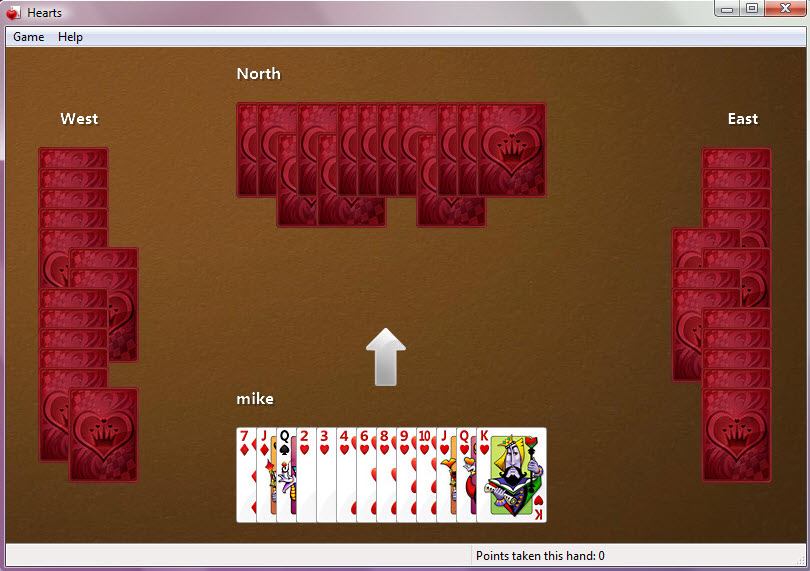
For those unfamiliar with the rules of Hearts, play starts with dealing 13 cards each to four players. The hearts suit is significant to the game, so how many you get is important. The following table shows the odds of being dealt 0 to 13 hearts.
Probability of 0 to 13 Hearts out of 13 Cards
| Hearts | Combinations | Probability | Inverse |
|---|---|---|---|
| 13 | 1 | 0.0000000000016 | 1 in 635,013,559,600.0 |
| 12 | 507 | 0.0000000007984 | 1 in 1,252,492,228.0 |
| 11 | 57,798 | 0.0000000910185 | 1 in 10,986,773.9 |
| 10 | 2,613,754 | 0.0000041160601 | 1 in 242,950.8 |
| 9 | 58,809,465 | 0.0000926113531 | 1 in 10,797.8 |
| 8 | 740,999,259 | 0.0011669030492 | 1 in 857.0 |
| 7 | 5,598,661,068 | 0.0088166008164 | 1 in 113.4 |
| 6 | 26,393,687,892 | 0.0415639752774 | 1 in 24.1 |
| 5 | 79,181,063,676 | 0.1246919258321 | 1 in 8.0 |
| 4 | 151,519,319,380 | 0.2386080062219 | 1 in 4.2 |
| 3 | 181,823,183,256 | 0.2863296074662 | 1 in 3.5 |
| 2 | 130,732,371,432 | 0.2058733541286 | 1 in 4.9 |
| 1 | 50,840,366,668 | 0.0800618599389 | 1 in 12.5 |
| 0 | 8,122,425,444 | 0.0127909480376 | 1 in 78.2 |
| Total | 635,013,559,600 | 1.0000000000000 |
This question was raised and discussed in the forum of my companion site Wizard of Vegas.
Drawing Ticket Experiment
| Subject | Folded | Unfolded | Total |
|---|---|---|---|
| 1 | 25 | 25 | 50 |
| 2 | 38 | 22 | 60 |
| 3 | 25 | 15 | 40 |
| 4 | 34 | 16 | 50 |
| 5 | 27 | 23 | 50 |
| 6 | 26 | 24 | 50 |
| Total | 175 | 125 | 300 |
So, 58.3% of the tickets drawn were folded!
If it's assumed that folding had no effect, then these results would be 2.89 standard deviations away from expectations. The probability of getting this many folded tickets, or more, assuming folding didn't affect the odds, is 0.19%, or 1 in 514.
I might add the subjects who drew tickets hastily were much more likely to draw folded ones. Those who carefully took their time with each draw were at or near a 50/50 split.
So, my conclusion is definitely to fold them.
For discussion about this question, please visit my forum at Wizard of Vegas.