
On this page
Sportsbooks Vs. Prediction Markets
On this page
Introduction

Recently, there has been a proliferation of Prediction Markets in the world of gambling, with perhaps the best known one being Polymarket.
For those of you who read any of my numerous articles about Predictit, which concerns the trading of politics-related binary options, PolyMarket is functionally the same thing, except it has categories outside of politics.
One thing that we noticed with PredictIt is that, due to market inefficiencies, it was often possible to lock up some all-but-guaranteed money on virtual sure things, let’s see an excerpt from my conclusion in the second-linked article above:
I have included the running amounts wagered (based on 100 shares of each option) and the running profits. The, “Big bet,” refers to the guaranteed winner of taking, “NO,” on every single Electoral College vote difference between the two. However, if you did not already have money on the site, you would be looking at the, “W/O Big Bet,” totals because that EC bet is not a winner if you have to deposit because you’ll eat 5% of all monies (deposit included) upon cashing out.
Another thing is that the returns are actually better than what I used. I assumed a roundup to the highest penny for the 10% fee on a per share basis, (because that was easy to do in my head) but by buying 100 shares of everything, you would pay exactly 10% on your gains every time.
 Ohio Recommended Online Casinos
View All

UP TO $11,000 BONUS
All US players welcome
Over 200 casino games
Play on PC or Mobile
UP TO $3000 BONUS
Casino & Sportsbook
American players only
Play on desktop or mobile

UP TO 777$ BONUS
Large welcome bonus
Daily casino tournaments
Popular games

$7777 + 300 Free Spins
Live Dealer Games
Daily Free Tournaments
Mobile and Desktop Friendly
If you were buying into PredictIt for the purposes of only these bets, you would have deposited $455 with profits (after 10% fee) of $43 for a total of $498. However, you must pay a withdrawal fee of 5% on all monies, which means that you would withdraw an actual total of $473.1 for profits of $18.10 on $455 bet for a return of 103.978% or +3.978%.
None of these outcomes were ever really in doubt, which demonstrates the inefficiencies that are often created in semi-legitimate or legitimate binary markets that are often exploitable. One exploitable inefficiency identified (but only if you already had money on the site that 5% of which is lost to withdrawal fees anyway) was being able to guarantee a profit by taking the NO on every single Electoral College vote difference result.
If you are going to use PredictIt, then I would generally recommend playing for only, “Sure things,” and leaving any funds in there unless you really need them for something. The reason why is because of the 5% withdrawal fee, so if you withdraw and then deposit anew (and have winnings) you’ll essentially pay 5% on the same money multiple times.
Either that, or you can just play with a fixed amount deposited and withdraw any profits over and over again, as long as they will let you keep doing that.
With that, one point of interest that we will examine later on is whether or not PolyMarket has those same kinds of inefficiencies that can lead to virtually locking up profits, on occasion.
In terms of how PredictIt made money, that site made money primarily based on the fees that it charged; the key two fees were a 10% haircut on all winnings in conjunction with a 5% withdrawal fee. Essentially, you would want to deposit a particular amount (in my estimation) and leave that amount there-withdrawing only profits after that. The reason for that is because you would otherwise be paying withdrawal fees on more initially deposited funds which would increase the functional house edge, for want of a better term.
With that, let’s look at both Sports Betting and PredictIt in a little more detail; after we have done that, we will compare it to PolyMarket.
HOW DOES PREDICTIT WORK?
Predictit is going to be more similar to PolyMarket in the sense that both are prediction markets. For my part, I’m unaware if the fee structure of PredictIt has recently changed, but since we aren’t specifically concerned with PredictIt right now, we will explain it based upon the model relevant to the two above-linked WoV articles.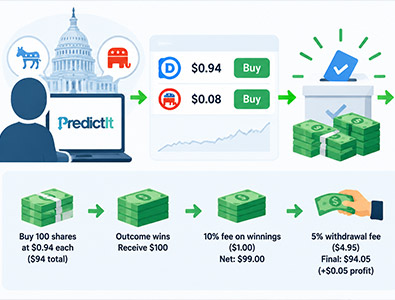
Essentially, PredictIt consisted of a two-pronged fee structure. The first fee would come from any winning outcomes being reduced by 10% of your winnings, which creates a functional House Edge. While a 10% haircut sounds like it would be unbeatable, and it certainly would be in the long-term if it functioned as a true house edge (or RTP of 90%), market inefficiencies were such that this 10% could be beaten, as we explored in the above articles.
The second prong of the fee structure is the fee of 5% on all withdrawals from the site. It is for that reason that I determined that optimal participation would consist of only making one initial deposit ever; the reason for that is, since we are operating on the assumption that we will be profitable on our options buys, we will functionally be paying a 5% fee on all amounts that we deposited.
For an example of this, let’s look back at our Elections Betting WoV article (the second WoV article linked above); one of the available options was for the Democratic Party to win the State of California in the 2020 Presidential Election; functionally, no outcome other than this was ever realistic, so this was just a free money play. We will now review the result of that Option:
Which Party Will Win California in 2020: Democrat $0.94, Republican $0.08:
This is free money, but only if you already have money on Predictit. There is no way in a million years that Joe Biden loses in California.
The only problem with this option is that you can’t really deposit funds to make this bet. The reason why is because you would bet $94 to purchase 100 shares. WHEN you win, 0.6 cents of your profits will be subtracted from your result, but that’s going to round up to the nearest penny and be a loss of $0.01/share.
The thing that was expected came to fruition. We bought 100 theoretical shares for $94, we made $0.06 per share, but had to give $0.01/share back in fees, for profits of $0.05/share.
RUNNING AMOUNT WAGERED: $94
RUNNING PROFIT: $5.00
In the case above, we see that this option was just free money provided you already had money on the site; perhaps counter-intuitively, this ceases to be the case if we had to make an initial deposit (with intent to cash out after) only for the purposes of making this play.
The reason why is because we would have deposited $94 to buy the 100 shares on that side of the option (again, this is hypothetical), we would have realized (after fees) $5 in total profits, which would then increase our balance to $99. However, if we then decided to withdraw that $99, we would pay a 5% fee on that withdrawal, which would be $4.95, so technically we would still have realized profits, but only of $0.05 on a $94 outlay, which isn’t a good rate.
Comparatively, if we already had money on the site, then this would simply increase our balance by $5 and be a good play.
For that reason, absent something outstanding coming up, players would do well to only ever make an initial deposit and then proceed to withdraw profits as the profits pile up; once again, you can be assumed to be paying an immediate 5% fee on anything you put in, if you are eventually going to take it out, assuming that you trade profitably.
That said, for those wanting to test the waters by exposing a smaller amount to PredictIt relative to the total amount they might want to expose if they are doing well, it wouldn’t be unreasonable to make a smaller initial deposit to be followed by a larger deposit later. Generally speaking, however, the goal would be to only ever withdraw profits.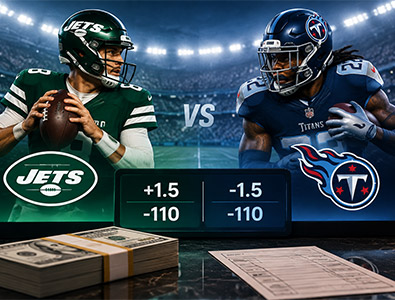
TRADITIONAL SPORTS BETTING
Alternatively, traditional sports betting works on a traditional House Edge basis. For example, if we look at DraftKings, as of this Monday, September 7th, 2026, at 11:33a.m., DraftKings is offering the most milquetoast line that can possibly exist and is great for our purposes.
The line being offered is on Sunday’s (September 13th) game between the New York Jets and the hosting Tennessee Titans; the line is -110, on both sides, with the Jets getting 1.5 points and the Titans laying 1.5 points. The question now becomes: What is the House Edge of this bet?
One area where sports betting differs from something like Video Poker is that the House Edge is implied; similar to Prediction Markets, there exists the possibility for real/perceived inefficiencies on betting lines, so a sharp sports bettor, theoretically, might consider the Jets to be massively undervalued on this line and would jump at the Jets +1.5. This differs from Video Poker in that the House Edge for Video Poker, assuming optimal strategy, is always going to be a fixed percentage…this is also generally true of slot machines, however, for land-based casino slots, we typically don’t know what that House Edge actually is.
LINE BETS
For the purposes of this discussion, let’s assume that +1.5 for the Jets and -1.5 for the Titans is a perfect betting line; having made that assumption, we can calculate a House Edge by simply betting both sides of the line.
If we bet $110 on each side to win $100 on each side, given that it is a half point line, one of our bets must win and the other must lose; because we are assuming the line is perfect, we’re also assigning a probability of 50% to each outcome, therefore, we are betting a total of $220 and the only possible outcome is a net loss of $10.
10/220 = .045454545 or 4.5454545%, rounded.
Of course, absent unusual circumstances (such as a promotion where you want to lock in profits or some kind of loss rebate where you and a confederate play both sides to ensure one wins and the other loses), nobody would ever bet this way. Typically, the House Edge would manifest, with the player only betting one side, like this:
(100 * .5) - (110 * .5) = -5
5/110 = .045454545 or 4.5454545%, rounded.
With both outcomes implied to be equally likely, you’re either going to win $100 or lose $110, so we can see why, if all lines were perfect, the only thing players could ever do in the long run is lose.
What kind of winning percentage is necessary to breakeven? That’s actually trivial to figure out using Algebra, here you go:
(100 * x) - (110 * (1-x)) = 0
You can do this the long way or, as long as you have expressed the question correctly, you can even use an Algebra Equation solver, such as this one.
In short, you would need to win 52.38% of such bets, long run, in order to break even. A win rate greater than that is profitable and a win rate lesser than that is losing.
The math gets a little bit more murky when it comes to Line Bets with non-standard (read: non -110) lay amounts or with opportunities to push, but in general terms, ignoring pushes, that is the win rate needed to beat Point Spread Sports Betting. For example, if you had an Even Money Point Spread bet (+100), then you’d only need to win 50% of the time to be breakeven; however, for a Sportsbook to offer such a bet would indicate that the implied probability of this bet resolving in your favor is less than 50%.
MoneyLine Bets
The next form of betting that we will take some time to examine is MoneyLine bets. Once again, this is going to be more similar to Prediction Markets in the sense that you are choosing for either x or y to happen; it remains a binary outcome.
Similar to Point Spread bets, Moneylines convey a certain Implied Probability; the more money that you stand to make if the bet resolves in your favor, the less likely that favorable outcome is implied to be; conversely, the less money you stand to make on a bet resolving in your favor, the more likely the outcome is implied to be.
For this, we will also use that Jets/Titans game in order to determine the House Edge. We will do this the same way that we did the last one, by having an analysis wherein we bet both sides of the line. The Jets are +105, so if we were to bet $100 on the Jets to win outright, we would receive a $105 profit; the Titans are -125, so we would need to bet $125 in order to win $100.
We have a tool on this website that calculates the Implied House Edge for Straight Bets; the tool suggests that the Implied House Edge of this line is 4.16%, regardless of what side you take. We can use the tool in conjunction with an Implied Probability tool, such as this one, to verify.
The Implied Probability tool yields a probability of 48.78% for the +105 bet to resolve in our favor; if you’re betting the -125 side, 55.56%. You’ll notice that these don’t add up to 100%, which is where the House Edge comes from, let’s take a look:
(100 * .5556) - (125 * .4444) = 0.01
In other words, given the rounding, this bet becomes a breakeven proposition. Let’s see if the same is true for our +105 bet:
(105 * .4878) - (100 * .5122) = -.001
Once again, this is a breakeven proposition, after we account for the rounding.
Where the juice comes from is the fact that, functionally, the Sportsbook is paying out according to probabilities that differ from what is implied. We can understand this by acknowledging two things:
- Sports Betting is, fundamentally, a binary option.
- Whatever side you’re betting, the Sportsbook is functionally betting the opposite.
It’s for that reason the Probabilities do not add up to 100%; similar to the House Edge of any other casino game, the Sportsbook’s ‘Juice,’ comes from the fact that the Odds being offered, at least as the intent, are fundamentally unfair. In other words, the Implied Odds are not the Odds that the Sportsbook is actually applying to the event, which is why they don’t add up to 100%.
Another calculator we will introduce is this win probability calculator, what this tool does is it lets you input the Point Spread and then it will give a probability of winning based on that. When we input the Jets’ +1.5 Point Spread, it tells us that the probability of them winning outright is 45.6%, as opposed to the Implied Moneyline Probability of 48.78%, with this new probability, we can do this:
(105 * .456) - (100 * .544) = -6.52
But, if we flip that:
(100 * .544) - (105 * .456) = 6.52 (Expected Sportsbook Profit)
Conversely, the 54.4% for the Titans to win, based on a -1.5 Point Spread, is less than the implied 55.56%, ergo:
(100 * .544) - (125 * .456) = -2.60
In both cases, we are expected to lose because the Implied Probability of the MoneyLine, regardless of what side we take, is worse than the actual probability that is implied by the Point Spread; in other words, relative to the Odds, the payouts are mathematically unfair, as with most other casino games.
For the time being, those are the only Sports Bet types we’re going to cover on this page; however, for other types of Sports Bets (which typically have greater House Edges), you can look here. 
PREDICTION MARKETS AND SPORTS
Again, we’ve gone over previous analyses of PredictIt in the articles linked in the Introduction, and at a fundamental level, PolyMarket (sports prediction market) isn’t much different.
In the case of our New York Jets v. Tennessee Titans example, we even see that the Odds are somewhat similar; they’re just expressed somewhat differently.
As of roughly the same time as we looked at DraftKings for this game, PolyMarket had the Jets at 48% (rounded) with a multiplier (how they express returns) of 2.11x. In other words, you could buy $5 worth of, ‘Shares,’ in the Jets to win this game outright and it would return $10.21, of which $5.21 would be profits.
Similarly, PolyMarket has Tennessee at roughly 53% (rounded) to win outright with a multiplier of 1.89x, which means that a $5 proposition would return $9.16 if you held it to conclusion and the Jets did, in fact, win the game.
The average price of the shares for the Jets to win is not actually $0.48, again, that’s rounded, but is actually $0.475, per share, according to PolyMarket. With that, we can do the math on the potential outcomes:
(5.21 * .475) - (5 * .525) = -0.15025 (Functional House Edge of 3.005%)
In other words, we’re actually expected to incur a loss on this bet and there is a House Edge, functionally.
If we take the Tennessee side, at 53%, then it would have $5 in shares returning $9.16 if Tennessee wins the game. That being the case:
(4.16 * .53) - (5 * .47) = - 0.1452 (Functional House Edge of 2.904%)
If this is supposed to be a true Binary Option, then where are these House Edges/Expected Losses coming from?
Going back to the Jets, at breakeven value with an average share cost of $0.475, $5 would then be equivalent to 5/.475 = 10.5263158 Shares. If each of those shares is going to resolve with a profit of $0.525/share, then it should look like profits of .525 * 10.5263158 = $5.53 (Rounded), but the site says that our return would actually be profits of $5.21 if the Jets won, so where is this disparity of $0.32 coming from?
The answer to that question is simple: Fees. If you take a side of one of these Binary Options, then Fees are going to be charged to you. The fee schedule for PolyMarket is such that, buying $0.48 (average price) options is going to result in, ‘Taker Fees,’ of $1.50 per 100 lot; in other words, buying $48 (100 lot) of this proposition results in fees of $1.50, which reflects 1.5/48 = .03125 or 3.125%.
However, there is an additional element to this. The Taker Fees are deducted from your balance at the time that you take the Binary; in other words, these fees are paid whether or not you win or lose. With that, using the Jets/Titans example, it would perhaps be more prudent to look at this based on a 100 lot:
With an average price of $47.50 on the Jets to win, we see that we are risking that for a positive return of $96.94 (to win) which already accounts for the fact that we have paid the $1.50 in fees. Given the probability of winning (based on the binary), our math would have looked like this:
(49.44 * .475) - (47.50 * .525) = - 1.4535 or 1.4535/47.50 = -3.06 or 3.06% Expected Loss
However, it’s actually worse than that because we lose the fees in addition to the $47.50 that our option represents, so in terms of total loss, it would actually be $49, which appears:
(49.44 * .475) - (49 * .525) = -2.241 or 2.241/49 = 4.5735 (rounded) or 4.5735% Expected Loss
Not to say that they would all be the same, but on this particular straight line bet, we have a greater expected loss than the average of betting at a traditional Sportsbook.
POINT SPREAD COMPARISON
The next comparison we make will have to do with Point Spread. As we have already discussed, the DraftKings line is set at +1.5 for the Jets and -1.5 for the Titans; PolyMarket does not express this line in exactly the same way, but on the Titans side, you can make functionally the same bet. If you want to bet that the Titans will win by more than 1.5 points, then a $50 bet (lot of 100) has the potential to return $97.08, of which $47.08 will be profits, after fees.
Comparing this to DraftKings, if we simply made a $50 bet and it won, we would be looking at this:
50 * (100/110) = $45.45 in profits.
Again, PolyMarket is superficially better, but we have to recall that we are going to pay the fee of $1.50, win or lose, to buy the $100 lots. With that, we are not actually risking $50 for a return of $97.08, we are risking $51.50 for that return. Once again, we treat this outcome as having an actual probability of 50%, because that is what the market implies, so:
(47.08 * .5) - (51.5 * .5) = -2.21 or 2.21/51.5 = 4.29126 or 4.29126% House Edge
Compared to DraftKings:
(45.45 * .5) - (50 * .5) = - 2.275 or 2.275/50 = 4.55 or 4.55% House Edge
In this case, we’re slightly better off with the Binary Option method of betting as opposed to the Traditional Sports Book, even though it’s close. It’s honestly unsurprising that there wouldn’t be a remarkable difference in the markets between the two things.
ARE THERE ADVANTAGES (OR LESSER DISADVANTAGES TO BE HAD) WITH POLYMARKETS?
This is a question that we will examine in greater detail, but the short answer is: probably.
For one thing, even someone sticking to traditional and/or online sportsbooks would always do well to shop lines, absent there being some sort of promotion to take advantage of.
For example, as of the time of this writing, DraftKings is offering -118 if you want to take the Patriots line of +3.5 compared to the -102 if you want to take the Seahawks at -3.5; Fanduel, on the other hand, is -112 if you want the same line on the Patriots as compared to -108 on the Seahawks. With that, if there were no promotions and you had no reason to prefer one website to the other, if you like the Patriots side, you’d bet on Fanduel; if you liked the Seahawks side, then you’d want to get your action down at DraftKings.
Similarly, the MoneyLine reflects a similar position on those online Sportsbooks; DraftKings only has the Patriots at +150 to win outright, whereas Fanduel has them at +158 (a few websites are offering even better payouts to take the Patriots outright); on the other hand, if you want the Seahawks, then you’d only be laying $180 to win $100 on DraftKings compared to laying $188 to win the same, on Fanduel.
There’s also disparity in totals betting as DraftKings seems to think this game is less likely to have a game total OVER 44.5, as you only have to lay $105 to win $100 if you want that; at the other websites, you’d generally have to lay more. Of course, on DraftKings, you’d have to lay $115 if you wanted to take UNDER 44.5, whereas it is less than that on most other websites.
The disparity could be based on the model that DraftKings uses, or it could be based on bets that have already come in causing them to adjust the line, but relative to other websites, they seem to think that the most likely result is the Seahawks winning a very close, but low-scoring, game.
Given that example I just gave about line shopping, which is literally the first game that I pulled up, it stands to reason that, if the prediction markets are going to have comparative value at all, then that value is probably going to be just in shopping (in general terms) and possibly on long shots.
COMPARING OTHER BET TYPES
Super Bowl Futures
One thing that interests me about the binary markets is the potential for more future-looking events to offer better odds than the sportsbooks do; I’d assume they are called, ‘Prediction Markets,’ for a reason. With that, I’m going to look to the Super Bowl futures on DraftKings and compare them to what PolyMarket is offering.
The nice thing about Futures Betting is that we don’t even need to know the House Edge to understand which line is better; we simply have to compare the lines and take the fees into account.
For example, let’s suppose that I wanted to pick the Baltimore Ravens to win the Super Bowl this season; as of the time of this writing, DraftKings would have this as a +1000 line, which means that I could bet $100 and would have profits of $1,000 were the Ravens to win the Super Bowl.
Interestingly, the fee structure, on PolyMarket, is such that long-shot bets charge less in fees. On PolyMarket, the average price for the Ravens to win the Super Bowl is $0.08, so it says that I would be betting $100 to win $1,184.60 ($1,084.60 in profits) after accounting for fees. Of course, the fees would be $0.44 per 100 lot, and $100.00 would reflect 12.5 such lots, so the fees (that are charged upfront) would be 12.5 * .44 = $5.50 on that transaction.
With that, we would simply factor these sunk costs in and we would be comparing the following:
$100 to win $1100
Vs.
$105.50 to win $1184.60
1100/100 = 11x
1184.6/105.50 = 11.228436x
In other words, if I wanted to bet on the Ravens to win the Super Bowl, then I would be better off to do so on PolyMarket as compared to DraftKings.
Of course, as of the time of this writing, Fanduel has the Ravens at +1300, so we don’t have to get into much of an analysis to immediately know that taking the Ravens, on Fanduel, would be better than doing so on PolyMarket.
Another example where PolyMarket wouldn’t make any sense at all is on an extreme long-shot, such as the Cleveland Browns to win the Super Bowl. DraftKings is presently offering +20,000 odds, if you wanted to take the Browns, whereas those are odds so long that PolyMarket functionally can’t handle them.
One consistent line that I have found, which differs on PolyMarket, is that the Rams Super Bowl futures are consistently +500 everywhere. In other words, you would bet $100 and would win $500 were they to emerge as the NFL Champions. PolyMarket, on the other hand, has those shares on Rams-YES at $0.18/share, such that $100 in shares would return $529.50, of which $429.50 would be profits.
Obviously, this proposition is significantly worse on PolyMarket as the 18% ($0.18 Binary Option on YES) is significantly greater than the implied probability of 16.67% that the Sportsbooks’ line of +500 represents, thereby making PolyMarket immediately worse, even before accounting for the fact that you would still pay the fees on a loss.
In fact, one quick way to compare the lines without even getting into fees is to simply look at the implied probabilities of the best betting line available to you and compare them to Polymarket. If you convert the PolyMarket Binary Option-YES to a percentage, and that percentage is greater than the implied probability that the Sportsbook line offers, then PolyMarket is immediately worse. If the Polymarket converted percentage is lower than the implied probability, then you would have to look at the effect of fees to know which is actually better, such as the Ravens example.
With that, as of this Monday, September 7th, let’s compare some available lines to PolyMarket and see which is worse and which is better:
| Team | Sportsbook + Line | PolyMarket Binary (Expressed As Percentage) | Outcome |
|---|---|---|---|
| Rams | Most +500 | 18% | Sportsbooks Are Better |
| Ravens | Fanduel +1300 | 8% | Fanduel Is Better |
| Bills | Most +1000 | 8% | PolyMarket is Better (See DraftKings Ravens Example Above) |
| Seahawks | Draftkings +1200 | 8% | DraftKings Is Better |
| Chiefs | Caesars +1700 | 7% | Caesars Is Better |
| Chargers | Caesars +1800 | 5% | PolyMarket Is Better Before Fees-Example Below*** |
| Eagles | Fanduel +1800 | 5% | Fanduel is Better, After Fees, Same as Chargers Example Below |
| Patriots | Caesars +2000 | 5% | Caesars Is Better |
| Bengals | FanDuel +2000 | 5% | FanDuel Is Better |
| Texans | BetMGM +2000 | 5% | BetMGM Is Better |
| 49ers | DraftKings +1900 | 5% | DraftKings is Better |
| Lions | FanDuel +2000 | 4% | PolyMarket is Significantly Better |
| Packers | Caesars +2200 | 4% | Accounting For Fees, Caesars is Better |
| Broncos | DraftKings +2000 | 5% | DraftKings is Better |
| Bears | FanDuel +2700 | 4% | FanDuel Is Significantly Better |
| Cowboys | DraftKings +2500 | 5% | PolyMarket is Terrible, In Comparison |
| Jaguars | Most, +3000 | 4% | PolyMarket is Considerably Worse |
| Vikings | DraftKings +5000 | 3% | DraftKings Is Extremely Better |
| Steelers | BetMGM +8000 | 2% | BetMGM Is Extremely Better |
| All Others | Unnecessary | Unnecessary | Sportsbooks Are Better** |
With the Chargers in the table above, we have arrived at our first example where PolyMarket could beat all sportsbooks for that Future. With Caesars, we would bet $100 in the hopes of a profit of $1800. With PolyMarket, $100 would show a win of $1892.2, however, we would pay $5.60 in fees to get those lots, so it would look like 1892.2/105.6= 17.9186x (rounded), which is lower than 18x with Caesars; therefore, PolyMarket is worse.
**At this point, we’re getting into Sportsbook odds so long that PolyMarket can’t even account for that correctly. That said, there could be some ‘Sweet Spots,’ in theory, where if a casino were between +5000 and +9500, and PolyMarket was at 1%, that PolyMarket could be the better play.
After accounting for fees, with these futures, we could only find one example (The Detroit Lions to become the NFL Champions) where PolyMarket was better than any straight lines that the largest sportsbooks were offering, at this moment. That said, I’m sure I could dig deeper into other sportsbooks, or look for some promotion, that would make the Lions a better bet at some sportsbook somewhere.
What About The Inverse?
With the extreme long-shot Super Bowl Futures, we found that PolyMarket is always worse because, anytime you have a betting line of +10000, or greater, PolyMarket simply cannot handle that with its percentage based model. However, the inverse should also hold, if a Sportsbook has a line of shorter than -10000, then, by definition, PolyMarket should be better than that simply because there’s no way to lay that much.
Unfortunately, at least upon this examination, the inverse did not hold. When it comes to so-called, “Mortal Locks,” it would seem that PolyMarket eventually takes them off the board or does not have them on the board to begin with; any games that would require such a substantial lay, which are available on DraftKings, do not exist on PolyMarket as options. It would seem that, at least for sports, PolyMarket is loathe to offer any, ‘Sure things,’ which is one of the aspects of PredictIt that was potentially exploitable.
Player Prop Bets?
With that, let’s take a look at some Player Prop bets and compare them to DraftKings. Once again, as long as we are dealing with Apples-to-Apples line comparisons (such as with the Super Bowl Futures), the actual probabilities don’t matter.
Once again, it’s impossible to analyze for every player prop bet there is, but since we are only going to compare one Sportsbetting site (DraftKings) to PolyMarket, we’re not even necessarily going to get the best betting lines available on traditional sportsbooks. Consequently, the general trends should establish whether DraftKings is generally better than PolyMarket.
DraftKings is currently offering +107 on Sam Darnold to throw more than two touchdowns, in the Patriots/Seahawks game, which means a $100 bet would return $207, of which $107 would be profits. Even ignoring that you would lose the fees on a losing PolyMarket bet, the return of a successful bet, for the same thing, is only $198.02, which makes PolyMarket significantly worse for this bet.
If you want Drake Maye, of the New England Patriots, to throw for more than two touchdowns, then DraftKings has that at +128, which means that a winning bet returns $228; conversely, PolyMarket has it at 43%, which means a win returns $224.86, which is worse.
For passing yards, DraftKings has Drake Maye at 250+ for +146, so a $100 bet would return $246, of which $146 would be profits. PolyMarket would return $267.50 for this amount; however, that represents 2.78 (rounded) betting lots with a fee of $1.38/lot, or $3.83/total. With that, you’re risking $103.83 for potential profits of $167.50, so let’s see how that breaks down:
246/100 = 2.46x
267.50/103.83 = 2.576x
With that, PolyMarket is actually superior for this particular bet.
Of course, PolyMarket has a notice that says, “Your Order May Not Fully Fill,” which means, unlike DraftKings where you could simply make that bet anytime you wanted, PolyMarket might not have that many shares being sold on the market to make that bet possible.
Quarterback performance is usually more popular for TD bets, so let’s pick out a few other games to examine.
For the 49ers v. the Rams, DraftKings has Matthew Stafford to throw 2+ touchdowns at -154, which means a $100 bet could yield $64.93 in profits; conversely, Polymarket has it at 59%, which means that you could have a return of $165.42, but then you have to account for the fact that fees are paid even if the bet loses, so the DraftKings bet is better.
DraftKings is offering +103 on Brock Purdy to throw more than two touchdowns, whereas PolyMarket has it at 50%, so PolyMarket is immediately worse before even considering fees.
Skimming over some of the other passing touchdown props, it’s just more of the same. In fact, I found some (such as the Falcons/Steelers game) where PolyMarket is remarkably worse than DraftKings when it comes to the potential return relative to the money wagered.
Additionally, I picked through some other Receiving and Rushing prop bets and it certainly seems that DraftKings being the better option is the general rule.
WHAT ARE THE BENEFITS OF PREDICTION MARKETS?
Of course, we can’t be entirely doom and gloom about Prediction Markets, as they do have some potential benefits, depending on your situation.
For one thing, Prediction Markets are either legal, or haven’t specifically been acted against, in some states that do not have legalized sports betting, so that might be the only option those wanting to participate in de facto sports betting think they have available to them, as they might not have access to DraftKings, or similar websites.
Other advantages to PolyMarket lie in the fact that PolyMarket, unlike most sports betting sites, is not restricted to sports. Similar to PredictIt, Politics markets are available; additional available markets are Crypto, Weather, Tech, Culture and Econ.
Whether or not you’d consider it a benefit is debatable, but with binary options, someone holding an option can get out before it resolves, by selling their options. For example, if you bought a lot of 100 on the Ravens to become the Super Bowl winners, then the Ravens opened the season by winning four in a row, presumably, the value of that lot would increase. In other words, it would be perceived as more likely that the Ravens would win the Super Bowl.
With a Super Bowl bet at a sportsbook, sure, you could conceivably sell your ticket to someone else (in the event of a physical ticket) or you could offer someone to buy your stake in an online bet for an agreed-upon price, but this sort of thing is the norm in an Options market, rather than an exception.
Of course, when you sell your Options, it’s not necessarily a good sale. After all, if your Options have improved on the Ravens winning the Super Bowl, that’s because recent events have served to make it seem more probable that they will do so—so you probably don’t want out; on the other hand, were the Ravens to perform poorly, an Options market does give you the possibility of getting out for a lesser loss than you might have taken on a traditional sports bet.
Naturally, the market might start to overvalue the Ravens based on recent events, thereby causing the probability of the option resulting in a YES, at any given time, to exceed the probability of the result actually going that way, so once again, you might be able to sell for value compared to a traditional sports bet where the Ravens either win it all or do not.
THE BEST PLAYS ON PREDICTION MARKETS/EXPLOITABILITY
As we discussed in the PredictIt articles, the best plays are generally going to pertain to market inefficiencies and/or people betting based on what they want to happen as opposed to what is likely to happen. I think it’s going to be somewhat rare to have opportunities like that with sports predictions because, if someone makes the simple assumption that Sportsbooks generally know what they’re doing, then any inefficiencies will be quickly corrected by people taking a particular side of a binary and resulting in the probability (of the binary resulting in yes) more closely mirroring its sportsbook equivalent.
With that, the best plays are generally going to exist outside of sports; it’s for that reason that I think we saw that PolyMarket is only rarely the better option compared to traditional sportsbooks, which becomes even more true if someone is willing to line shop at multiple books.
However, for people who are willing to invest some time into researching other sorts of binary markets, or who just know how to look for inefficiencies, there’s probably some money to be made with the polymarkets. Similar to sports betting, you just have to know more about the subject matter than those you are up against.
For example, on PolyMarket, you can get an option on the release date of Grand Theft Auto VI, which has already been announced. If you believe the November 19th release date provided by RockStar Games is solid, then any binary that includes any date after that should just be free money. Even though the binary is all but certain to resolve in a, ‘Yes,’ it has not yet done so, so it remains available as an option. My best guess is some people are just happy to cash that one out, just in case.
That aside, the best play is probably to wait for the next POTUS Election season (or whatever equivalent in any country you’re from and know a lot about) and hope for some sure things, similar to PredictIt. Much like sportsbook shopping, a person could also shop prediction markets in order to get the best prices on whatever binary option it is they are wanting to buy.
CONCLUSION
In conclusion, my take is that the fees are generally too high for Prediction Markets, at least as far as PolyMarket goes, to be generally preferable to traditional Sportsbooks. As we saw, with only a few exceptions (and they still wouldn’t necessarily yield expected profits), Sportsbooks generally offer better payouts for the amount of money that would be exposed, on apples-to-apples comparisons, as opposed to Prediction Markets.
That said, if someone wanted to get involved in a sports betting equivalent and lived in some jurisdiction/state with access to Prediction Markets, but that did not have legalized Sportsbooks, then they might be inclined to go with the former. In terms of Super Bowl futures, as with the Detroit Lions, we also saw one example (as of the time of this writing) where the Prediction Market offered superior potential returns to the best (in a quick search) available sportsbook, but that definitely marked an exception to the general rule that Sportsbooks are better.
Additionally, Sportsbooks often offer phenomenal promotions, or at least decent ones, that yield a player advantage or cut into the House Edge a bit, whereas, with Prediction Markets, the only way to have the equivalent is with inefficiencies. For example, we covered an absurdly profitable promotion (by expectation) that was once offered by DraftKings.
Overall, this just isn’t the play for someone with access to regular Sportsbooks, especially not for casual bettors who are much less likely to shop lines. For sophisticated bettors, you might find occasional value with the Prediction markets, compared to sportsbooks, but again, that’s going to be the exception rather than the rule.