
On this page

7Rings Gaming
On this page
Introduction
7Rings Gaming is a casino-game developer that launched commercially in 2025. Its catalogue is led by video slots, with an arcade-style branch represented by SnakeX Arcade. Rather than attempting to supply every casino game under one brand, the studio concentrates on character-driven games with interacting wilds, collectors, multipliers, and developing bonus features.
There are two particularly important aspects of this software. First, several games give the playing field a memory: a symbol or multiplier can remain relevant after the spin on which it appeared. Second, the studio has introduced operator-configurable mathematical profiles. A game’s title alone may therefore be insufficient to identify its volatility and maximum award.
The provider also places considerable emphasis on leaderboards, big-win replays, and hot/cold indicators. These can make the software more engaging. Whether they tell a player anything useful about the next wager is a different question.
Company and Distribution
Hub88 announced its partnership with 7Rings Gaming on March 9, 2026. At that time, it described a portfolio of 17 titles, including Wild Bite, Book of Wild West, Crazy Shark, Godshot, and SnakeX Arcade. That is a dated catalogue count, not the size of the library today. Publicity shared by the studio in September described more than 25 games.
The company’s August 2026 distribution overview also named EveryMatrix and SOFTSWISS. These arrangements help explain how the same supplier’s games can appear at multiple casinos without those casinos being operated by 7Rings itself.
The distinction matters. This review concerns the game software, not the withdrawal practices, customer support, or promotional terms of every casino carrying it. A game-supplier relationship is not an endorsement of the host casino.
Game Selection
The catalogue is not simply a sequence of identical games with different artwork. Its published descriptions include fixed-line slots, ways-paying slots, pay-anywhere games, and an arcade-style format. Even a shared five-by-five layout does not establish a shared mathematical model.
The following examples illustrate the differences. These are published specifications for the described versions, not returns independently reconstructed from reel strips or outcome probabilities.
| Game | Winning system | Published RTP | Published volatility | Advertised maximum |
|---|---|---|---|---|
| Bar of Fate | 5 × 5; pay anywhere | 96.40% | High | 10,000× |
| Necro Party | 5 × 5; 20 paylines | 96.40% | Medium | 10,000× |
| Dead Gun | 5 × 5; 20 paylines | 96.09% | High | 20,000× |
| Alien X-vasion | 5 × 5; ways | Up to 96% | Variable | 2,500×–50,000×, by configuration |
| Egypt Apocalypto | 5 × 5; 20 paylines | Up to 96% | Low through Extreme, by configuration | 2,500×–50,000×, by configuration |
The maximum-win figures reproduce the published multipliers. The rules of the installed version must establish their wager basis and settlement conditions. In particular, a feature-purchase price should not automatically replace the reference bet when interpreting a maximum-win multiplier.
Bar of Fate
Bar of Fate places a second slot within the first. Matching symbols pay anywhere on the main field, while Tokens activate a separate Mega Slot. The number of Tokens determines the initial number of Mega Slot spins. In the bonus, additional Tokens extend play and Chips increase the total multiplier.
A gamble feature allows Tokens to be risked for a chance to double them or lose them. Separately, a progress bar advances the presentation but is described as having no effect on payouts.
That last distinction is worth making explicit: an animation showing progress is not necessarily progress toward an award. Nor does a choice between two hands prove that the gamble has a 50% success probability. Its probability and the value of the Tokens would be needed to assess that decision mathematically.
Necro Party
Necro Party combines a cartoon graveyard setting with persistent bonus wilds. Triggering scatters become wilds that remain during the feature; the Pentagram mechanic can retain additional wilds and increase multipliers.
Its placement-based design provides a useful contrast with Bar of Fate’s pay-anywhere structure. A wild’s usefulness depends partly on which prescribed lines pass through its square and what connects with it. The separate Necro Party review provides the complete displayed symbol paytable and detailed line analysis.
Dead Gun
Dead Gun uses revolvers to create wilds. A revolver moves down its reel on successive spins until it leaves the field. Bullets carry multipliers, and a bullet hitting an existing wild adds its multiplier to that wild.
During the bonus, shooting a Drum shifts the relevant positions upward and awards an additional free spin. That reverses the downward movement and can prolong the feature.
The important distinction is genuine persistence. An active revolver is part of the game state, not merely a record of earlier wins. A proper mathematical analysis must account for that state rather than treating every visible spin as an identical fresh start.
Alien X-vasion
Alien X-vasion replaces livestock with multiplier positions when the appropriate UFO event occurs, then introduces fresh symbols. The base-game position multipliers clear after the spin sequence. Its bonus uses a different structure involving abductions and accumulating Boxes rather than simply repeating an ordinary spin a fixed number of times.
The feature options also demonstrate why their names cannot substitute for their rules. The published Signal Boost description guarantees a UFO but removes the Grandpa scatter from that spin’s reel strips. It is therefore a different proposition from purchasing immediate bonus entry.
Egypt Apocalypto
Egypt Apocalypto combines line wins with tumbles. Winning symbols disappear and replacements can create further wins from the same paid spin. Its Ra Wheel multiplier applies to the accumulated spin win, including its tumbles.
The bonus guarantees a number of wilds on each free spin, determined by the qualifying entry. Guaranteed wilds are not guaranteed profit: they still have to produce awards, and a purchased feature must return more than its price to leave the player ahead.
F*Louvre
F*Louvre moves the action to a museum robbery. The studio describes a Thief that collects symbols and leaves wilds behind, along with instant-win events and a Max Win symbol.
The character’s actions are therefore part of the feature mechanism, not merely a background performance. However, the presence of a maximum-award symbol says nothing by itself about its probability of being collected.
SnakeX Arcade
SnakeX Arcade takes the catalogue beyond conventional reels. The developer describes spin-to-move progression through four connected environments, a growing global multiplier, lives, and revival mechanics.
The relevant unit of analysis is the complete sequence of paid actions and resulting awards. Looking only at the prize on the final screen can conceal the total cost of reaching it. Likewise, movement and apparent tactical choices do not establish a player advantage. The probabilities, costs, and consequences of those choices would be needed to evaluate any strategy.
7Rings Gaming Casinos
Filter
More filters

If we have jumped the gun, you can remove that filter by clicking here.


Operator-Configurable Mathematics
The studio’s Maths Levels are particularly important when comparing versions of the same title. These are configurations selected by the operator, distinct from a player choosing a bonus purchase.
Egypt Apocalypto’s published tier breakdown illustrates the approach:
| Configuration | Published volatility | Maximum-win multiplier |
|---|---|---|
| Low | Low | 2,500× |
| Medium | Medium | 5,000× |
| High | High | 20,000× |
| Extreme | Extreme | 50,000× |
The tier list gives 50,000× as its highest setting. The same announcement contains a conflicting 500,000× figure in its introductory prose; that inconsistency does not establish an additional configuration, and the table above follows the explicit tier list.
A 50,000× ceiling is twenty times a 2,500× ceiling. It does not follow that the game returns twenty times as much, that its largest prize is equally likely, or that its standard deviation is twenty times higher. A ceiling specifies an extreme outcome, not the distribution of all outcomes.
Similarly, “up to 96% RTP” is not the same disclosure as “this installed version returns 96%.” The upper limit does not identify the configuration in front of the player. Nor does a volatility label establish whether the return is identical across all available profiles.
The practical comparison is between the actual rules, return, and maximum award of the installed versions—not merely their matching names and artwork. I would check these before comparing two casinos’ offerings of the same configurable title.
Return to Player and House Edge
There is no single return that can responsibly be assigned to every 7Rings game and every purchase option. The published examples already demonstrate differences.
For a game with return r, expressed as a decimal, the corresponding house edge is:
House edge = 1 − r.
For wagering volume W evaluated at that applicable return:
Theoretical expected loss = W × (1 − r).
The following calculations normalize the cost to $1,000 of wagering:
| Applicable RTP | House edge | Theoretical cost per $1,000 wagered |
|---|---|---|
| 96.40% | 3.60% | $36.00 |
| 96.09% | 3.91% | $39.10 |
| 96.00% | 4.00% | $40.00 |
The first two returns appear in the published specifications above. The last row illustrates a version actually running at 96.00%; it does not assume that every title advertised as “up to 96%” operates at its upper limit.
The difference between 96.40% and 96.09% is 0.31 percentage points. Over $1,000 of wagering, the corresponding theoretical cost differs by $3.10. That is a useful comparison even though individual sessions will vary much more widely.
These calculations use overall return rates, not an estimate conditioned on a particular persistent-symbol position or unfinished bonus. They describe theoretical cost, not a promise about a session’s final balance.
Wagering is also different from a deposit. Returned money may be bet again, making total wagering substantially greater than the original amount deposited.
A studio-wide average would require meaningful weights. For amounts W₁, W₂, and so on wagered at applicable returns r₁, r₂, and so on, the combined return would be:
Combined RTP = (W₁r₁ + W₂r₂ + …) ÷ (W₁ + W₂ + …).
A simple average of selected promotional percentages is not a substitute for that calculation.
Volatility and Maximum Wins
Bar of Fate and Necro Party illustrate an important point: their published RTPs are the same, but their published volatility classifications differ. Equal expected return does not mean equal session risk.
The labels Low, Medium, High, and Extreme are qualitative descriptions. Without a numerical variance or the complete payout distribution, they do not support a precise probability of losing a bankroll or reaching a target balance. A hit frequency, when supplied, is another statistic again: a payout smaller than the wager is still a net loss.
A maximum award is not automatically a progressive jackpot, either. The studio’s October preview of Multi Bandit specifically describes a Jackpot increasing when Jackpot Chips appear, alongside coin wins and stacking multipliers. The announcement identifies a developing jackpot mechanism, but does not establish a network-wide pool shared across casinos.
Those details must come from the game’s jackpot rules. A prominent maximum-win number, a growing in-game counter, and a pooled progressive prize are not interchangeable descriptions.
Bonus Purchases and Boosted Spins
7Rings offers both direct bonus entry and options that modify an upcoming spin. Its website lists Buy Bonus features and ante bets as part of the product offering. Those labels cover different transactions and should not be treated as equivalent.
A direct purchase guarantees the specified entry, not a profit. A booster may improve the chance of a particular symbol or event without guaranteeing the complete bonus combination. Alien X-vasion’s Signal Boost is one concrete example of why the precise conditions matter.
The amount actually charged belongs in the return calculation. For a bonus costing C with applicable return rB:
Theoretical expected loss per purchase = C × (1 − rB).
For example, a hypothetical $100 purchase with a 96% return has an expected gross payout of $96 and an expected loss of $4. This is not a claim about the return of any particular 7Rings bonus. The corresponding loss on a $1 wager at the same percentage return would be four cents.
The percentage can be identical while the money exposed in one transaction differs by a factor of one hundred. It is therefore misleading to compare bonus purchases using the reference bet alone.
More starting wilds, additional spins, or a higher multiplier can make an entry more productive without making it better value after allowing for its price. The necessary comparison is expected total payout divided by total cost, using the return for that particular option.
Necro-Party
Introduction
Necro Party is a 7Rings Gaming video slot played on a five-column, five-row field with 20 prescribed paylines. The cartoon graveyard setting includes spellbooks, stitched dolls, horned skulls, daggers, poison bottles, and stone symbols. Its tilted playing surface gives the game a different appearance from conventional vertical reels, but the distinction that matters mathematically is in the bonus: certain wild symbols remain in place, and their multipliers can grow as the feature develops.
The published return to player is 96.40%, equivalent to a 3.60% house edge. The published volatility classification is Medium. These are reported game specifications; the arithmetic and payline analysis below are separate calculations, not a claim to have independently reconstructed the developer’s probability model.
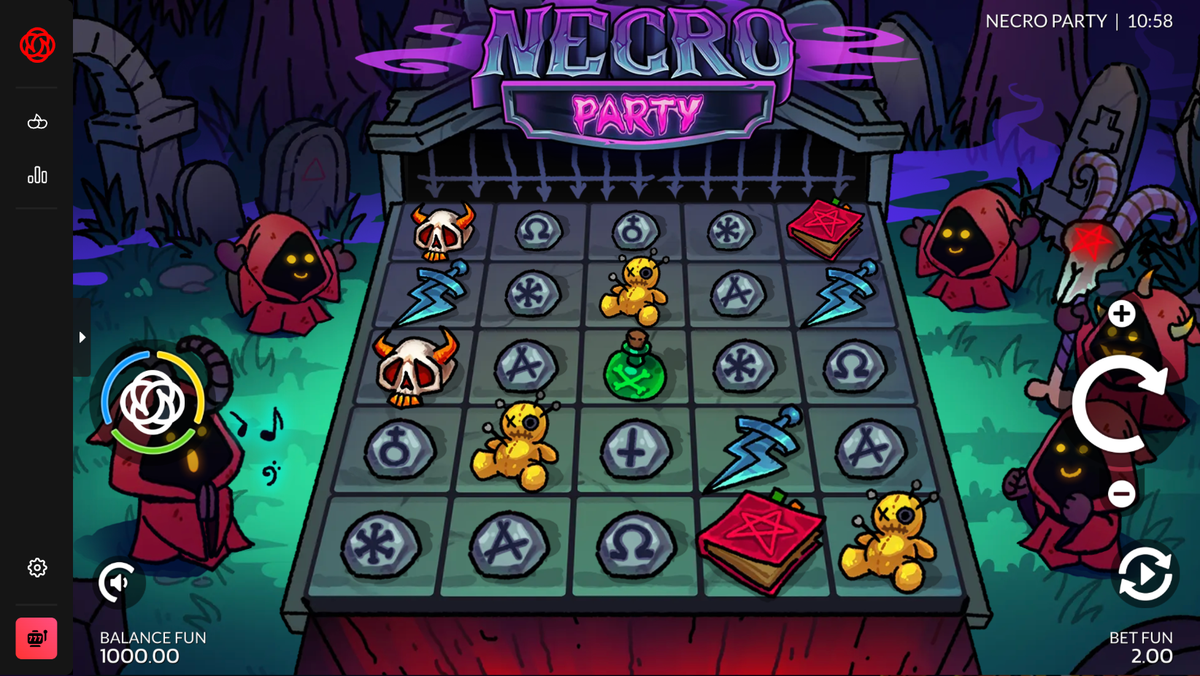
The 5-by-5 playing field. The captured demo shows a 2.00 FUN wager.
Game overview
| Item | Description |
|---|---|
| Developer | 7Rings Gaming |
| Playing field | 5 columns × 5 rows |
| Paylines | 20 prescribed lines |
| Published RTP | 96.40% |
| Implied house edge | 3.60% |
| Published volatility | Medium |
| Published hit frequency | 26.91% |
| Advertised maximum win | 10,000× |
| Principal features | Demon wilds, wild multipliers, persistent bonus wilds, and the Pentagram feature |
| Optional paid features | FS Booster 5X, Game Booster, Warm-Up Ritual, and Hellfire Bash |
The field, lines, and feature descriptions are documented in the game screenshots. The RTP, volatility, hit frequency, and maximum-win specifications are taken from the launch announcement.
The playing field and paylines
The game uses the 20 paths shown in its line diagram. A five-by-five field does not, by itself, mean that every possible route across the field pays. There are 5⁵ = 3,125 possible selections of one position from each column, but Necro Party documents 20 specific paylines rather than a 3,125-ways system.
The first five lines are horizontal. The remaining lines include diagonals, V-shaped patterns, inverted V-shaped patterns, and alternating paths. The paytable lists three-, four-, and five-symbol awards. A collection of matching symbols somewhere on the field is not, by itself, proof of a winning line; the game’s prescribed paths and settlement rules still apply.
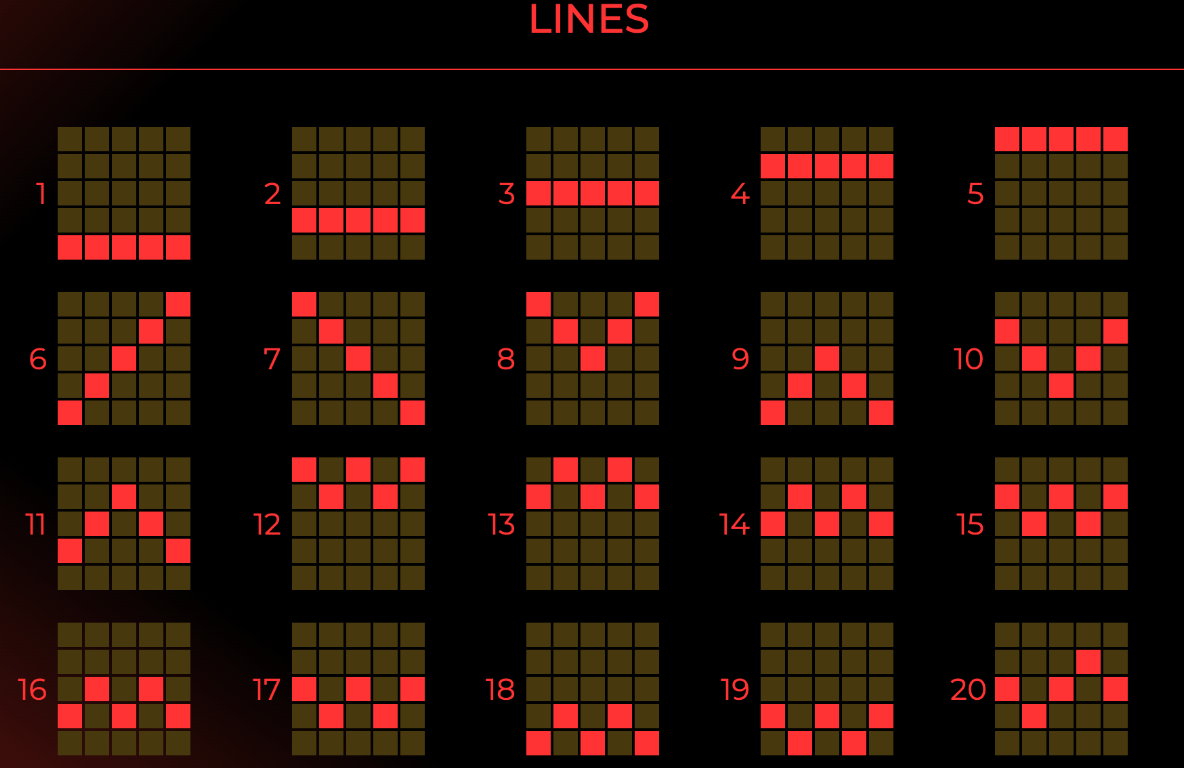
All 20 prescribed paylines, in the numbering used by the game.
Why a wild’s position matters
The line diagram permits a useful calculation without knowing the reel strips or symbol probabilities. Count how many of the 20 paylines pass through each square. Numbering rows from top to bottom and columns from left to right gives the following table:
| Position | Column 1 | Column 2 | Column 3 | Column 4 | Column 5 |
|---|---|---|---|---|---|
| Row 1 — top | 4 | 2 | 2 | 2 | 4 |
| Row 2 | 4 | 5 | 4 | 6 | 4 |
| Row 3 | 4 | 5 | 8 | 5 | 4 |
| Row 4 | 4 | 6 | 4 | 5 | 4 |
| Row 5 — bottom | 4 | 2 | 2 | 2 | 4 |
Original calculation from the game’s 20 payline diagrams.
The center position belongs to eight lines: 3, 6, 7, 8, 9, 14, 17, and 20. Some other positions belong to only two. Each column totals 20 incidences, because each line uses exactly one position in each column. The complete field therefore contains 20 × 5 = 100 line-position incidences, averaging four per square.
This helps explain the appeal of locking a wild in a position shared by several lines. It does not establish that the center wild is four times as valuable as a wild on a two-line square. The symbols elsewhere on each line, the multiplier, the remaining bonus spins, and the payout rules also matter. Line coverage is a count, not a win probability or an expected-value estimate.
Symbol paytable
The following paytable lists the displayed awards for three, four, and five matching symbols. Symbol names other than Brain are descriptive labels for identifying the artwork. The five stone designs are listed separately even though they share the same displayed pay schedule.
Amounts are reproduced as displayed, not labeled as multiples of the total wager. In the original layout, “x3,” “x4,” and “x5” indicate the number of matching symbols; they are not additional factors to multiply into the adjacent award.
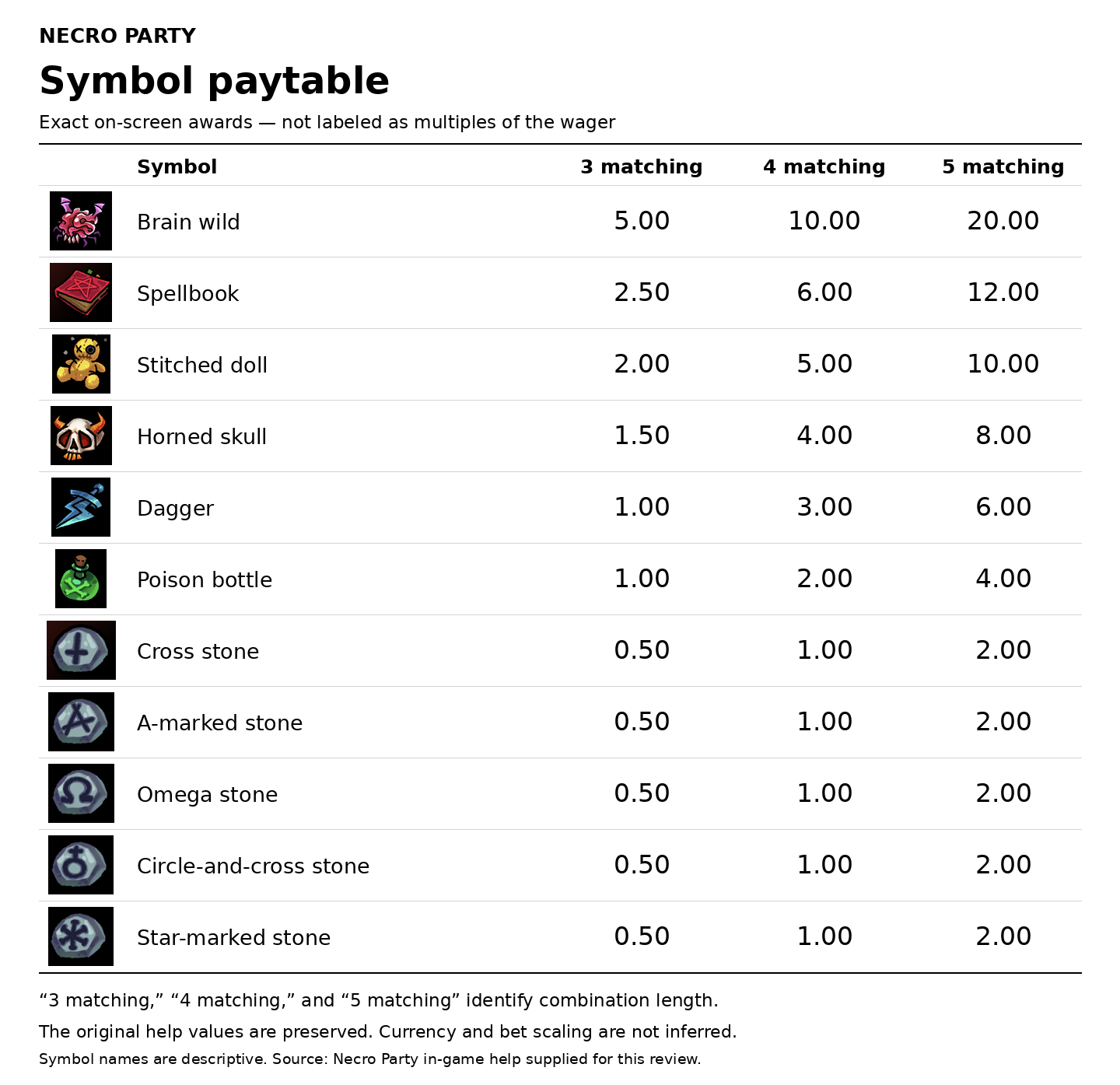
Complete symbol paytable transcribed from the game help. Values are the original displayed amounts, not asserted total-bet multipliers.
| Symbol | 3 matching | 4 matching | 5 matching |
|---|---|---|---|
| Brain wild | 5.00 | 10.00 | 20.00 |
| Spellbook | 2.50 | 6.00 | 12.00 |
| Stitched doll | 2.00 | 5.00 | 10.00 |
| Horned skull | 1.50 | 4.00 | 8.00 |
| Dagger | 1.00 | 3.00 | 6.00 |
| Poison bottle | 1.00 | 2.00 | 4.00 |
| Cross stone | 0.50 | 1.00 | 2.00 |
| A-marked stone | 0.50 | 1.00 | 2.00 |
| Omega stone | 0.50 | 1.00 | 2.00 |
| Circle-and-cross stone | 0.50 | 1.00 | 2.00 |
| Star-marked stone | 0.50 | 1.00 | 2.00 |
Source: the three original paytable screenshots.
The accompanying gameplay capture shows a 2.00 FUN wager. However, the cropped paytable images do not show the selected bet at the same time. Preserving the original display values avoids treating the relationship between those separate captures as an established payout-denomination rule.
For illustration, if the paytable was displayed at that same 2.00 FUN reference bet, the five-Spellbook award of 12.00 would equal 12.00 ÷ 2.00 = 6 times the reference bet. The five-Brain award of 20.00 would equal 10 times the reference bet, and the five-stone award of 2.00 would equal the reference bet. Those divisions are exact; the shared-bet assumption is stated rather than hidden.
The raw paytable does support comparisons that do not require a wager denomination. Five Spellbooks pay six times the five-stone award, because 12.00 ÷ 2.00 = 6. Likewise, the five-Brain award is ten times the five-stone award. These ratios describe awards, not relative symbol frequencies or contributions to RTP.
Wild symbols and multipliers
The game’s individual help entries identify the following five wild appearances. A useful way to describe them is one wild without a multiplier, followed by four multiplier-bearing categories.
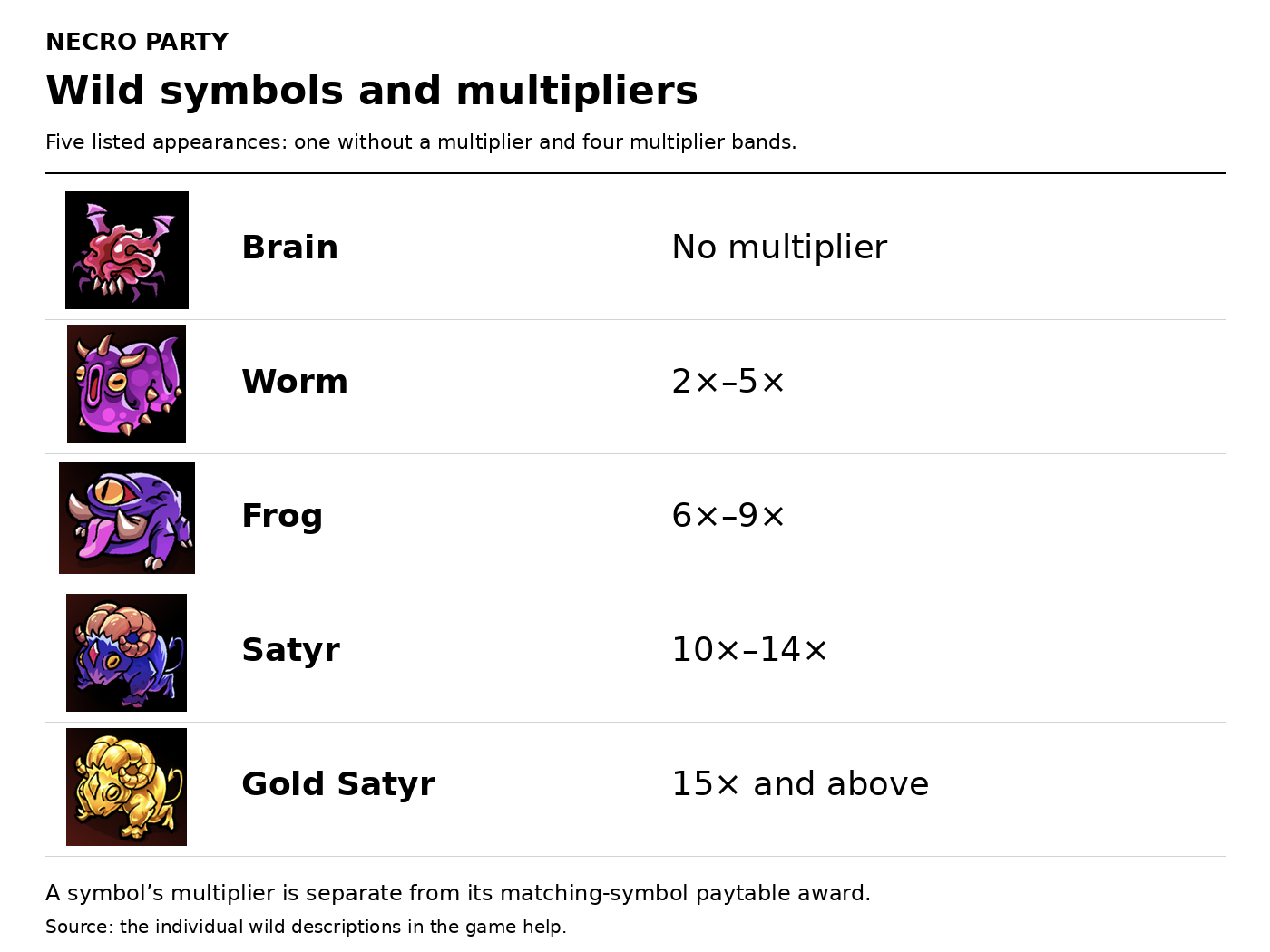
The five wild appearances listed in the game help, including four multiplier-bearing categories.
| Wild appearance | Multiplier stated in the help |
|---|---|
| Brain | No multiplier |
| Worm | 2×–5× |
| Frog | 6×–9× |
| Satyr | 10×–14× |
| Gold Satyr | 15× and above |
The Brain’s lack of an additional multiplier does not mean that it has no value. It is identified as a wild, and it has its own matching-symbol awards in the paytable. The matching-symbol award and an additional wild multiplier are different pieces of the payout calculation.
The listed ranges are categories, not probability distributions. For example, “2×–5×” does not tell us that 2, 3, 4, and 5 are equally likely. It would therefore be unjustified to assign the Worm a 3.5× expected multiplier merely by averaging the endpoints.
A worked example from the game help
The game’s illustration shows a horizontal line of Omega symbols completed by a wild, with the calculation 2.00 × 5 displayed above it. The resulting illustrated line award is:
2.00 × 5 = 10.00.
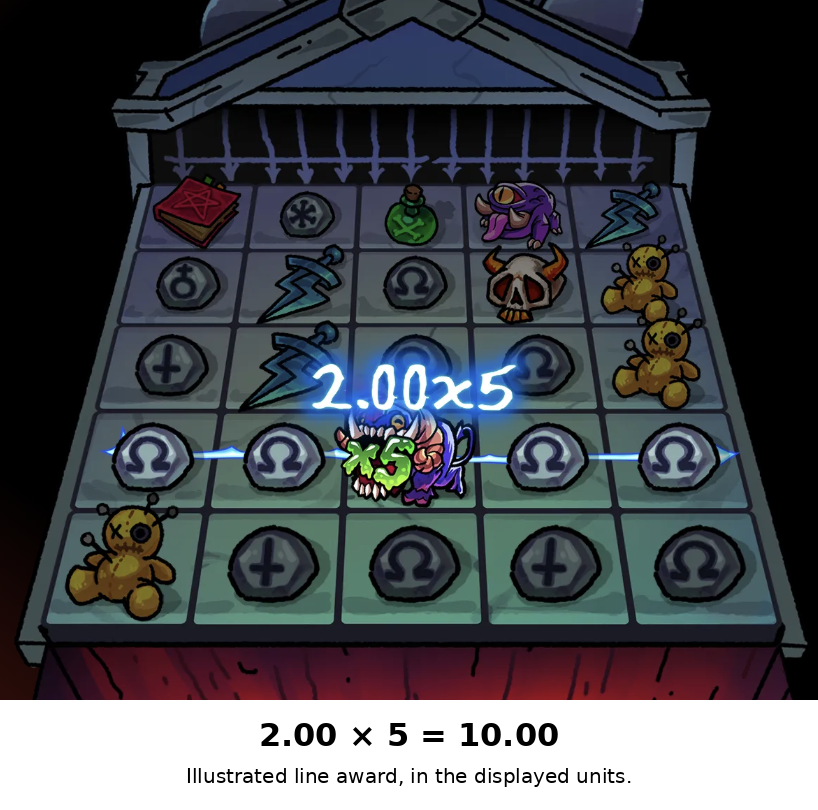
The illustrated line pays 2.00 × 5 = 10.00 in the displayed units. This is not a statement of the total spin payout.
That is the award for the illustrated line, in the displayed units. It does not establish the total payout for the whole spin. Other winning lines, if any, must be accounted for under the game’s settlement rules.
Net profit is a separate calculation. For a hypothetical paid round costing 2.00 and returning a total of 10.00, the net profit would be 10.00 − 2.00 = 8.00. When evaluating a bonus purchased for a larger amount, the correct cost to subtract is the purchase price. A reference bet used to scale awards is not a substitute for the amount actually paid.
Free spins and the Pentagram feature
The tutorial states that three or more scatters start the Bonus Game and that each triggering scatter becomes a wild that remains until the feature ends. The published initial free-spin awards are:
| Triggering scatters | Initial free spins | Triggering symbols becoming persistent wilds |
|---|---|---|
| 3 | 6 | 3 |
| 4 | 8 | 4 |
| 5 | 8 | 5 |
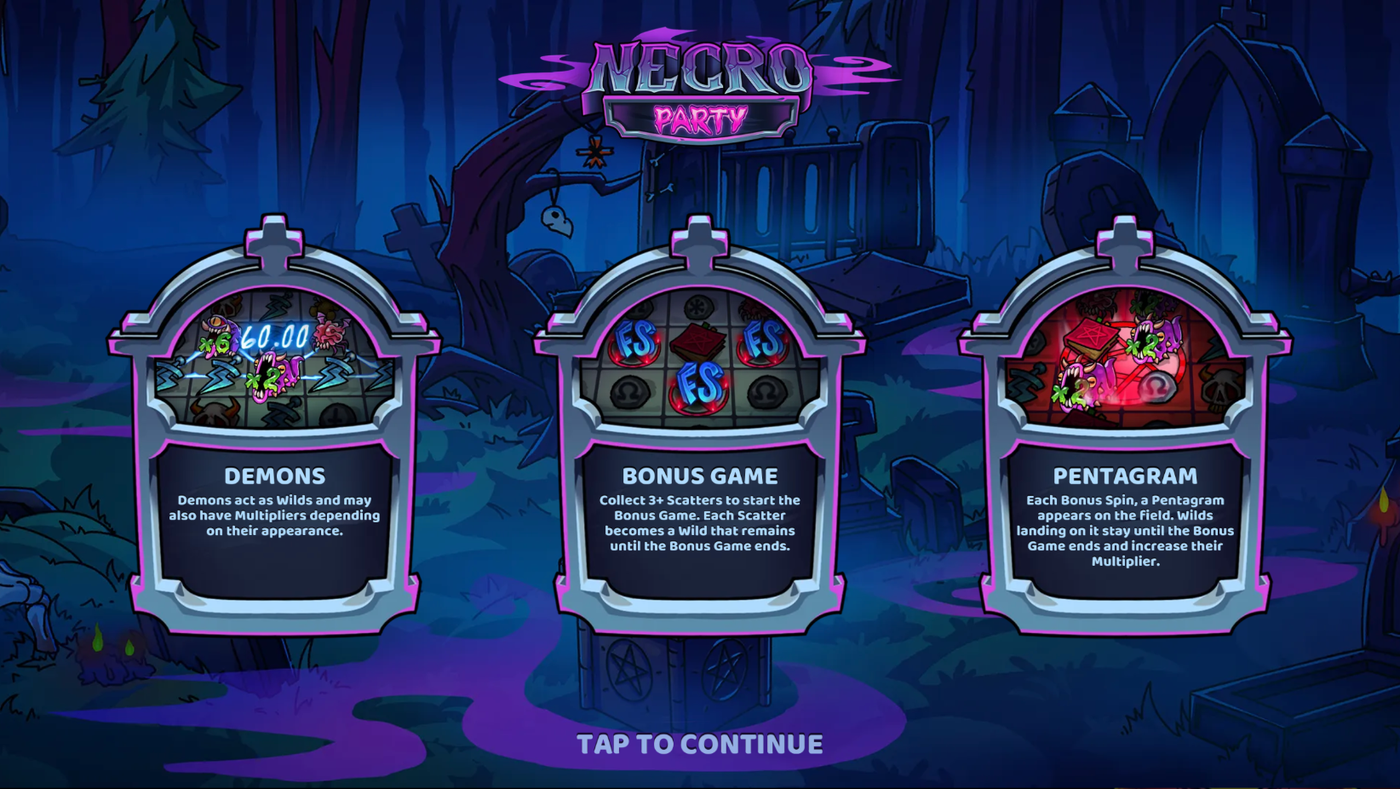
The game tutorial describes demon wilds, persistent triggering wilds, and the Pentagram feature.
Four and five scatters have the same stated initial spin count, but five scatters supply one more persistent starting wild. Equal initial spin counts therefore do not imply identical starting bonus states.
During the bonus, a Pentagram appears on the field each spin. The tutorial explains that wilds landing on it remain for the rest of the feature and can increase their multipliers. The launch description specifies one-step multiplier increases. An increase from 4× to 5× is an addition of one to the multiplier, not a doubling to 8×.
The useful distinction is between an ordinary wild that helps on a particular spin and a persistent wild that can participate in later spins. A useful position secured early has more subsequent opportunities to contribute than the same position secured just before the feature ends. That observation does not require assuming that every opportunity produces a win.
Nor should the term “random position” be silently replaced by “each of the 25 positions is equally likely.” The supplied material does not establish a uniform selection rule. Consequently, the probability of a favorable Pentagram placement cannot be calculated simply by counting visible wilds and dividing by 25.
Boosters and purchased bonuses
The game help lists four optional paid features. Two modify play, while two guarantee bonus entry. The help also states that availability is jurisdiction-dependent. The price ratios below are corroborated by a captured in-game purchase menu displaying a 3.00 FUN reference bet and prices of 9.00, 150.00, 300.00, and 750.00 FUN.
Let b denote the reference bet displayed in that menu.
| Option | Price relative to b | Price at a hypothetical $1 reference bet | Stated function |
|---|---|---|---|
| FS Booster 5X | 3b | $3 | Increases the landing chance of bonus activators by five times |
| Game Booster | 50b | $50 | Increases game-feature activity and bonus-activator appearances |
| Warm-Up Ritual | 100b | $100 | Guarantees bonus entry with three starting wilds |
| Hellfire Bash | 250b | $250 | Guarantees bonus entry with four starting wilds |
Functions: in-game help. Price ratios: in-game purchase-menu capture.
These prices are different from the selected reference bet. At a 0.20 reference bet, for example, Warm-Up Ritual costs 20.00 and Hellfire Bash costs 50.00. The latter is the same expenditure as 250 ordinary wagers of 0.20. Equal expenditure does not make the payout distributions of those alternatives identical.
The difference between the two guaranteed-entry options is not just the price or the number of wilds in isolation. A fair comparison would require their complete bonus distributions and their own applicable RTPs. An additional starting wild does not, by itself, establish better value per unit paid.
What the booster wording does — and does not — establish
The supplied FS Booster text describes a fivefold increase in the landing chance of bonus activators. That wording should not automatically be turned into an exact fivefold increase in the probability of completing a bonus trigger. A trigger requires the qualifying combination, and the probability of that combination depends on how the symbols are generated.
Accordingly, the rules shown are not sufficient to calculate an exact bonus-trigger rate per dollar. Neither five times as many triggers per dollar nor any other precise improvement ratio follows from the label alone. The booster also does not promise five times the RTP or five times the profit.
The 96.40% RTP used in this review is not automatically assigned to every paid option. Separate feature prices do not prove that the modes share one return. Without the applicable mode disclosure, multiplying each purchase price by 3.60% would present an unsupported expected-loss figure.
RTP and house edge
Using the published 96.40% RTP, the implied house edge is:
100% − 96.40% = 3.60%.
For a fixed amount of wagering W at that applicable return:
Expected gross payouts = 0.964 × W.
Expected net loss = 0.036 × W.
| Total wagering | Expected gross payouts | Expected net loss |
|---|---|---|
| $100 | $96.40 | $3.60 |
| $1,000 | $964.00 | $36.00 |
| $10,000 | $9,640.00 | $360.00 |
For example, 500 paid rounds at $2 each produce $1,000 in wagering and an expected loss of $36 at this return. Individual sessions can finish far above or below that expectation. The calculation is not a forecast that a particular player will finish with a particular balance.
Wagering also differs from the initial deposit. Returned money can be wagered again, so a deposit can support a much larger cumulative amount of betting. RTP applies to the relevant amount wagered, not simply to the original amount placed in the account.
For an ordinary paid round that triggers free spins without a further charge, its bonus payouts belong to that paid round’s return. They are not free money outside the RTP calculation. Conversely, the reference bet should not be counted as a fresh expenditure on every no-additional-charge free spin.
Volatility and hit frequency
Necro Party’s published volatility classification is Medium, and its published hit frequency is 26.91%.
Volatility concerns how widely payouts vary, not merely how often a paying result occurs. A qualitative label does not provide the numerical standard deviation needed to calculate a confidence interval for a session, a probability of doubling a bankroll, or a probability of exhausting a specified bankroll.
Hit frequency must also be distinguished from the frequency of a net profit. A paid round costing 2.00 and returning 0.50 loses 1.50, even though it produces a payout. Thus a percentage describing hits cannot be treated as the percentage of rounds that leave the player ahead without checking how the provider defines a hit.
The distinction matters especially with purchased features. A feature can return a conspicuous amount and still lose money relative to its price. For a hypothetical 250.00 purchase returning 150.00, the net result is −100.00, regardless of how the game presents that payout.
A useful mental separation is: RTP describes the average return per unit wagered; hit frequency describes how often a defined event occurs; volatility describes dispersion. None is a substitute for the others.
Maximum win
The advertised maximum is 10,000×. This is a quoted game specification, not an independently calculated frequency of reaching that award.
The Gold Satyr help entry’s “15× and above” describes a wild-multiplier category. It does not establish an unlimited cash payout. The multiplier attached to a symbol, the reference wager used to scale awards, the price paid for a feature, and the maximum payable award are distinct quantities.
In particular, a 250-times-reference-bet purchase should not automatically be used as the denominator for the advertised maximum. The applicable maximum-win clause must define that basis and the treatment of any unfinished bonus. The supplied screenshots do not establish those settlement details, so no dollar-valued maximum or probability of hitting the cap is asserted here.
What can be calculated from the supplied material?
The paytable gives awards conditional on particular combinations. The line diagrams give the prescribed paths. Neither supplies the complete probabilities of the outcomes.
To independently reconstruct RTP, one would need the symbol-generation probabilities or equivalent reel information, together with the complete rules governing wilds, bonus transitions, purchased features, and payout limits. For a complete paid round with gross payout R and cost b, the basic calculation is:
RTP = E[R] ÷ b.
The bonus must be included in R when it is part of that paid round. Reading the paytable alone cannot recover E[R], because the awards still need their probability weights.
The 20 lines must not be treated as 20 independent trials either. They share positions and wilds. Expected line awards can be added without assuming independence, but the spread of their combined result depends on how they move together. That is another reason a numerical volatility calculation cannot be reverse-engineered from the paytable and line count alone.
Assessment
Necro Party is more distinctive for what persists between bonus spins than for what appears on a single spin. The documented interaction between persistent wilds, their multipliers, and the prescribed paylines gives the bonus a developing structure. The eight-line center position is a concrete example of why the placement of a persistent symbol can matter, although it is not enough to determine that symbol’s expected value.
The financial assessment is more restrained. The stated 96.40% return implies a 3.60% house edge in the applicable configuration. A more frequent feature is not necessarily a better-returning wager, an extra starting wild does not by itself justify a higher price, and a large displayed award is not necessarily a net win.
The appeal is therefore the bonus mechanics and presentation, not a demonstrated mathematical advantage. The useful comparisons remain the applicable RTP, the full amount charged, and the distribution of results—not the size of a multiplier graphic alone.
Leaderboards, Replays, and Hot/Cold Indicators
The provider promotes live rankings, large-win replays, and indicators of recent game performance as a connected part of its software. These features deserve attention because they sit alongside the wagering controls rather than only in external advertising.
Hot and Cold Are Descriptions, Not Predictions
A recent return percentage, when calculated as payout divided by wagering, describes what happened during a sample period. Theoretical RTP describes the underlying game model. They are not the same quantity.
A large payout can dominate a short reporting window. Meaningful interpretation would require the time period, total wagering, number of completed rounds, and the mix of game configurations and purchase options. A colorful label supplies none of those details by itself.
For independent outcomes under an unchanged configuration and equivalent game state, recent losses do not make the next round due to win, and recent wins do not give the next player better odds.
The qualification about game state matters here. A retained wild or an active revolver can affect later play under the rules. That is different from inferring an advantage from a historical hot/cold label. The rules can preserve an actual feature state; a label alone does not establish one.
Big-Win Replays
Replays can help explain an unfamiliar feature. They are poor evidence of how often it succeeds. A collection chosen because the wins were large is not a representative sample of all paid rounds.
To estimate the frequency of a particular award, one needs its occurrence count and the relevant total number of trials, under comparable rules. Watching several spectacular examples supplies the numerator without the denominator.
Leaderboards
The ranking measure matters. Cash-win rankings favor larger wagers. Rankings by multiples of the bet reduce that issue, but additional rounds still provide additional opportunities to record an unusually large result.
A leaderboard also has no calculable promotional value without rules specifying any prizes, eligibility, scoring, and costs. I would not add a hypothetical leaderboard reward to a game’s RTP merely because a ranking panel is present.
Interface and Information
The company advertises multi-platform support, localization, a remote gaming server, and browser-accessible demos. These describe the intended delivery of the games; they are not a substitute for checking the particular casino’s implementation.
For the player, the useful interface questions are practical: Is the actual wager clear? Is a purchased feature’s full price visible? Can the applicable RTP and maximum-win rule be found? Does the result show the full-round payout rather than only the most conspicuous component?
Demos are useful for learning those controls and the sequence of a feature. A short demo session is not sufficient to measure a high-volatility game’s return, and a demo should not be assumed to use the same operator-selected profile as a separate real-money installation.
Game Fairness and Transparency
There are three distinct questions: whether the advertised mathematics are implemented correctly, whether the supplier and operator have the relevant permissions, and whether the casino handles the player’s money properly. A favorable answer to one does not establish the other two.
The distribution agreements provide identifiable commercial evidence. They do not, by themselves, identify the scope of a laboratory certificate or the legal permissions for every jurisdiction. I have not independently verified primary regulatory or laboratory records establishing a specific 7Rings licence or comprehensive game certification for this review. That is a limit on the claims made here, not a finding that its games are untested or unfair.
Likewise, the RTP figures in this review are reported specifications. Independently verifying them would require the outcome probabilities and full feature rules for the relevant build, or an appropriate mathematical testing report. A paytable gives the amount paid for an outcome; it does not supply the probability of that outcome.
The most useful improvement would be a readily accessible record for each mathematical configuration: its identifier, RTP, volatility measure, maximum-win rule, and applicable certification. Configurable games particularly benefit from that level of disclosure.
Conclusion
7Rings Gaming has a recognizable design direction. Moving revolvers, UFO collectors, nested slot features, and arcade progression provide more variety than a change of theme alone. The case for the software is its game design and the different ways its features develop.
The qualification is that the player must distinguish presentation from price. A progress animation need not change the payout, a hot game need not offer a better next wager, and a larger maximum award need not mean a higher return. Operator-configurable profiles make checking the actual version especially important.
My assessment is favorable toward the mechanical variety, but not toward using promotional indicators as gambling advice. Compare the installed game’s RTP and rules, account for the full cost of purchases, and regard replays and rankings as entertainment unless their statistical or promotional value can be demonstrated. The software offers reasons to be interested; the published figures do not establish a player advantage.