
Wizard Recommends
-
 $11000 Welcome Bonus
 -
 $3000 Welcome Bonus
 -
 UP TO $777 BONUS
Slots - General Questions
I forwarded your question to Brian, a former regulator and current casino manager. Here is what he said.
There are two types of changes. The first would involve completely swapping out the machine and the second would consist of simply changing the game, but keeping the existing cabinet. As you can imagine, changing the software is much cheaper which is why there is so much hype around downloadable games. How often games are swapped out depends on a casinos capital expenditures budget. Participation machines are turned over much more rapidly because the manufacturer has a vested interest in keeping the best product on the floor. In many instances, they will handle the scheduling for software and new machine replacements. Participation machines are those that are on lease to the property by the manufacturer. Usually, the manufacturer gets 20% of the revenue, less taxes. From an accounting perspective, the useful life of a slot machine is 5 years and then the asset is fully depreciated (no longer has a book value). The final consideration is popularity. How often do you go into a casino and see a section of slot machines that are the old IGT three reel Red White and Blue machines? If the machines are performing well, why spend $10,000+ to replace each unit?
You're always saying there is no skill in slots, but wouldn't the player get a better return betting one line only in this game, since the value of the bonus is the same regardless of how many coins the player bet?
- 2 or 12: 1,000
- 3 or 11: 600
- 4 or 10: 400
- 5 or 9: 300
- 6 or 8: 200
My question is what is average bonus win?
Click the following button for the answer.
Click the following button for the solution.
I won't go into the basics of dice probabilities but just say the probability of each total is as follows:
- 2: 1/36
- 3: 2/36
- 4: 3/36
- 5: 4/36
- 6: 5/36
- 7: 6/36
- 8: 5/36
- 9: 4/36
- 10: 3/36
- 11: 2/36
- 12: 1/36
Before considering the consolation prize, the value of x can be expressed as:
x = (1/36)*(1000 + x) + (2/36)*(600 + x) + (3/36)*(400 + x) + (4/36)*(300 + x) + (5/36)*(200 + x) + (5/36)*(200 + x) + (4/36)*(300 + x) + (3/36)*(400 + x) + (2/36)*(600 + x) + (1/36)*(1000 + x)Next, multiply both sides by 36:
36x = (1000 + x) + 2*(600 + x) + 3*(400 + x) + 4*(300 + x) + 5*(200 + x) + 5*(200 + x) + 4*(300 + x) + 3*(400 + x) + 2*(600 + x) + (1000 + x)36x = 11,200 + 30x
6x = 11,200
x = 11,200/6 = 1866.67.
Next, the value of the consolation prize is 700*(6/36) = 116.67.
Thus, the average win of the bonus is 1866.67 + 116.67 = 1983.33.
Let's look at an example based on a game with five reels and three visible rows. All wins are left aligned only. Suppose the player had a winning symbol on reels 1, 2, 3, and 5. The player would be paid only once for three of that symbol. It does not matter that there are 9 ways to run through reels 4 and 5, because in this example the pay-lines end with reel 3.
Next suppose the player had the same winning symbol this many times on each reel:
- Reel 1: 2
- Reel 2: 1
- Reel 3: 3
- Reel 4: 2
- Reel 5: 1
The player would be paid for 2×1×3×2×1 = 12 pay-lines.
If the player covered the entire screen with the same winning symbol, he would be paid for 35=243 pay-lines.
Next, let's move onto the answer. Let's assume there are wins for 3 to 5 symbols only.
Let's define some terminology:
- tx = total reel stops on reel x.
- nx = total count of the winning symbol on reel x.
- px = positions on reel strips x where there is no winning symbol visible on the reel.
For reel 3 the answer is 33 × n1 × n2 × n3 × p4 × t5.
For reel 4 the answer is 34 × n1 × n2 × n3 × n4 × p5.
For reel 5 the answer is 35 × n1 × n2 × n3 × n4 × n5.
I'm sure you've heard of the guy who claims to know of a bug in Aristocrat slot machines and is offering to tell them about it, for a price. If you knew of such a bug, how would you go about getting the most money out of it?
- A) Hit a big casino hard with a few max bets, then leave for a few weeks before hitting another big casino. Keep going until they fix the hole or back you off.
- B) Intersperse medium sized winning bets with small losers all over town and milk the cows for hopefully a longer period of time.
- C) Form a team and do (A).
- D) Form a team and do (B).
- E) Contact the manufacturer and offer it to them for a finders fee + a residual.
- F.) Other?
Yes, I've heard that story. For the benefit of my other readers, here is a Wired link to the story: Meet Alex, the Russian Casino Hacker Who Makes Millions Targeting Slot Machines.
Putting moral issues aside, and assuming getting caught is not a major concern, I would go with choice B. I would have a hard time trusting a team to report winnings honestly and not reveal the secret. Seems to me flying under the radar would be the best choice.
First, let me explain the question for the benefit of other readers. A popular new way for slot machines to pay is according to every "way" on the screen. A "way" is every unique set of positions that go through a paying combination, counting only reels that are part of the win. Let's look at the following picture as an example from a Buffalo slot:
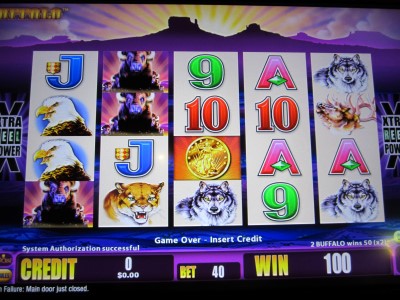
This game as 45=1,024 "ways" to win, because there are four positions shown on each reel. However, in this case, only two ways pay, for two buffalo each. Both include the one buffalo on reel 1. Then 1 way for the buffalo on row 1 of reel 2 and a second way for the buffalo on row 2 or reel 2. Although there are 43 = 64 ways the game could go through positions on reels 3 to 5, it doesn't matter. "Ways" only count the ways to go through symbols that contribute to the win.
With that explanation out of the way, let me introduce some functions for my answer to your question:
- Let v = number of visible rows on the machine.
- Let n(s,r) = number of times symbol s or a wild appears on reel r.
- Let b(s,r) = number of sequences on reel r with no appearances of symbol s or a wild symbol that may substitute for s. In other words, sequences blocking any wins for a given symbol on the reel because it doesn't appear.
- Let t(r) = Total length of reel r
That said, here are the number of winning combinations according to the number of winning symbols in the win:
- The number of combinations for a five-symbol win of symbol s equals n(s,1)*n(s,2)*n(s,3)*n(s,4)*n(s,5)*v^5.
- The number of combinations for a four-symbol win of symbol s equals n(s,1)*n(s,2)*n(s,3)*n(s,4)*b(s,5)*v^4
- The number of combinations for a three-symbol win of symbol s equals n(s,1)*n(s,2)*n(s,3)*b(s,4)*t(5)*v^3
- The number of combinations for a two-symbol win of symbol s equals n(s,1)*n(s,2)*b(s,3)*t(4)*t(5)*v^2
That depends on lots of things. The way I will interpret your question is what is the value of an extra wild above the average number the player would normally get. While the answer will vary significantly from game to game, a significant factor is the number of rows on the screen. If there are three rows, the extra wild will benefit 1/3 of the paylines. Likewise, if there are four rows, it will be less valuable, affecting 1/4 of the paylines.
To answer your question, I looked at the game Cleopatra, which I already deconstructed. The following table shows the increase in the expected value for a wild, compared to a random number of wilds.
Value of Extra Wild in Cleopatra
| Reel | 3 Rows | 4 Rows |
|---|---|---|
| 1 | 95.71% | 71.79% |
| 2 | 99.76% | 74.82% |
| 3 | 76.24% | 57.18% |
| 4 | 21.25% | 15.93% |
| 5 | 1.96% | 1.47% |
Thank you for your analysis of must-hit-by progressives. My question is does your formula for the hit point to play assume an immediate player advantage or a situation that may be slightly negative at first, but will shortly turn positive as the player contributes to the meter?
Good question. It previously gave a formula for a "short term" player, where the jackpot must be positive on bet one.
However, for the long-term player, who can afford to play until the jackpot hits, the hit point is less. I have updated the page to include formulas for both types of players. Briefly, the two formulas are:
j (short term) = m × (1-f)/(1-f+r)
j (long term) = m × (1-f-r)/(1-f+r)
Where:
j = Breakeven jackpot size (with 0% house edge)
f = Value of all fixed wins plus slot club points and incentives.
m = Maximum jackpot (the must-hit-by point)
n = Minimum jackpot (the reseed point)
r = Rate of meter rise
I hear the minimum taxable slot machine jackpot has been increased from $1,200 to $5,000. Is this true?
No.
A bill has been introduced to do just that. However, most bills go nowhere and never even get voted on, so slot players should not get their hopes up.
Personally, if I had a vote in the matter I would vote YES enthusiastically. The current $1,200 limit has not been increased since 1977. According to the American Institute or Economic Research, $1,200 in 1977 would have been worth $5,336 in 2021. I could easily make an argument against all taxation of gambling winnings. However, I know that ship won't float, so the least we can do is recalibrate the minimum taxable jackpot to inflation, which should have been done all along.
For more information, please read Bill would raise slot jackpot tax report threshold to $5,000 at the Las Vegas Sun.