
Wizard Recommends
-
 $11000 Welcome Bonus
 -
 $3000 Welcome Bonus
 -
 UP TO $777 BONUS
TED-Ed’s Frog Riddle Answer is Wrong
A very good YouTube channel is TED-Ed. One thing I like about it is they frequently tackle math and logic puzzles. However, in this newsletter I call them out for their incorrect answer to their “Frog Riddle.”
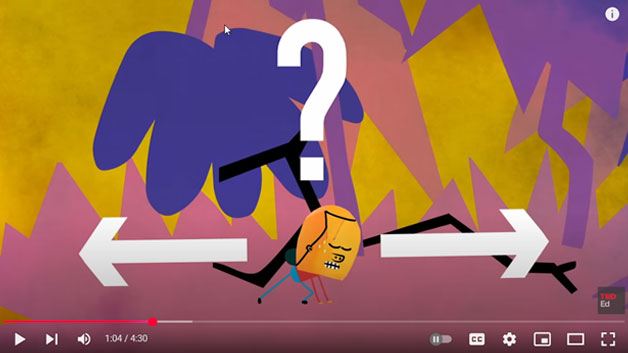
Before going further, I suggest you watch the video here is a link:
If you didn’t watch the video, here is the information given:
- You’re stranded in a huge rainforest and ate a poisonous mushroom.
- To save your life, you need the antidote excreted by a certain species of frog.
- Unfortunately, only the female of the species produces the antidote.
- The male and female appear in equal numbers and look identical.
- The male has a distinctive croak.
- To the left, you spot a frog on a tree stump.
- Before you can get to the frog on the tree stump, you hear a croak coming from a clearing in the opposite direction.
- In the clearing, you see two frogs, but you can’t tell which one made the sound.
- You feel yourself losing consciousness and have only time to go in one direction.
- All frogs are docile and may be easily licked if approached.
The question is which way should you go? In other words, what is the probability of survival in each direction?
The puzzle is clearly meant to be a rewording of the classic boy-girl riddle. Let’s put the frog riddle to the side for a moment and properly ask the boy-girl riddle. In that puzzle we’re given:
- Male and female children appear in equal numbers and are independent of any siblings (in other words, we can ignore identical twins).
- A woman with exactly two children is asked “Do you have at least one boy?” She answers “yes.”
The question is what is the probability she also has a girl?
The frequently given incorrect answer to this one is “1/2.” The argument is that the “other child” has a 50/50 chance of being a boy or girl. The fallacy is that there is no “other child.”
The correct way to work it out is with Bayes’ theorem of conditional probability. In general, it states that the probability of statement A being true, given information B, is the ratio of both being true, divided by the probability of B being true. This is expressed as:
Pr(A | B) = Pr(A and B) / Pr(B).
In the boy-girl puzzle:
A = Mother has a girl
B = At least one boy
This can be solved as Pr(boy and girl) / Pr(At least one boy).
In general, for two-child families, the probabilities are:
Boy and girl = 50%
Boy and boy = 25%
Girl and girl = 25%
The answer to the boy-girl puzzle is then 50%/(50% + 25%) = 50%/75% = 2/3.
Another common way to explain the 2/3 probability is with the following table.
| Child 1 | Child 2 | |
| Male | Female | |
| Male | No | Yes |
| Female | Yes | |
The female/female cell is blacked out because it is impossible. A “yes” indicates at least one female. You can see of the three possibilities, two out of three contain a female. Thus, the probability of at least one female is 2/3.
Now let’s get back to the frog riddle. Based on how they work out the answer in the video, they clearly use the part about males croaking to get at the knowledge that at least one of the frogs in the clearing is male. However, they way the phrase the answer, the croaking part, leads to an answer other then 2/3.

To get at a correct answer, we need to know the probability a specific male frog will be heard croaking. For the sake of argument, let’s assume it’s 10%. Let’s also assume that if you hear croaking from the clearing, you have no idea whether it is coming from one frog or two.
Let’s first examine the probability the frog on the log is female. The expression for that probability is:
Pr(female | no croak) =
Pr(female and no croak)/Pr(No croak) =
Pr(female and no croak)/(Pr(Female and no croak) + Pr(Female and no croak)) =
(0.5 * 1)/(0.5 * 1 + 0.5 * 0.9) = 0.5/(0.5 + 0.45) = 0.5/0.95 = 10/19 =~ 52.63%.
Now, let’s first examine the probability there is a female in the clearing. The expression for that probability is:
Pr(female | croak) =
Pr(female and croak)/Pr(croak) =Pr(female and croak)/(Pr(Female and croaking male) + Pr(Non-croaking male and croaking male) + Pr(Two croaking males)) =
Let’s look at each individual probability separately:
Pr(female and croak): There must be one female and one croaking male. The probability of that is 2 * 0.5 * 0.5 * 0.1 = 1/20 = 0.05. The reason for the 2 is there are two ways to choose which frog is the female.
Pr(Female and croaking male) = The same as above, as a croak can come from a male only.
Pr(Non-croaking male and croaking male) = 2 * 0.5 * 0.5 * 0.9 * 0.1 = 0.045. The reason for the 2 is there are two ways to choose the male that croaks.
Pr(Two croaking males) = 0.5 * 0.5 * 0.1 * 0.1 = 0.0025
The overall probability there is a female in the clearing is 0.05 / (0.05 + 0.045 + 0.0025) = 0.05/0.0975 = 20/39 =~ 51.28%.
To summarize, the probability of survival both ways is:
Lick frog on log = 52.63%
Lick both frogs in clearing = 51.28%.
Thus, you should lick the frog on the log.
Let’s look at the general case where the probability you will hear a specific male croak is c. The probabilities of survival are:
Lick frog on log = 1/(2-c)
Lick both frogs in clearing = 2/(4-c)
For any value of c>0, the odds will favor licking the frog on the log. We know c>0, because we heard a croak.
Thus, you should lick the frog on the log!