
Wizard Recommends
-
 $11000 Welcome Bonus
 -
 $3000 Welcome Bonus
 -
 UP TO $777 BONUS
Alaska Ferry (part 1)
As usual, we begin with a logic puzzle. The goal is to make the fish, shown below, point the other direction by moving three toothpicks only.
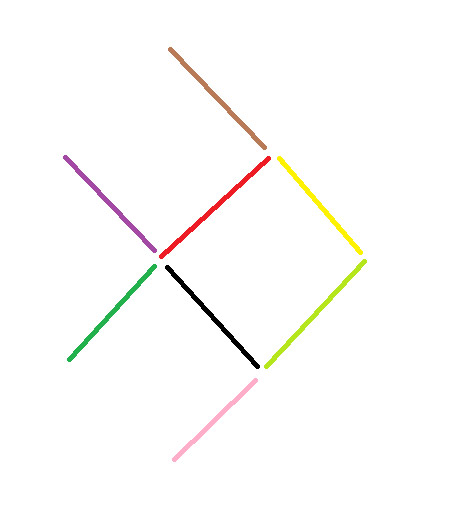
Scroll to the end for the answer.
I love ferries in the same way that some people love trains. Maybe part of the reason why is my father loved them too. Growing up, we had a second house in the San Juan Islands in Washington, which necessitated taking a ferry to get to. I could tell this was my father’s favorite part of the 1000-mile journey from Los Angeles to Orcas Island once or twice a year.
Even without the good memories, I enjoy the beautiful places ferries tend to travel and the design and art of a good solid ferry. Ultimately, I don’t need reasons to understand why I like ferries. I just do – deep in my heart.
My first experience with the Alaska Marine Highway System was on a 2021 voyage on the MV Kennicott, from Juneau to Bellingham, Washington. This trip took 2.5 days and stopped only in Ketchikan. Here are some statistics about the Kennicott.
- • Length: 382 feet
- • Width: 85 feet
- • Staterooms: 109
- • Berths: 320
- • Passengers: 450
- • Horsepower: 13,200
On that trip, I had a stateroom. I could clearly see many passengers slept in just about any public area on the ship, including pitching tents on the decks. At that time, I thought on my next voyage I would rough it and sleep in common areas with the common people.
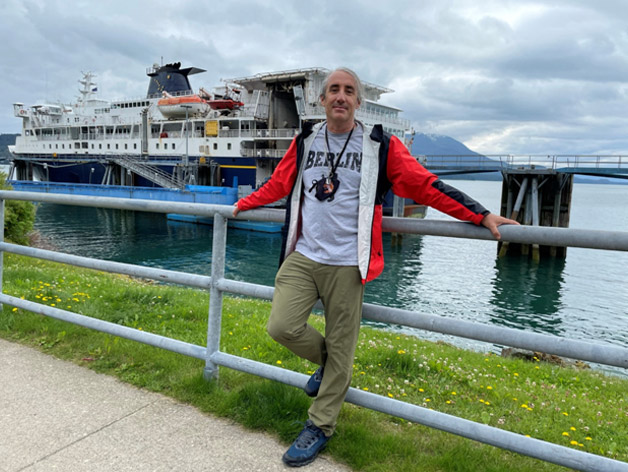
Fast forward four years and I found myself back in Bellingham, which is the only port the Alaska Ferry serves outside of Alaska and maybe one in British Columbia. It was the perfect opportunity to take another voyage. This time I would travel north from Bellingham to Sitka, Alaska. The four-day voyage would take me through stops in Ketchikan, Juneau, Wrangel, Skagway and Haines. Some of them twice. This route gets as far north as Skagway and then hits most of the same places going back south. However, it goes through Sitka going southbound only. This, I’m pretty sure, is the longest trip one can do on any of the Alaska Ferries.
The ship I took was the Columbia, which is the largest and fastest in the Alaska Marine Highway System. Here are some statistics:
- • Length: 418 feet
- • Width: 85 feet
- • Staterooms: 104
- • Berths: 298
- • Passengers: 499
- • Horsepower: 14,000
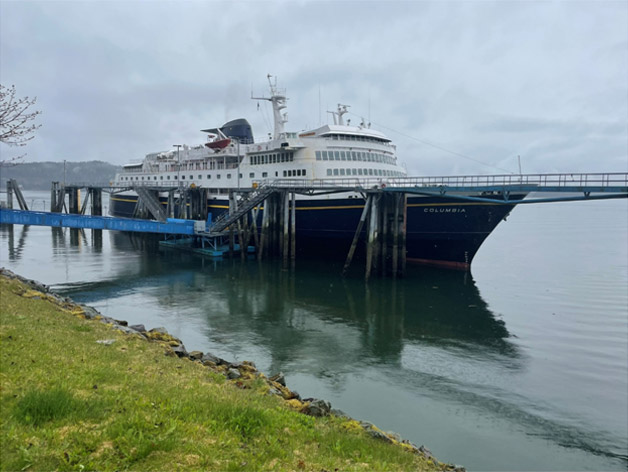
The ferry left Bellingham at 4:00 PM on April 25. I was rip roaring and ready to go when they let passengers board about 2:30. Quickly, I made my way to the top, level 8, to set up my tent. I was the third of six tents on the upper deck. From my possibly incorrect memories of the Kennicott, I thought the area for tents was in a sheltered area on the side of the ship.
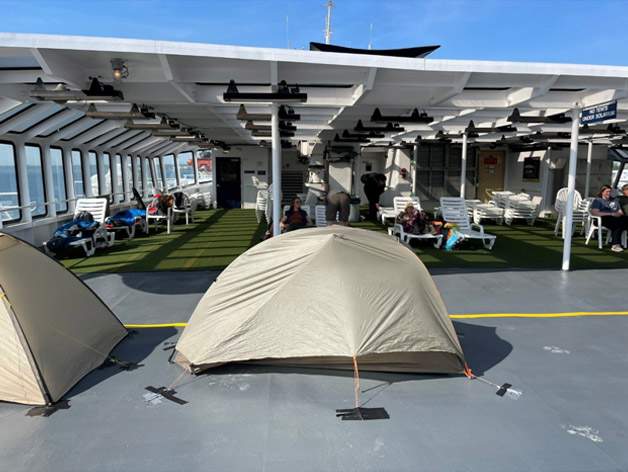
On the Columbia, the upper tent area was in the back and totally exposed to the rain and wind. At least it was right next to a covered area with heat lamps and plenty of lawn furniture. A yellow line separated the two areas, clearly saying “no tents” in the covered warm section. For every one person in a tent I would estimate there were two who set up sleeping bags on folding recliners under the shelter. These people, I would later concede, were the smart ones. I might add there were many more people who slept in chairs and on benches inside the ship.
Later, I found there was another section on level 6, in the back of the ship, that allowed pitching tents. This area was partially covered by the restaurant on level 7, which offered much better protection from the rain and wind than in my area on level 8. It was also much quieter, as level 8was very loud from what I presume was exhaust from the engines. However, it did lack a heated solarium. All things considered, I should have chosen the quieter and dryer deck on level 6. Live and learn.

Next week I will continue my story of the Alaska Ferry after leaving Bellingham.
Links:
Solution to logic puzzle.
There are two solutions which follow the same logic. I will show just one of them.
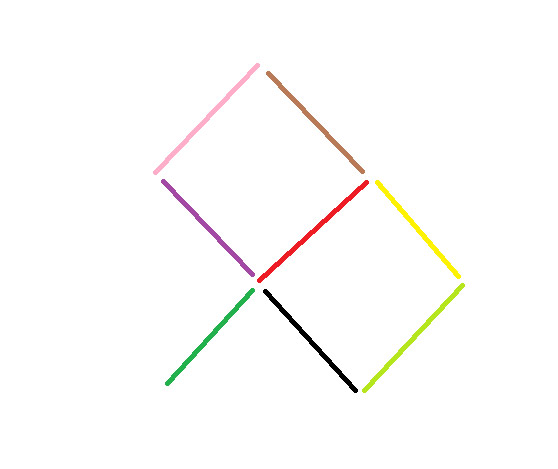

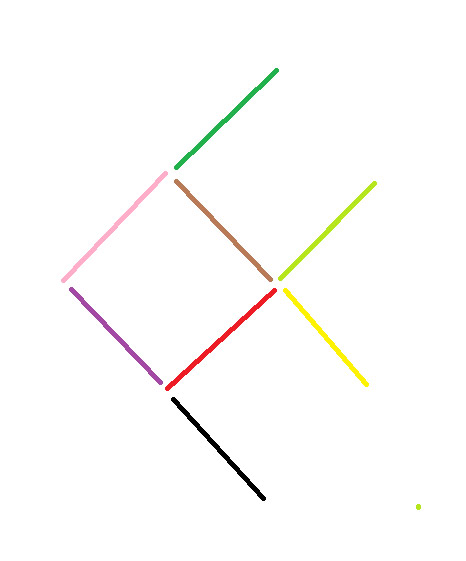
An easier way to remember may be to first move either the top or bottom fin to complete a new square, forming a new head. Then, the other two movements should be obvious.