
Wizard Recommends
-
 $11000 Welcome Bonus
 -
 $3000 Welcome Bonus
 -
 UP TO $777 BONUS
Roulette - General Questions
Update: This casino has since closed.
1) Regarding the basic blackjack strategies, you have for different online casino groups. Specifically, two different ones that both use single deck: Microgaming and Unifed Gaming. I cannot understand why you list 11 VS 10 as a hit for Microgaming, but as a double for Unified. Since they both use single deck, it seems the same strategy should be used here. I lose more often than win when I double this.
2) In Roulette, it seems to me that your odds would be better to bet equally on both red, and the 3rd column, or black and the 3rd column. The 3rd column has, I believe, 8 reds and only 4 blacks. Conversely, the first column has more blacks. Does betting like this lower the house edge?
All combinations of bets in roulette yield the same expected return, assuming the dreaded five-number combination is avoided. You're right that the third column has eight reds and four blacks. The probability of winning 3 units is 8/38, 1 unit is 4/38, breaking even is 10/38, and losing 2 units is 16/38. The combined expected per unit bet is return is (1/2)*(3*8 + 1*4 + 0*10 + 2*16)/38 = -2/38. Betting on black and the third column the probability of winning 3 units is 4/38, 1 unit is 8/38, breaking even is 14/38, and losing 2 units is 12/38. The expected return is (1/2)*(3*4 + 1*8 + 0*14 + 2*12)/38 = -2/38. Both combinations weight the various outcomes differently, but they average to the same number.
Oh, and the man behind me in the white coat wants to say that he loves your web site and is grateful for all the work you have put in to show the math. He says it saved him a lot of time and money. Keep up the good work.
Wins in 1000 Roulette Bets
| Number | Probability |
| 0 | 0.00000000000262 |
| 1 | 0.00000000007078 |
| 2 | 0.00000000095556 |
| 3 | 0.00000000859146 |
| 4 | 0.00000005787627 |
| 5 | 0.00000031159330 |
| 6 | 0.00000139655555 |
| Total | 0.00000177564555 |
So the answer is 0.00000177564555, or 1 in 563175. I hope this didn’t happen at an Internet casino.
You may wonder why I didn’t use the normal approximation as I did with the coin flipping problem above. That is because it doesn’t work well with very high and very low probabilities.
With a bankroll of b units, winning goal of g units, probability of winning p, and probability of losing q your probability of success is ((q/p)b-1)/((q/p)b+g-1). In this case b=20, p=18/37, q=19/37, and g=20, 50, and 100. So for a bankroll of $200 the probability is ((19/18)20-1)/((19/18)40-1) = 0.253252.
For a winning goal of $500 the probability is ((19/18)20-1)/((19/18)70-1) = 0.045293.
For a winning goal of $1,000 the probability is ((19/18)20-1)/((19/18)120-1) = 0.002969.
What happens to single-imprisoned bets if the ball lands in zero? If the casino allows only single imprisonment, then it would lose. However, some casinos allow for double imprisonment, which is what would happen. If a double imprisoned bet wins, then it returns to being single imprisoned. If the casino allows only up to double imprisonment, then a double imprisoned bet would lose on another zero. By the same logic, if a casino allows triple imprisonment, then a double imprisoned bet would become triple imprisoned on another zero.
The house edge under triple imprisonment is 1.370120%. Before I explain how I arrived at that, let’s do single and double imprisonment first. Assume the first bet is on red.
Let Z = probability of a zero = 1/37.
Let R = probability of a red number = 18/37.
Single imprisonment
pr(push) = ZR = 0.0131482834.
pr(win) = R = 0.4864864865.
pr(loss) = 1-pr(push)-pr(win) = 0.5003652301.
Expected value = pr(win)-pr(loss) = -0.0138787436.
Double imprisonment
The player will push if the first spin is a zero, then the player can repeat ZR from 0 to an infinite number of times, and then get a red. In other words, the ways to push are:
ZR, Z(ZR)R, Z(ZR)(ZR)R, Z(ZR)(ZR)(ZR)R, ...

pr(push) = 0.013323464
pr(win) = 18/37 = 0.4864864865.
pr(loss) = 1-pr(push)-pr(win) = 0.5001900494.
Expected value = pr(win)-pr(loss) = -0.0137035629.
Triple imprisonment
First, let’s find the probability p1 that a single imprisoned bet becomes triple imprisoned with two more zeros, and then eventually rises back up to being single imprisoned again. This can happen as follows:
ZZRR, ZZ(RZ)RR, ZZ(RZ)(RZ)RR, ZZ(RZ)(RZ)(RZ)RR, ...
In other words, the bet can bounce between triple and double imprisonment up to an infinite number of times.

Second, let p2 = the probability that a single imprisoned bet reaches the first or second level of imprisonment and then returns to single imprisonment.
let p2 = ZR + p1 = 0.013323464.
The player can repeat returning to the first level from zero to an infinite number of times. So the probability of a push is:
ZR + Z p2R + Z p2 p2R + Z p2 p2 p2R + ... =

Z × (1/(1- p2)) × R = 0.013325830.
pr(push) = 0.013325830.
pr(win) = 18/37 = 0.4864864865.
pr(loss) = 1-pr(push)-pr(win) = 0.5001876839.
Expected value = pr(win)-pr(loss) = -0.0137011974.
Infinite imprisonment
Not that you asked, Maff, but in Spain I hear they allow infinite imprisonment. Let p = probability of a push. This is also the probability of starting at level x of imprisonment, falling deeper in levels, but eventually climbing back up to x.
p = ZR + ZpR + ZppR + ZpppR + ...
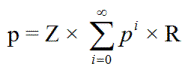
p2 - p + ZR = 0
By the Quadratic Formula p = (1-(1-4*RZ)1/2)/2 = 0.0133258620.
pr(push) = 0.0133258620.
pr(win) = 18/37 = 0.4864864865.
pr(loss) = 1-pr(push)-pr(win) = 0.5001876515.
Expected value = pr(win)-pr(loss) = -0.0137011650.
Zeros ignored imprisonment
Finally, at some casinos zeros are simply ignored after the first zero which imprisons the bet. There the probability of a push is simply (1/37)×(1/2) = 0.0135135135.
The following table summarizes all four kinds of rules.
Imprisonment Odds
| Imprisonment | Win | Push | Loss | Expected Value |
| Single | 0.48648649 | 0.01314828 | 0.50036523 | -0.01387874 |
| Double | 0.48648649 | 0.01332346 | 0.50019005 | -0.01370356 |
| Triple | 0.48648649 | 0.01332583 | 0.50018768 | -0.01370120 |
| Infinite | 0.48648649 | 0.01332586 | 0.50018765 | -0.01370117 |
| Zeros ignored | 0.48648649 | 0.01351351 | 0.50000000 | -0.01351351 |
I’d like to thank ChesterDog and weaselman for their mathematical help. I’d also like to give thanks and a plug to professor G. Artico and polarprof.it for the HTML of the summation formula above.
This question was raised and discussed in the forum of my companion site Wizard of Vegas.
Is there any pattern to the order of the numbers on the roulette wheel?
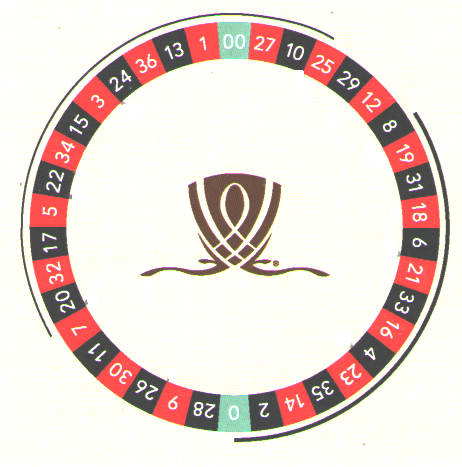
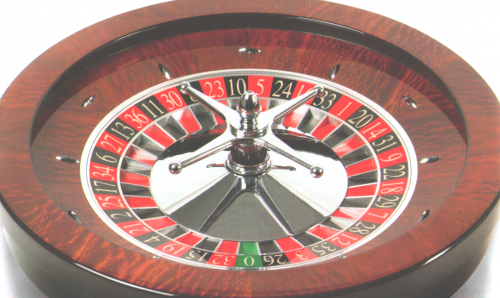
The idea is that the wheel should be balanced. In other words, if you took the average of a section of consecutive numbers on the wheel, they would be close to the average number 18.5. I thought of a way to explain how the numbers are distributed on a double-zero wheel, as follows.
- Position the 00 at the 12:00 position and the 0 at the 6:00 position.
- The numbers at the top of the wheel are 13, 1, 00, 27, 10*, 25. This must simply be memorized.
- All low odd numbers (from 1 to 17) are on the left side and the high odds (19 to 35) on the right side.
- Starting with the 1 and 13, move four positions counter-clockwise to get the next odd, but do not pass the zero.
- As an exception to rule 4, do not place the 19 four positions counter-clockwise from the 17, because the 19 is a high odd and belongs on the right side. Instead, put the 11, the only low odd not otherwise covered in rule 4.
- All even numbers are directly across the wheel, 180 degrees, from the preceding odd number.
I'm at a loss to explain the order on a single-zero wheel. For now, I can say that if you put the zero in the 12:00 position, then:
- On the left side will be all red low numbers and black high numbers.
- On the right side will be all red high numbers and black low numbers.
This question is raised and discussed in my forum at Wizard of Vegas.
I tracked 3,000 spins in double-zero roulette because the first dozen numbers did not seem to come up as much the second two dozens. In the 3,000 spins, the numbers in the range of 1 to 12 came up 742 times. What are the odds of that?
You would expect the number of times the ball would land in 1 to 12 to be 3000*(12/38) = 947.37.
The difference between your results and expectations is 947.37 - 742 = 205.37.
The variance is 3000*(12/38)*(1-(12/38)) = 648.20.
The standard deviation is the square root of the variance = sqrt(648.20) = 25.46.
Your results are 205.37/25.46 = 11.75 standard deviations south of expectations.
The p value, or the probability of being off by 11.75 standard deviations or more is 1 in 28,542,806,257,940,300,000,000,000,000,000.
I would be interested to know where the wheel is.
What is your opinion of the Comp Killer roulette strategy, as covered in this video?
It's easy to see the purpose of that system is to cover most numbers so it's a fairly low risk way of playing roulette. Here is what to bet on each spin:
- $5 each on 3, 16, 24, 28, and 33.
- Make a corner bet on each of these sets of numbers: 2/3/5/6, 7/8/10/11, 14/15/17/18, 19/20/22/23, 26/27/29/30, 31/32/34/35.
Note that this does not cover the following nine numbers: 0, 00, 4, 9, 12, 13, 21, 25, and 36.
The following return table shows the probability and contribution to the return of all possible outcomes.
Comp Killer
| Event | Net Win | Combinations | Probability | Return |
|---|---|---|---|---|
| Straight up win | 5 | 5 | 0.131579 | 0.657895 |
| Corner win | 50 | 24 | 0.631579 | 31.578947 |
| All other | -175 | 9 | 0.236842 | -41.447368 |
| Total | 38 | 1.000000 | -9.210526 |
The lower right cell shows an expected loss of $9.21 per spin. The total amount bet per spin is $175. This results in a house edge of $9.21/$175 = 5.26%, the house edge in double-zero roulette.
I would like to add that you will probably lose more than you get back in comps with this strategy, or any roulette strategy. The rule of thumb is casinos will give you back about 1/3 of your expected loss in comps. There are ways of fooling the casinos that your expected loss is more than it really is, but playing this strategy isn't one of them.
What do you think of this strategy in roulette:
- Bet two units on black
- Bet one unit on the third column
The beauty of this strategy is there are 8 red numbers and 4 black numbers in the third column. Of the 16 red numbers, half are on columns 1 or 2 and half are on column 3. Let’s ignore the 0 and 00 for now. When the ball lands in red, 8 out of the 18 red numbers are in the third column. If the probability of winning is 8/18 and wins pay 2 to 1, I have a player advantage of 33.3%. Even if we average that with the bet on black with 0% house edge, again ignoring 0 and 00 for now, I still have a 16.7% player advantage. Mixing in the 0 and 00, isn’t my advantage (2/38)*-100% + (36/38)*16.7% = 10.53%! What do you think?
I agree that the conditional advantage of the third column bet is 33.3%, assuming the ball lands in red, and ignoring both zeroes. However, by the same logic, if the ball lands in black, the probability of the third column bet winning is 4/18 = 2/9. A bet with a 2/9 chance of winning that pays 2 to 1 would have a house advantage of 33.33%. So, looking at it your way, the third column bet would have a player advantage of 33.33% half the time and a house edge of 33.33% the other half. Cancelling each other out, that bet has 0% house edge. Finally, mix in the two zeros and the overall player edge is (2/38)*-100% + (36/38)*0% = -5.26%.
Looking at it another way, the following table shows the number of ways all possible outcomes can occur, the probability, units won, and the contribution to the return. The lower right cell shows an an expected loss of -0.105263 units. Divided by the two units bet, that comes to a house edge of 5.26%.
Bohemia Strategy
| Event | Pays | Numbers | Probability | Return |
|---|---|---|---|---|
| 0, 00 | -2 | 2 | 0.052632 | -0.105263 |
| Red & column 1 or 2 | -2 | 10 | 0.263158 | -0.526316 |
| Red & column 3 | 1 | 8 | 0.210526 | 0.210526 |
| Black & column 1 or 2 | 0 | 14 | 0.368421 | 0.000000 |
| Black & column 3 | 3 | 4 | 0.105263 | 0.315789 |
| Total | 38 | 1.000000 | -0.105263 |
Here is my solution (PDF).
This question is asked and discussed in my forum at Wizard of Vegas.
I hear quadruple-zero roulette is now out there. What is the house advantage?
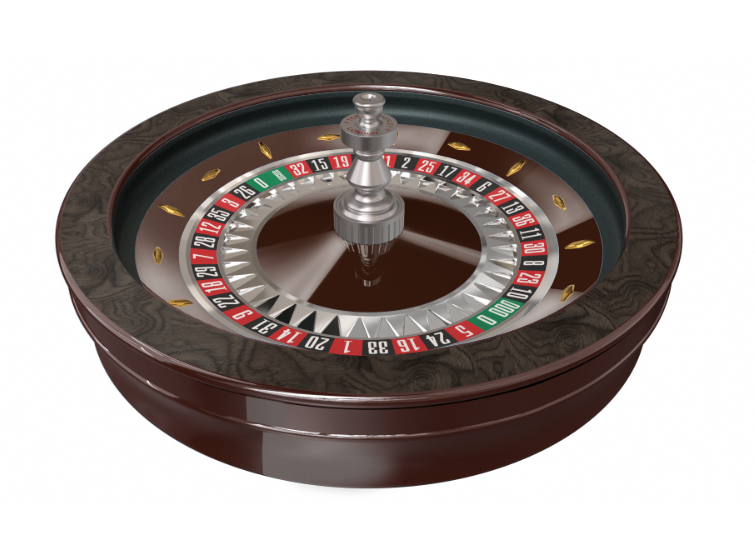
Yes, such a wheel is marketed by TCS John Huxley. I am not aware of any placements yet.
The formula for the house edge in standard roulette is z/(36+z), where z = number of zeroes. In this case, the house edge is 4/(36+4) = 4/40 = 1/10 = 10%.