
Est. 1997 | Last Update: 12 Oct, 2008


Get the Wizard's free newsletter!

Monthly, 100% spam-free

Play the Wizard's free games:
Blackjack

Craps

Pai Gow

WPT Holdem 10x

Blackjack: Strategy and Odds

Last update: Sep. 3, 2008

How to Play Blackjack

Blackjack can be played with one to eight ordinary decks of cards. Cards of rank 2 through 10 are scored according to their face value. All face cards are 10 points. Aces are semi-wild and can be worth either 1 or 11 points. The highest hand in blackjack is an ace and any 10-point card and is called a blackjack. A winning blackjack pays 3 to 2. If both player and dealer have a blackjack the bet is a push. Aside from a blackjack, a winning hand pays even money. The player wins if his hand has more points than the dealer, without going over 21. Thus, a 21-point hand is the highest and is why the game is sometimes called 21. If either the player or dealer go over 21 it is called a break or bust and a busted hand automatically loses. If both the player and the dealer bust the player loses, where lies the house advantage. If the player and the dealer tie, the bet is a push.


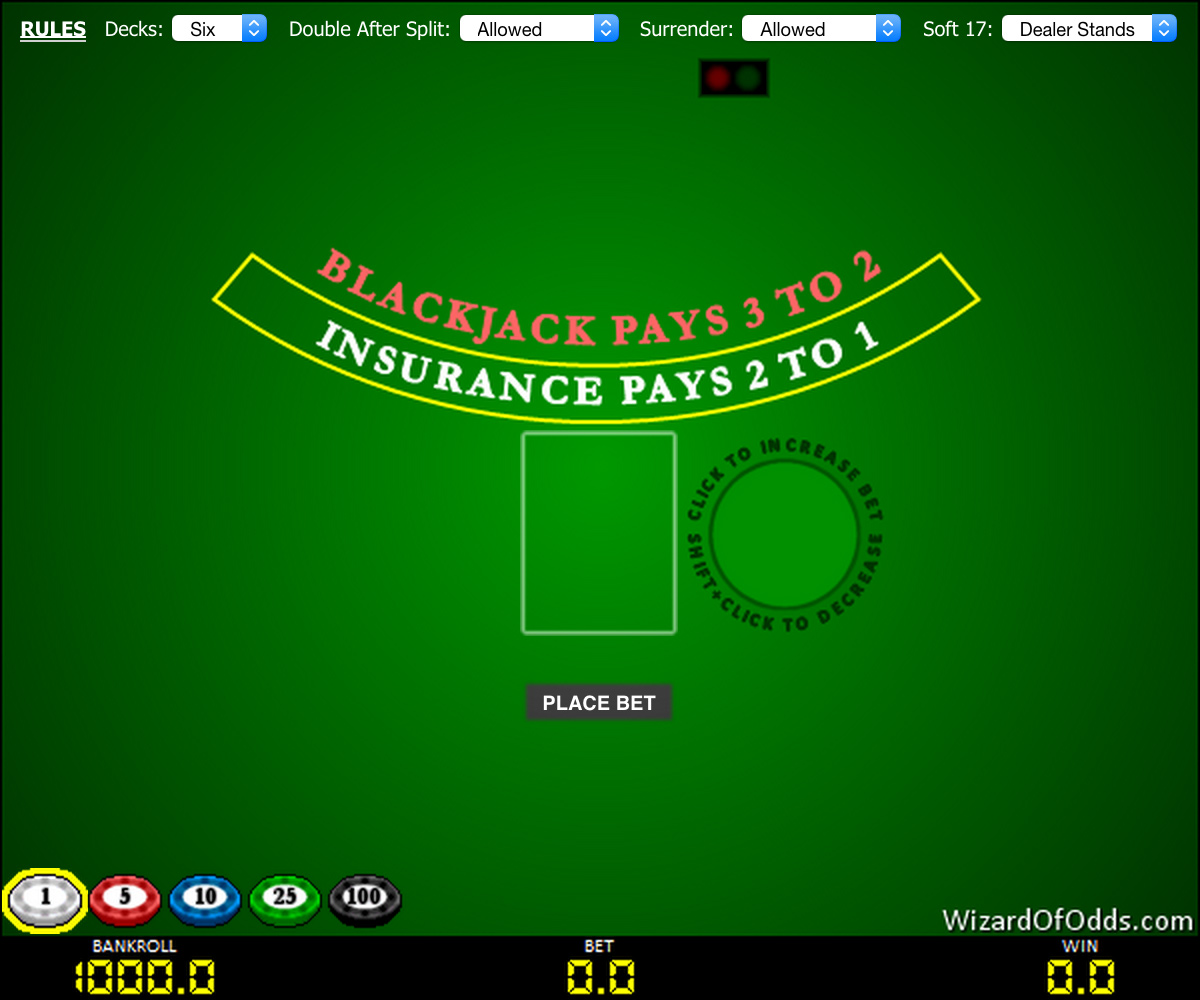
Play my custom-made blackjack game. A special feature is that it tells you when you make a mistake in basic strategy. Choose from various numbers of decks and rule variations.

A round of blackjack begins with each player placing a bet in the circle or logo directly in front of him. Then the dealer will give each player and himself two cards. Player cards are usually dealt face up. One dealer card is dealt face up (the up card) and the other face down (the hole card). If the dealer has a ten or an ace as the up card it is possible he has a blackjack, in which case all player hands will lose except those with another blackjack. In the U.S. the dealer will check for blackjack immediately, if one is possible, and will collect all losing bets immediately if he does have a blackjack.

In the event the dealer has an ace as the up card he will allow the players to insure their hands against a blackjack. This is much like any insurance policy in which you are betting something bad will happen. The insurance bet in blackjack pays 2:1 if the dealer has a blackjack. If the dealer has an ace showing and a player has a blackjack the dealer may ask "even money?" This is because if the player has a blackjack the net result of both the blackjack and the insurance bet will be an even money win regardless of whether the dealer has a blackjack. After all players have had a chance to accept or decline insurance the dealer will check the hole card.

After it has been established that the dealer does not have a blackjack the players in turn may play their hands. The following options are available.

Stand: If the player is satisfied with his hand as-is he may stand pat. To signify you wish to stand, wave your hand as if to wave the dealer away. In a single deck game, tuck your cards face down under your bet.

Hit: If the player wishes to take another card he may continue to do so until he either stands or busts. To signify you wish to hit, tap the table with your finger. In a single deck game, scrape your cards lightly against the felt.


Play this realistic blackjack game at Bodog Online Casino.

No download, no registration, no popups, no B.S., just the game. One click and you're in.

Double: If the player feels he needs one and only one more card then he may double his bet and be dealt one more card, good or bad. This option is only offered on the first two cards, and sometimes on the first two cards after splitting. To signify you wish to double, place another wager next to your original wager of equal value. In single deck, place your cards face up by your bet.

Split: If the player's first two cards are of equal point value he may split them into two hands. In this event each card is the first card of a new hand. The player must also make another wager, of equal value to the first wager, for the second hand. Splitting after splitting is allowed; however, resplitting aces is often an exception. The player may usually split up to 2 or 3 times if another splitting opportunity arises. Doubling after splitting is usually but not always allowed. To signify you wish to split put the additional wager next to the original wager. In single deck, place your cards face up by your bet.

Surrender: Finally, some casinos offer the player the option to surrender on the first two cards. If the player does not like his prospects he may forfeit half the bet as well as his cards. If the dealer has a ten or ace showing, and the dealer peeks at his hole card for a blackjack before the first player's turn, then the option is called "late surrender." If the dealer does not check for blackjack, or does not take a hole card at all, then the option is called "early surrender." Early surrender is much better for the player, because of the protection against a dealer blackjack.

After all players have played their hands, from the dealer's left to right, the dealer will play his hand. The dealer has no free will but must always play by certain house rules. Usually the rule is that the dealer must hit until he reaches a score of 17 or more. Some casinos stipulate that if the dealer has a soft 17, an ace and any number of cards totaling 6, he must also hit. If the dealer busts, all players that did not bust automatically win.

Blackjack Basic Strategy

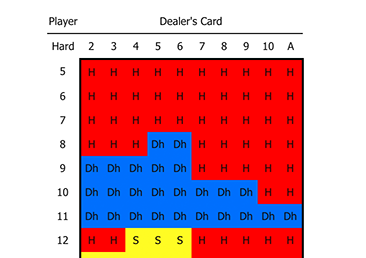
The most important thing to know about blackjack is the basic strategy. This strategy is simply the best way to play every possible situation, without any knowledge of the distribution of the rest of the cards in the deck. At the top of the page is the basic strategy for four or more decks when the dealer hits on soft 17, which is the most common game. Below are links to more basic strategy charts for other rules. If you only memorize one table I would suggest the one above. It can be played effectively under any rules.

To use the basic strategy look up your hand along the left vertical edge and the dealer's up card along the top. In both cases an A stands for ace. From top to bottom are the hard totals, soft totals, and splittable hands. Rule variations can have an effect on some borderline situations. The most flexible rules are the number of decks, whether the dealer hits or stands on a soft 17, and whether doubling is allowed after splitting.

Some obvious situations have been left out to keep the chart as small as possible. I have more basic strategy charts for other numbers of decks, as well as European blackjack.

The best way, I have found, to memorize the basic strategy is notice patterns and to try to understand why you should play every situation as the chart says. Then make flash cards and go over and over them until you know it cold. Do not deal out cards to yourself because the soft totals and the pairs will not occur often enough to test your knowledge.

Many people do not believe in the basic strategy because they once took the advice of someone who knew it and then lost the hand. Let me make something perfectly clear, you will not win every hand with the basic strategy! In fact, you won't even win half your hands. However, I can personally testify that while you will have short term ups and downs, over the long run you will roughly break even using it.

Las Vegas Rules Survey

I am proud to present my Las Vegas blackjack rules survey. This is an attempt to list the blackjack rules at every casino in the Las Vegas area.

House Edge

See my Blackjack House Edge Calculator to determine the house edge under 3,456 possible rule combinations. And here's that calculator on a full page.

Rule Variations

Rule variations will have an effect on the player's expected return. The numbers below show the effect on the player's return under various rules and after taking into consideration proper basic strategy adjustments. These changes are relative to the following rules: 8 decks, dealer stands on soft 17, player may double on any first two cards, player can double after splitting, player may split to 4 hands.

Rule Variations

Rule

Effect

Blackjacks pay 2 to 1 +2.27%
Five card Charlie 1 +1.46%
Suited blackjacks pay 2 to 1 +0.57%
Player 21-points is automatic winner +0.54%

Early surrender against ace

+0.39%

Early surrender against ten

+0.24%

5-card (or more) 21 automatically pays 2 to 1 +0.24%
Player may double on any number of cards +0.23%
Ace and 10 after splitting aces is a blackjack +0.19%

Player may draw to split aces

+0.19%

Six card Charlie1

+0.16%

Double Down Rescue+0.10%

Player may resplit aces

+0.08%

Late surrender against ten

+0.07%

777 pays 3 to 1 automatically+0.05%
777 pays 2 to 1 automatically+0.03%

Seven card Charlie1

+0.01%

Late surrender against ace+0.00%
Dealer must stop with six cards+0.00%

Late surrender after splitting

+0.00%

Split to only 2 hands

-0.01%

No-peek: ace showing2

-0.01%

BB+13

-0.01%

OBBO4

-0.03%

Player and dealer cards dealt from separate shoes5 -0.06%

Player may double on 9-11 only

-0.09%

No-peek: ten showing6

-0.10%

Player may not resplit

-0.10%

European no hole card7 -0.11%

Player may not double after splitting

-0.14%

Player may double on 10,11 only

-0.18%

Player may not split aces -0.18%

Dealer hits on soft 17

-0.22%

Blackkjack pays 7-5 -0.45%

Blackjack pays 6-5

-1.39%

Player loses 17 ties

-1.87%

Blackjacks pay 1 to 1 -2.27%

Player loses 17,18 ties

-3.58%

Player loses 17-19 ties

-5.30%

Player loses 17-20 ties

-8.38%

Player loses 17-21 ties-8.86%
Dealer bust on 22 is a push-9.53%

Notes:

  1. A "Charlie" is an automatic winner. For example the five-card Charlie rule means the player automatically wins with 5 cards, as long as he didn't bust.
  2. Dealer does not peek for blackjack with an ace up. If dealer has a ace-up blackjack, player loses all bets made, including from doubling and splitting. A 10-up blackjack will be revealed immediately after peeking, and the player will lose only his original wager, except a blackjack tie will push.
  3. “BB+1” refers to an Australian rule, in which the player will lose all busted bets, plus one unit, if the dealer gets a blackjack. For example, if the player splits 8's to three hands of a 20, (doubled) 19, and a busted hand, and the dealer get a blackjack, then the player will lose 2 units, one for the busted hand, and one from the remaining 3 units on the table. There is a great deal of confusion for the term for his rule, some sources calling it "OBBO," for Original and Busted Bets Only.
  4. “OBBO” stands for Original Bets and Busted Only. "Original Bets" means each original bet per hand. So, if the player bet $5 and split to three hands, he would have three original bets of $5 each. As far as I know, the OBBO rule is confined to some parts of Australia and Malaysia. In the example above, the player would lose 3 units under this rule, one for the busted hand and two for the number of unbusted hands. The term is discussed in depth in the book The Pro's Guide to Spanish 21 and Australian Pontoon by Katarina Walker.
  5. This strange rule is actually followed in Pennsylvania, on Shufflemaster TMS-300 video multi-player blackjack games, which prohit one players actions to affect the the other players.
  6. Dealer does not peek for blackjack with a 10 up. If dealer has a 10-up blackjack, player loses all bets made, including from doubling and splitting. An ace-up blackjack will be revealed immediately after peeking, and the player will lose only his original wager, except a blackjack tie will push.
  7. Dealer does not not a hole card, or never peeks at it if he does. If dealer has a blackjack, player loses all bets made, including from doubling and splitting, except a blackjack tie will push.

Insurance

Do not take insurance, even if you have a blackjack. Card counters can get away with making smart insurance bets when the deck is rich in tens but the non-counting player should always decline it. The following table shows the house edge on the insurance bet depending on the number of decks used.

House Edge on Insurance

Number
of Decks

House
Edge

1

5.882%

2

6.796%

4

7.246%

6

7.395%

8

7.470%

Beware Short Pays on a Blackjack

More and more tables are showing up that pay less than the full 3 to 2 on a blackjack. Most of these tables pay 6 to 5, but some even money and 7 to 5 tables are known to exist. I would estimate that 10% of "21" tables in Las Vegas now pay less than 3 to 2. In my opinion, only games that pay 3 to 2 deserve to be called "blackjack," the rest fall under "21" games, including Super Fun 21 and Spanish 21. Regardless of the other rules, demand nothing less than 3 to 2 blackjack. You should always check the felt to be sure, and if the felt doesn't say, look for a sign. If nothing says the win on a blackjack, then ask. Here is a link to an article in the Las Vegas Sun about this game, which quotes myself.(cache of article).

Bad Strategies

Three popular bad strategies encountered at the blackjack table are never bust, mimic the dealer, and always assume the dealer has a ten in the hole. All three of these are very bad strategies. Following are my specific comments on each of them, including the house edge under Atlantic City rules (dealer stands on soft 17, split up to 4 hands, double after split, double any two cards) of 0.43%.

Never bust: For my analysis of this strategy I assumed the player would never hit a hard 12 or more and based all other decisions on maximizing expected value under this assumption. This results in a house edge of 3.91%.

Mimic the dealer: For my analysis of this strategy I assumed the player would always hit 16 or less and stand on 17 or more. The player as well as dealer stood on soft 17. The player never doubled or split, since the dealer is not allowed to do so. This results in a house edge of 5.48%.

Assume ten in the hole: For this strategy I first figured out the optimal basic strategy under this assumption. If the dealer had an ace up I reverted to the proper basic strategy assumption of assuming the dealer did not have a ten. Then I went back and used this strategy under regular playing conditions. This results in a house edge of 10.03%.

Card Counting

Let me say loud and clear that card counting is hard and is not as rewarding as television and the movies make it out to be. If it were an easy way to make money everyone would be doing it.

If you do not know the basic strategy, trying to count cards is highly ill-advised. Experienced card counters still play by the basic strategy the great majority of the time. There can be no short cut around learning the basic strategy, those who attempt card counting without a firm foundation in the basic strategy are making a big mistake.

To be a successful counter you have to be able to count down a deck fast and memorize large tables of numbers as well as make it look like you're just a casual player. Furthermore, with today's rules, a realistic advantage the counter will have is only 0.5% to 1.5%. You will not win money slowly and gradually but your bankroll will go up and down like a roller coaster in the short run. Only in the long run, over hundreds of hours of playing, can you count on winning.

The underlying principle behind card counting is that a deck rich in tens and aces is good for the player, a deck rich in small cards is good for the dealer. When the counter knows the odds are in his favor, he will bet more, and adjust his playing strategy to stand, double, and split in some plays where basic strategy says to stand. All the options the player has at his disposal favor the player even more when the deck is ten and ace rich. Here is a list and a brief reason why.

Standing: The player may stand on stiff totals of 12 to 16, and the dealer may not. In ten-rich shoes, hitting stiff hands becomes more dangerous, favoring the more conservative player strategy.

Insurance: On average, when the dealer has an ace up, the remaining cards in blackjack will be 30.87% tens (based on a six-deck game), making insurance a bad bet. However, if the probability gets above 33.33%, it becomes a good bet. Counters know when the remaining cards are ten-rich, and make powerful insurance bets at those times.

Doubling: Usually when the player doubles he wants a ten. In ten-rich shoes, the player makes better double downs, getting closer to 21.

Blackjack: Both player and dealer will see more blackjacks, but the player gets paid 3 to 2, and the dealer does not.

Surrender: The alternative to surrendering is much worse in ten-rich shoes. If the alternative is hitting, the player is more likely to bust. If the player would otherwise stand, due to the high count, the dealer is still more likely to get a 10. While the counter will surrender more in high counts, the savings will be greater.

Splits: The player is usually splitting high cards and/or off of a weak dealer card. Either way, a ten-rich shoe helps the player get higher totals, and increases the probability of the dealer busting.

I’m working on an in-depth study of how these effects break down. The contribution to each factor depends on the rules, deck penetration, and bet spread. However, based on average conditions in a six-deck shoe, my initial results break down the benefits of counting as follows.

Why Card Counting Works
Player Option Portion of Benefit
Stand 40%
Insurance 34%
Double 9%
Blackjack 7%
Surrender 6%
Split 4%

The probability for insurance was taken from Don Schlesinger’s “Illustrious 18” list, as found in Blackjack Attack. The rest of the breakdown is mine.

To gauge the richness of the deck in good cards the player will keep track of the cards the are already played. Strategies vary but all assign a point value to each card. For example the Ken Uston's Plus/Minus strategy assigns a value of +1 to 3, 4, 5, 6 and 7, and -1 to tens and aces. Everything else is 0, or neutral. At the beginning of a deck or shoe the count is 0. Then the counter constantly adds and subtracts from the count according to the cards played. This running total is called the "running count." A positive count means that a disproportional number of small cards have already been played which means the deck is rich in large cards. To determine the "true count" divide the running count by the number of decks left to be played, or in some strategies the number of half decks. This will tell you the relative richness of the deck in good cards.

The true count is used in two ways, to determine how much to bet and how to play your hand. Unless it is obvious, every situation has a line in which you should play one way if the count is above the line and another if below. For example, a 12 against a 6 may dictate that you stand if the true count is +1 or greater and hit if the true count is less than +1. The counter will also bet more when the deck is rich in good cards.

A problem arises when it comes to treating aces. The player should bet more when the deck is rich in aces since they add to the probability of getting a blackjack. However, when it comes to playing your hand, the number of aces left is not nearly as important as the number of tens, so it is desirable, but not necessary, to distinguish between tens and aces. Some card counting strategies keep a side count of aces. In the Hi-Opt I and Revere Plus/Minus aces are counted separately and only considered when making the wager. This is a more accurate and powerful way to play than assigning a negative value to aces and not keeping a side count, as some strategies do. Yet many people feel that for the beginner it is too confusing to keep two counts. A player is more likely to make mistakes keeping two counts and that costs money. The efficiency of a strategy that does not keep a side count of aces is only modestly less but you likely will gain more from fewer mistakes made. Different experts fall in various places in the spectrum in terms of what to recommend for the beginner. The Zen Count takes the middle ground and gives aces a value of -1 and tens -2. Personally I have tried both and would recommend against a count that requires a side count of aces to a person ready to take up card counting. The Uston Advanced Plus/Minus is a good strategy that does not involve an ace side count and can be found in the book Million Dollar Blackjack. How well you know a counting strategy is much more important than which strategy you know.

Legally speaking, the player may play blackjack any way he wants without cheating or using a computer, and the casinos may do anything from making conditions unfavorable to barring, in an effort to stop anyone who they deem has an advantage over the game. Much of the challenge of card counting is avoiding suspicion that you are anything but a normal non-counting player. The most obvious indication that somebody is counting is that they make a substantial increase in bet size after a lot of small cards leave the table. Although the greater the factor by which you can increase your bet the greater your odds of winning, more than doubling your last bet is a fast way to arouse "heat" from the dealer and pit boss. Usually when casinos employees realize you are counting, they will either shuffle the cards whenever you increase your bet, essentially removing any advantage, or ask you to leave.

This is only scraping the surface of the subject of card counting. I suggest the following pages of mine.

More Pages on Blackjack

  • Appendix 1: Total dependent expected return table for an infinite deck.
  • Appendix 2a: Dealer probabilities after dealer peeks for blackjack.
  • Appendix 2b: Dealer probabilities before dealer peeks for blackjack.
  • Appendix 3a: Composition dependent exceptions to single deck basic strategy where the dealer stands on soft 17.
  • Appendix 3b: Composition dependent exceptions to double deck basic strategy where the dealer stands on soft 17.
  • Appendix 3c: Composition dependent exceptions to single deck basic strategy where the dealer hits a soft 17.
  • Appendix 4: Details on the standard deviation in blackjack.
  • Appendix 5: Infinite deck expected return according to player hand and dealer up card.
  • Appendix 6: Fine points of when to surrender.
  • Appendix 7: Effect of card removal.
  • Appendix 8: Analysis of some popular blackjack side bets including Super Sevens, Streak, Royal Match, and a tie.
  • Appendix 9: Composition dependent expected returns for 1, 2, 4, 5, 6, and 8 decks.
  • Appendix 10: The effect on the house edge of the continuous shuffling machines vs. the cut card.
  • Appendix 11: Value and strategy for 678 and 777 bonuses.
  • Appendix 12: Risk of ruin statistics.
  • Appendix 13: Probabilities in the first four cards. May be used to test for the number of decks in online blackjack.
  • Appendix 14: Value of each initial player card
  • Appendix 15: House edge using total dependent vs composition dependent basic strategy
  • Appendix 16: Basic strategy when dealer exposes both cards.
  • Appendix 17: The Wizard Ace Five Count. Possibly the easiest way to count cards.
  • Appendix 18: Basic strategy exceptions for three to six cards.
  • Appendix 19: Blackjack splitting strategy when a back-player is betting.
  • "21" Movie — Truth and Fiction : My comments on the movie "21."
  • Australian Blackjack: Rules and odds for blackjack down under.

Blackjack in Macau

For a detailed explanation of blackjack rules in Macau, please visit my companion site, Wizard of Macau.


    See important note about Bodog payouts & deposits.

©1998-2008 Wizard Of Odds Consulting, Inc. All rights reserved.   Privacy/Terms   Contact   Advertise   About Us   Links

The Wizard's other sites: Wizard of Macau,   Sweat the Money,   Math Problems
The Wizard's recommends: Casino Meister,   Online Casino City,   Online Poker Room Reviews,   (See more of the Wiz's picks)