Get the Wizard's free newsletter!

Monthly, 100% spam-free

Craps

Last update: Nov. 25, 2009


Play this realistic craps game at Bodog Online Casino.

No download, no registration, no popups, no B.S., just the game. One click and you're in.

Introduction

Craps can be an intimidating game for the beginner. The table seems to have about a hundred different kinds of bets, the players are barking out commands in what seems to be a foreign language, and the pace is too fast to ever ask a question. I can sympathize with the beginner, because at one point in time this was how craps appeared to me.

If this is how you view the game, I have good news. There is one fundamental bet, the "pass line" bet, that almost all players make. You can easily get by knowing just this bet your first time. As you get more experienced, you can add more bets to your repertoire. After just your first five minutes, you should feel comfortable with the flow of the game and can start acting natural, like you've been a craps player for years.

The Pass Line

The pass line is the most fundamental bet in craps; almost every player at the table bets on it. If you only understand one bet in craps, it should be this one.

The pass line bet is put on the the pass line itself on a come out roll. You can tell it is a come out roll if there is a black laminated marker on the table that says "off." If the come out roll is a 7 or 11, then you win even money. If the come out roll is a 2, 3, or 12, then you lose. If any other total is rolled (4, 5, 6, 8, 9, or 10) that total is called "the point." The dealer will turn over the marker that says "off" to the white "on" side, and place it on an area of the table with that number, to help the players remember what the point is. Then, the shooter will roll the dice until he either rolls that same point again, or a seven. If a seven comes before the point, then you lose. If the point is rolled first, then you win even money.

Do not make a pass line bet after the come out roll. This is allowed but is highly illadvised because the value of a pass line bet is diminished after the come out roll.

The house edge on the pass line is only 1.41%, which is not bad compared to most other bets on the table and other games in the casino.

Taking the Odds

Have you ever wanted a bet with no house edge? In most U.S. casinos there are only two, the double-up feature on some video poker games, and the "odds" in craps. However, you have to make a pass line bet first. After a point has been thrown you may bet up to some multiple of your pass line bet, usually 3 to 5 times, on the "odds." To make an odds bet after a pass line bet just put the odds bet behind the pass line bet, outside of the pass line area on the side closer to you.

The odds are simply an additional wager that the point will be rolled before a 7. Because seven is the most likely total roll, you win more than even money when you win. Specifically, if the point is a 6 or 8 the odds pay 6 to 5, if the point is a 5 or 9 the odds pay 3 to 2, and if the point is a 4 or 10 the odds pay 2 to 1. These are exactly statistically fair payouts.

The table below shows the combined house edge on the pass line and taking the odds.

Combined house edge on the
pass line and taking odds
Odds House Edge

1X

0.848%

2X

0.606%

Full double odds

0.572%

3X

0.471%

3-4-5X

0.374%

5X

0.326%

10X

0.184%

20X

0.099%

100X

0.021%

"Full double odds" means the player can take 2.5 times odds on a point of 6 or 8, and 2 times on all other points. "3-4-5 times odds" means the player can take 3X odds on the 4 and 10, 4X on the 5 and 9, and 5X on the 6 and 8. Assuming the player takes the maximum allowable odds the payoff on any odds bet will conveniently always be 6X the pass or come bet. If the maximum odds would result in an uneven win, the dealers will usually let you bet even more to get to an even payoff.

It is worth noting that while taking the odds lowers the combined house edge, the expected loss remains the same. That is because you are applying a lower average house edge to a higher average bet. Readers often write to me, making this point, as an argument against betting the odds. However, if it is you goal to minimize expected loss as much as possible, then don't play at all! If you are going to gamble anyway, and your goal is to minimize the ratio of losses to amount bet, then you should bet as much as you can on the odds.

Don't Pass

The don't pass is almost the opposite of the pass line bet. If the come out roll is a 2 or 3 then you win, a 7 or 11 you lose. A 12 is a push, except in Reno and Lake Tahoe, where a 2 is a push instead of the 12. Otherwise, the dice are rolled over and over until either the point or a 7 is rolled. If the 7 comes first you win, if the point come first you lose. All wins pay even money.

A person betting on the don't pass is called a "wrong" bettor and is usually winning when everone else is losing, and vise versa. If you make this bet, keep a low profile. The other players are not want to see you yelling "yippy" as they are losing.

There is some disagreement about the house edge on the don't pass. The following return table shows all the possible outcomes. The lower right cell shows a house edge of 1.36%. Some gambling books state the house edge is 1.40%. This is the expected loss per bet resolved. In other words it ignores ties. Today, most gambling writers, including myself, count ties, and thus would go with 1.36% as the house edge.

Don't Pass Return Table
Event Pays Combinations Probability Return
Win 1 949 0.479293 0.479293
Push 0 55 0.027778 0
Lose -1 976 0.492929 -0.492929
Total 1980 1 -0.013636

Laying the Odds

This is the opposite of taking odds, in other words betting that a 7 will be rolled before the point.

To make an odds bet, after a don't pass line bet, you have to give the bet to a dealer and tell him you want to lay odds on whatever the point is. Never hand the dealer a bet, but instead put it in front of him and say something like "layings odds on the 4." The dealer will put it in the right place.

If the point is a 4 or 10 laying the odds pays 1 to 2.
If the point is a 5 or 9 laying the odds pays 2 to 3.
if the point is a 6 or 8 laying the odds pays 5 to 6.

The amount you may win by laying odds is the product of your don't pass bet and the multiple of odds allowed per the table rules. If the table allows five times odds then you can win five times your don't pass bet by laying odds. Note that the multiple applies to how much you can win, not how much you can bet. For example, if you bet $2 on the don't pass and the table allows full double odds then you can bet $8 to win $4 on a point of 4 or 10, $6 to win $4 on a point of 5 or 9, and $6 to win $5 on a point of 6 or 8.

The following table shows the combined house edge on both the don't pass bet and laying the odds.

Combined house edge on the
don't pass and laying odds
Odds House Edge

1X

0.682%

2X

0.455%

Full double odds

0.431%

3X

0.341%

3-4-5X

0.273%

5X

0.227%

10X

0.124%

20X

0.065%

100X

0.014%

Come

Have you ever become bored waiting for a point to be thrown, and didn't want to waste your money on the sucker bets, to add excitement? If so, then consider the come bet. It is like the pass line bet, but may be made at any time. Like the pass line bet, you may also put money on the odds if a point is thrown on the first roll after the come bet is placed and has a house edge of 1.41%.

There is a nuance to the come bet the player should know about. If a point is thrown and there are still active come bets on the table, waiting for a different point, then special rules apply for the following come out roll. The come out roll will still apply to active come bets, but it will not apply to their respective odds bets. If a 7 is rolled on a come out roll, odds bets on top of come bets will be returned. The player may ask to keep the odds turned on, but few do.

Turning the come odds off on a come out roll increases the combined house edge from 0.326% to 0.377% in a 5-times odds game, not counting returned odds bets as bets made. So if you want to maximize your return on resolved bets then keep those come odds turned on.

A good strategy for the player who likes constant action is to have a new bet on either the pass line or come on every throw, and to always take the maximum allowable odds.

Don't Come

The don't come bet is like the don't pass bet, but is made on a non-come out roll.

Place Bets

In craps the 4,5,6,8,9, and 10 are known as the "place numbers." The player may bet on any of these numbers, and if it is rolled before a seven, the bet wins. Place bets are just like odds bets, except no pass line bet is required, and they pay worse odds.

Place Bets
Number Pays Ways to Win Ways to Lose Prob. Win House Edge
6,8 7 to 6 5 6 45.45% 1.52%
5,9 7 to 5 4 6 40.00% 4.00%
4,10 9 to 5 3 6 33.33% 6.67%

When a place bets wins, the dealer will return your winnings but leave the original bet on the table, essentially establishing a new place bet. You may request a place bet be "turned off" temporarily, or taken down, at any time.

Place Bets to Lose

Place bets to lose are the opposite of place bets. They win on a 7, and lose on the number. These bets can be found at the Star City casino in Sydney, Australia, and some Internet casinos. (source)

Place to Lose Bets
Number Pays Ways to Win Ways to Lose Prob. Win House Edge
6, 8 4 to 5 6 5 54.55% 1.82%
5, 9 5 to 8 6 4 60.00% 2.50%
4, 10 5 to 11 6 3 66.67% 3.03%

Buy Bets

Buy bets are essentially the same as the place bet, only with a different payoff. The player may "buy" any of the points (4, 5, 6, 8, 9, and 10), which means to bet that the number will be rolled before a 7. When making a buy bet you must pay a 5% commission and your bet will pay fair odds if it wins. Fair odds are 2-1 on the 4 and 10, 3-2 on the 5 and 9, and 6-5 on the 6 and 8.

A buy bet should be an increment of $20 so that the 5% commission can be an even dollar amount. If the bet is not divisible by $20 the commission will usually be rounded up to the nearest dollar.

The following table shows the house edge on each Buy bet. The payoff has been converted to a “for one” basis.

Buy Bets — Commission Paid Up Front
Number Pays Ways to Win Ways to Lose Prob. Win House Edge
6,8 23 to 21 5 6 45.45% 4.76%
5,9 29 to 21 4 6 40.00% 4.76%
4,10 39 to 21 3 6 33.33% 4.76%

Some casinos only charge the commission on buy bets on 4 and 10 if it wins. If this is the case the house edge is lowered to 1.67% on the 4 and 10. I have heard of some casinos only charging on a win on the 5 and 9 too, but have never seen that with my own eyes. The following table shows the house edge if the commission is only paid if the player wins.

Buy Bets — Commission Paid on Wins Only
Number Pays Ways to Win Ways to Lose Prob. Win House Edge
6,8 23 to 20 5 6 45.45% 2.27%
5,9 29 to 20 4 6 40% 2%
4,10 39 to 20 3 6 33.33% 1.67%

Comparing buy bets to place bets, on points of 6 and 8, the place bet always has the lower house edge. On points of 4 and 10, the buy bet always has the lower house edge. On points of 5 and 9, it depends on whether the commission is always paid, or only on wins. If the commission is paid up front, as is usually the case, then place bets are better, otherwise buy bets are.

Tip:If the commission is rounded down, the player can cut down the house edge by betting just under $40 for a commission of $1. A buy bet of $39 on the 4 or 10 has a house edge of 2.5%. A buy bet of $38 on the 5 or 9 has a house edge of 2.56%. A buy bet of $35 on the 6 or 8 has a house edge of 2.78% (which is still not as good as the place bet).

Big 6 and 8

The Big 6 and 8 are exactly like the place bets on 6 and 8, respectively, except pay only even money. The house edge on the big 6 and 8 is 9.09%, which is much higher than the 1.52% on 6 and 8 place bets. In Atlantic City these bets are illegal. In Las Vegas, that area of the felt is sometimes used for other sucker bets instead.

Hard Ways

There are four different hard way bets. For example, a hard 4 bet is betting that a pair of 2's will be rolled before a 7 or before any other way to roll a total of 4. This is called "the hard way" because it is harder to roll two 2's than a one and a three. Likewise, you can bet on a hard 6, 8, or 10, each of which is a bet that the hard way of rolling the given number will occur before a 7 or any "easy" way.

The following table shows the house edge on hard way bets. Most casinos follow the stingier payoffs of 7 and 9 to 1. The liberal payoffs of 7.5 and 9.5 to one can be found in England and Australia.

Hard Way Bets
Number Pays Way to Win Way to Lose Prob. Win House Edge
6,8 9 to 1 1 10 9.09% 9.09%
6,8 9.5 to 1 1 10 9.09% 4.55%
4,10 7 to 1 1 8 11.11% 11.11%
4,10 7.5 to 1 1 8 11.11% 5.56%

Lay Bets

The lay bet is the opposite of the buy bet . The lay bets may be placed on the 4, 5, 6, 8, 9, or 10. The bet itself is that a 7 will be rolled before the number you choose. Because the 7 is the most likely number to be rolled you will wager more than you can win. The player must pay a 5% commission on the possible winnings and the fair odds are paid on the bet itself. The following table shows the house edge for each lay bet, after converting the odds to a “for one” basis.

Lay Bets
Number Pays Ways to Win Ways to Lose Prob. Win House Edge
6,8 19 to 25 6 5 54.55% 4%
5,9 19 to 31 6 4 60% 3.23%
4,10 19 to 41 6 3 66.67% 2.44%

If you should be at a casino that offers place bets to lose, those are preferable to lay bets on all numbers except the 4 and 10.

Hint:If the commission is rounded down, the player can cut down the house edge by betting so that the winnings will be just under $40. A lay bet of $78 on the 4 or 10 has a house edge of 1.27%. A lay bet of $57 on the 5 or 9 has a house edge of 1.72%. A lay bet of $42 on the 6 or 8 has a house edge of 2.33%. All of these are better than the place bets to lose.

Put Bets

A put bet is a combination of making a pass line or come bet after a point is established and betting on the odds. It is in general a bad idea to make a line bet after a point is established, however, by taking the odds the combined house edge can be lower than a corresponding place or buy bet. The following table displays the combined house edge according to the point and the multiple of odds taken.

Put Bets
Odds Multiple Point of 4,10 Point of 5,9 Point of 6,8

0

33.33%

20.00%

9.09%

1

16.67%

10.00%

4.55%

2

11.11%

6.67%

3.03%

3

8.33%

5.00%

2.27%

4

6.67%

4.00%

1.82%

5

5.56%

3.33%

1.52%

6

4.76%

2.86%

1.30%

10

3.03%

1.82%

0.83%

20

1.59%

0.95%

0.43%

100

0.33%

0.20%

0.09%

If the point is a 4 or 10, the house edge on the put bet with six times odds is the same as a corresponding buy bet. If the point is a 5 or 9, the house edge on the put bet with four times odds is the same as a corresponding place bet. If the point is a 6 or 8, the house edge on the put bet with five times odds is the same as a corresponding place bet. In other words, you have to back up the put bets with 4 to 6 times odds for the house edge to be equal to the best option between a corresponding place or buy bet.

It should be noted that put bets are not allowed in some casinos.

The Proposition Bets

Proposition bets either win or lose on the next throw. In general these have the highest house edge of all the crap bets and players with any sense at all will avoid them completely. The following table shows the various prop bets available. Different wins are known to exist on the prop bets. In the U.S., usually the payoff odds are the lower ones. The casinos in the U.K. and Australia are known to have the more liberal rules.

Proposition Bets
Number Pays Ways to Win Ways to Lose Prob. Win House Edge
2, 12, and all "hard" hop bets 33 to 1 1 35 2.78% 5.56%
2, 12, and all "hard" hop bets 32 to 1 1 35 2.78% 8.33%
2, 12, and all "hard" hop bets 31 to 1 1 35 2.78% 11.11%
2, 12, and all "hard" hop bets 30 to 1 1 35 2.78% 13.89%
2, 12, and all "hard" hop bets 29 to 1 1 35 2.78% 16.67%
3, 11, and all "easy" hop bets 16 to 1 2 34 5.56% 5.56%
3, 11, and all "easy" hop bets 15 to 1 2 34 5.56% 11.11%
3, 11, and all "easy" hop bets 14 to 1 2 34 5.56% 16.67%
Any craps (2, 3, or 12) 7 to 1 4 32 11.11% 11.11%
Any craps (2, 3, or 12) 7.5 to 1 4 32 11.11% 5.56%
Any seven 4 to 1 6 30 16.67% 16.67%

There are various ways of making combinations of prop bets. One common one is the “horn” bet, which is divided equally between the 2, 3, 11, and 12. Sometimes a player will make “horn high” bet, which doubles the bet on one of those numbers. Another common bet is the “world” which is five equal bets on the 2, 3, 7, 11, and 12.

Tip: If you must bet on a 7, don’t make the any 7 bet, with a house edge of 16.67%. Instead, divide your bet by 3, and put 1/3 each on the 1-6, 2-5, and 3-4 hop bets. Even at the stingy payoff of 15 to 1, you will still lower the house edge to 11.11%.

Field Bet

The field is a one time bet that the next roll will be a 2, 3, 4, 9, 10, 11, or 12. All wins pay 1 to 1, except the 2 and 12 pay 2 to 1. The following table shows the possible outcomes. The lower right cell shows a house edge of 5.56%.

Field Bet — 2 and 12 pay 2-1
Number Pays Combinations Probability Return
2, 12 2 2 0.055556 0.111111
3, 4, 9, 10, 11 1 14 0.388889 0.388889
5, 6, 7, 8 -1 20 0.555556 -0.555556
Total 36 1 -0.055556

Sometimes, especially in Nevada, the 12 will pay 3 to 1. In northern Nevada, sometimes the 2 will pay 3 to 1 instead. The following table shows the return table for this more liberal field bet. The lower right cell shows a house edge of 2.78%.

Field Bet — 2 or 12 pay 3-1
Number Pays Combinations Probability Return
2 2 1 0.027778 0.055556
12 3 1 0.027778 0.083333
3, 4, 9, 10, 11 1 14 0.388889 0.388889
5, 6, 7, 8 -1 20 0.555556 -0.555556
Total 36 1 -0.027778

Net Gain/Loss per Session

The chart below shows the net gain or loss you can expect over 100 trials, or come out rolls. For purposes of creating the chart the player would bet $1 on the pass line and take full double odds.

Here are some actual numbers that show the probability of falling into various intervals.

Session Win/Loss
Interval Probability

loss of over $100

0.0422%

loss of $76-$100

0.6499%

loss of $51-$75

4.6414%

loss of $26-$50

16.3560%

loss of $1-$25

30.0583%

break even

0.6743%

win of $1-$25

28.6368%

win of $26-$50

14.4257%

win of $51-$75

3.9097%

win of $76-$100

0.5639%

win of over $100

0.0418%

The graph and table were created by simulating 1,000,000 sessions of 100 trials, or come out rolls, and tabulating the results of each session.

Miscellaneous Advice

  • Most bets can be removed, added to, or deducted from at any time. Exceptions would be the pass and come bets, and you can not exceed the maximum bet on the odds. With the place number and proposition bets the dealers will often pay winnings only and let the original bet ride, unless otherwise requested.
  • The players take turns throwing the dice. In general the same person will throw until they seven out. The player may pass the dice if they want to.
  • Know the rules and what to do before you arrive at the table, especially a busy one. Try not to rely on the dealers for answering questions.
  • Craps has a language all its own. It is beyond the scope of this page to define all the terminology but you can pick it up as you go. For example, "Two way yo" is crap slang for a bet on 11 in which half is for the player and half is a bet for the dealers.
  • When you throw the dice they are supposed to rebound off the other side of the table.
  • Don't put drinks on the table. There is a little shelf under the chips for glasses and bottles.
  • Don't sit or lean on anything. Except for some sit down tables I have seen in Laughlin, players must stand.
  • Don't listen to the advice of the other players, especially those betting anything in the middle of the table.
  • As in all games you should tip the dealers, especially if they are being especially helpful. When you tip don't make a bet for the dealers on a sucker bet as most players do. I like to make a field bet for the dealers. To place a bet for the dealers say "for the dealers" when you make the bet. The reason I don't make line bets for the dealers is I have been goaded into making an odds bet for the dealers as well, which was more than I intended to give.
  • Blend in with, but do not interact with, the other players. The players at the crap table tend to be a tough and superstitious crowd who prefer to be left alone. Do not rebuke anybody for making sucker bets. Do not do anything that can be interpreted as being unlucky, like saying a number that would cause the table to lose. I know this sounds irrational but don't forget that gambling should be for fun so don't take from anyone else's experience.
  • If you are playing for the first time don't announce this if you are male. Male virgins to the game are said to be unlucky, and the opposite for females. This is evidently because virginity is despised in men and valued in women.

Play for Free

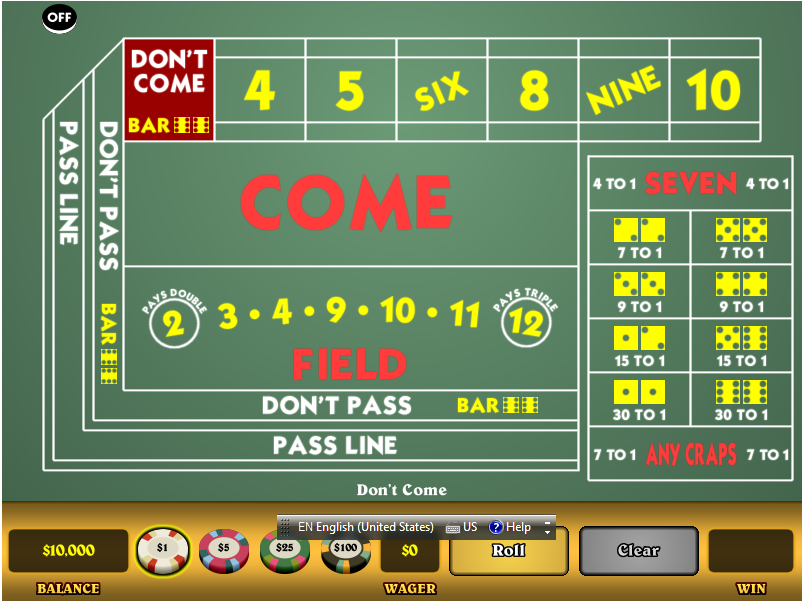
I'm very proud of my play for free craps games. Just click on the image below to try your luck.

Las Vegas Craps Survey

My companion site Wizard of Vegas has a survey of the odds allowed in craps in Las Vegas.

Links

For a simplified explanation of craps, please see my companion site, Wizard of Vegas.

My other info on Craps

©1998-2009 Wizard Of Odds Consulting, Inc. All rights reserved.   Privacy/Terms   Contact   Advertise   About Us   Links

The Wizard's other sites: Wizard of Vegas, Wizard of Macau, Math Problems The Wizard recommends: The Bear Growls,   Casinomeister, Online Casino Suite