
Wizard Recommends
-
 $11000 Welcome Bonus
 -
 $3000 Welcome Bonus
 -
 UP TO $777 BONUS
Blackjack - Blackjack Variants
In a live casino, if you could find a blackjack table that uses Unified Gaming rules, including a single deck, but deals reasonably deep into the deck before shuffling, would the house edge be different than -0.14%?
Yes, however the edge would actually be less for the basic strategy player in a live casino. This is because in a live casino the dealer will generally deal until a certain point is reached, finish that hand, and then reshuffle. If the deck is rich in small cards (good for the dealer) when the cut card or shuffle point is reached then more cards are likely to be dealt than if the deck were rich in big cards at the shuffle point (good for the player). The effect over thousands of hands is that a disproportionately high number of small cards are dealt which is directly related to a lower player return on investment. The effect is not huge but it is mathematically better to play with the same rules at an online casino as opposed to a physical casino.
For more on this topic, please see my blackjack appendix 10 on the cut-card effect.
First of all, I'd like to say I really like your site. It's hard to find a casino site that actually gives good information. Secondly, I'd like to ask a question. I'm from Europe, so I play blackjack with the European hole card rule. It's a multiple-deck game. The dealer deals out the first card to all of the players and one to himself. After that, he gives all the players their second card and none for himself. The players can make decisions after that. After all the players are done, the dealer gets his second card and after that he can make his "decisions". I was wondering what basic strategy I should use for this game. Should I use the Microgaming strategy? The rules of the Microgaming casinos are a bit different though."
For the benefit of others, let me explain that in European blackjack the dealer does not check if he has a blackjack until all players have finished playing their hands. If the dealer does have a blackjack and a player doubled or split, then the player will lose his entire bet. In the United States, the player can lose no more than the original bet if the dealer has blackjack. As you pointed out, online casinos that use Microgaming software follow the European rule. However, Microgaming casinos also play a single-deck game and let you draw to split aces which is unlike the European rules. To make a long story short, please see my European basic strategy.
I am a 18 year-old from South Africa and I have recently become very interested in blackjack. In all the casinos I have been to in South Africa (a grand total of 4), early surrender is offered. I was wondering if there are further situations when you should surrender with early surrender apart from the four situations for late surrender. I also wondered how much it cuts down the house advantage, and how effective it could be to exploit this rule while using a card counting system. I would be grateful for any sort of help or direction regarding these matters.
My blackjack appendix 6 has a full strategy for early surrender.
Dear Wizard! I'm about to play Blackjack on Finnish site with the following rules:
- 4 decks
- 9-11 double
- one split only
- double after split allowed
- one card to split aces
- dealer stands on soft 17
- European card rule= none
- no surrender
Are these rules a good deal for me? What is the house edge? Thank you for an answer.
The house edge in this game is 0.51%.
I think your website is one of the best gambling sites on the net, and I have a question that I am hoping you would be able to answer. There is an Indian casino a few hours from my house that has some odd rules and regulations. I was wondering if you would be able to determine the house edge from these rules:
- There is a 50-cent charge on each hand if your wager is between $5 and $25
- There is a $1 charge on each hand if your wager is $26 to $500.
- You can split up to 4 times, not including aces
-You can double on any first two cards - You can double after a split
- Dealer stands on all 17s
- Early surrender is available
- One card on each hand if you split aces
- $100 bonus on getting 7 cards without busting
- $100 bonus on getting 3 7's in a row
- $500 bonus for getting 3 Blackjacks in a row
- $10,000 bonus for getting 4 Blackjacks in a row
Any help you can give is appreciated.
I'm going to assume that eight decks are used and that the bonuses are not applicable if the dealer has a blackjack. Using the Blackjack Count Analzyer I get a player advantage of 1.4% with a $5 bet. Unfortunately, this advantage is not available at greater bet sizes as the comparable benefit of the bonuses decreases and the additional fee for bets of $25 or over. With a $24 bet the house edge is 1.4%, and with a $25 bet it is 3.3%. This certainly is a very interesting game. If you play it let me know how you do.
Here in Finland we have blackjack tables in some nightclubs and restaurants but these tables follow the following rules: six decks, ties push only on 21 and blackjack, ties on 17,18,19 and 20 the house wins!! No surrender, European no hole card rule, double 9-11, unlimited splits! I understand this is a bad deal for players but how bad is it? What is the house edge in this game?
I have actually seen these rules when I went to Helsinki in 1986. Without a doubt, the worst blackjack rules I have ever seen.
To answer your question, my blackjack house edge calculator says the house edge is 0.54%, before considering the rule that ties lose on 17-20. My list of rule variations says the effect of losing on 17-20 ties is 8.38% in the house's favor. So, the overall house edge would be 8.92% (ouch!).
Biloxi, Mississippi casino has single-deck blackjack dealt to the bottom. What is the casino's edge on this game? Does the basic strategy for blackjack still hold still hold for this game? by the way, blackjack in this game pays even money.
Dealing to the bottom of the deck would not help the basic strategy player but greatly benefits the counter. There would be no changes to the basic strategy. However, this game may be of interest to card counters. Vegas World (now the Stratosphere) in Las Vegas used to have such a game but I don't think card counters ever took it seriously because of other adverse rules like a blackjack only paying even money.
I just came back from Costa Rica. They pay even money on a blackjack. What is this worth to the house and should I double down on 21 versus say a dealer 3-6, since I am only going to get paid 1to1?
Please see my page on rummy, which is the blackjack variant popular in Costa Rica.
I just got to your site and like it a lot. Is there a table for hits and splits when playing European blackjack? It seems like there should be some remedy for the house taking all the doubles and splits on blackjack.
Since you asked I added a blackjack strategy for European blackjack to my site. I also discussed this topic in one of my recent newsletters.
I don't have a blackjack simulator personally, but wondered what the house edge would be on the video blackjack here in Rhode Island. It is single deck (reshuffled every round of course), split pairs only once (no splitting unlike tens), double on hard 10&11 only, pull six cards automatic winner regardless of dealers hand (i.e. If you have a soft 19 or 20 after 5 cards, you automatically hit because it is 100% impossible to bust on 6th card) double on splits on hard 10&11 only) split aces receive only one card each. BUT, here's the clincher, split Blackjacks pay 3 to 2 whereas traditionally they pay 1 to one) I know this can make a difference of maybe 0.5 % in the overall house edge. Also late surrender on any hand, and dealer hits soft 17. So, playing optimum basic strategy for these situations, what is the overall house edge. My guess is that it' in the 1.5% range because of the single deck and 3-2 pay out on split blackjacks.
According to my blackjack house edge calculator, the house edge before the 6-card Charlie rule and the 3-2 on blackjack after splitting, is 0.34% with perfect strategy.
My list of rule variations says that the 6-card Charlie rule is worth 0.16%, and a 3-2 paying blackjack after splitting aces is worth 0.19%. It still doesn't pay to split tens. So, the overall house edge is 0.34% - 0.16% - 0.19% = -0.01%. In other words, a player advantage of 0.01%.
In blackjack, I've read that the dealer breaks about 25% of the time. If that figure is correct, is that 25% of all the hands dealt, or 25% of just the hands that he hits? Also, in blackjack the house edge varies according to the rules of that particular game. What I'd like to know is, what effect, if any, does playing head to head with the dealer have. It would seem to me that both of you will get more blackjacks, thereby reducing the house edge somewhat.
Assuming six decks, and the dealer hits on soft 17, if the dealer is forced to play out every hand them my blackjack appendix 2B says the probability of the dealer busting is 28.58%. However, in a head-to-head game where the dealer doesn't bother to draw cards if the player has a blackjack or busts first, then my blackjack appendix 4 says the probability of busting is 24.36%.
I read on your web site that you recently had a chance to visit Tunica, Mississippi. I play very often at the Grand. I am sure you have heard of the side bet known as Triple 7s. I don't consider myself a good card counter, or even an average one, but say no 7s had been played at all in six hands would the odds not be in my favor to play the side bet?
Yes, I've seen that bet in Tunica. I address it in my blackjack appendix 8. I agree that side bet would seem very countable.
I just came back from Vegas and played at the Las Vegas Club. They have a game called "Most liberal 21" with the following rules:
- Eight decks
- Dealer hits soft 17
- Double any first two to four cards
- Double after split allowed
- Late surrender allowed
- Re-split aces allowed
- Six-card Charlie
What kind of advantage does the house have with these kind of rules?
At the time you asked this they still paid 3-2 on blackjacks. Before considering the rule about doubling on 3 or 4 cards, and the six-card Charlie, the my blackjack house edge calculator says the house edge is 0.50%. My list of rule variations says that doubling on 3 or 4 cards is worth 0.23%, and the six-card Charlie rule is worth 0.16%. So, the overall house edge is 0.50% - 0.23% - 0.16% = 0.11%.
However, since you wrote they changed their rules to pay 2 to 1 on suited blackjacks and 1 to 1 on all other blackjacks. This increases the house edge by 1.13%, to 1.24%. They still have the sign stating it is the "World's most liberal blackjack," which is patently untrue, if you interpret the word "liberal" to mean lowest house edge.
There are a great number of Casinos in the Vancouver area. All except one offer no surprises. However, one of them allows a funky variation on blackjack ... the player may double down or surrender after ANY number of cards until that player stands or busts. Could you please inform me as to how exactly this affects the odds. I would think it would be of great benefit to the player?
According to Basic Blackjack by Stanford Wong, this rule adds 0.2% to the player's expected return. Wong also indicates some strategy deviations under this rule on pages 60-61.
Do you have a strategy for the California "No bust" Blackjack, where the players can be the bank. It is played at several Casinos including Larry Flynt's Hustler Casino in Gardena CA.
Since you wrote I analyzed one version of California no-bust blackjack. However, that set of rules has since disappeared. It seems every casino in the L.A. area has their own rules and it is hard to keep up. With the fee to play, it is a lousy bet anyway, unless you're banking. Sorry I can't be of more help.
I was at the Soaring Eagle Casino in Mt. Pleasant, MI this past weekend and while I was there I noticed a game called "Pitch" blackjack. The game uses 6 decks, which are put into a shuffle machine, and then the machine delivers one "deck" to the dealer. Dealer cuts and deals (usually only two hands for a full table). Then he takes the deck, puts it back in the shuffle machine, and retrieves another 52 card "deck" from the machine. The rules are the same as for a standard shoe game except that the player is allowed to double down with 3 cards if they total 9, 10, or 11. I’m always suspicious of "special" games, so I wondered how the house advantage on this game would differ from a standard shoe game. Does the house have a greater or lesser advantage?
I’ve seen these things at the Las Vegas club, only they cut off two decks out of six I believe. It is a deceptive way to appear to be using fewer decks than are actually involved. Mathematically speaking the house edge would be the same as for the total number of decks in the shuffle machine. Penetration does not matter for the non-card counter. Thus it would not matter whether a machine or a human being cut off two decks from a six-deck shoe, the cards were taken from a six-deck shoe either way.
hi there..love your website....my favorite game to play in ac is triple action blackjack...i wanted to know if u had a strategy chart for that game, and if the strategy changes, which it must.....ex...16 against i face card i usually stand in this game since the dealer usually breaks once....let me know...thanks
For those who don’t know what you’re talking about, Triple Action Blackjack is a blackjack variant in which the dealer plays out three different hands, all starting with the same up card. The player makes three bets and his one hand is played against the three dealer hands individually. The strategy for this game is exactly the same as conventional blackjack.
My friend and I are debating two blackjack issues that arose from his Caribbean Vacation. (1) What shift in odds does the dealer NOT drawing the second card have? House favor or player favor? (2) in your simulations, what impact does the number of players have on the accuracy of the odds?
(1) It depends what happens if the dealer does have a blackjack. If the player is guaranteed to lose no more than the original wager then it doesn’t matter if the dealer takes a second card or not. If the player stands to lose the total amount bet after doubling or splitting and the dealer gets a blackjack then that works to the dealer’s advantage. (2) I don’t have to simulate this because the number of players makes no difference.
On your Super Fun 21 strategy chart you show doubling your 10 against an ace if you have less that 4 cards. Why is this? Also, do you have a strategy based on simple card counting for this game? Thank you.
The reason you double with 2-4 cards and hit with 5 or more is because a hand of 6-cards automatically wins, and a 5 card total of 21 pays 2-1. However these incentives do not apply after doubling. Once the player already has four cards there is a stronger incentive to hit as opposed to double. I nice count strategy has been introduced in the green chip section at bj21.com.
At the Spielbank Stuttgart, one is given the option in blackjack to take even money immediately if one gets a black jack and the dealer shows a ten or an ace (to avoid a push). Is this a sucker bet? I won 390 euro thanks to your card. Many thanks!
Yes, this is a sucker bet, especially with a 10 showing. This is equivalent to taking insurance. The casinos here always offer "even money" in this situation and both dealer and other players will treat you like a fool if you decline it. However the expected value of a blackjack when the dealer has an ace showing is 1.04 units, better than the 1.00 units you’ll get by taking the even money. So unless you’re a card counter and know the remaining deck to be 10-rich then always decline even money. I’m glad my basic strategy helped you win.
The Mohegan Sun casino here in Connecticut recently added a limited number of blackjack tables that don’t seem to be addressed in your synopsis. It is a 4 deck shoe dealt from a Shufflemaster that, essentially created an infinite deck, inasmuch as the dealer puts the dead cards back into the machine for reshuffling pretty much as the completion of each round of decisions. The game allows splitting to 4 times, double down on splits, dealer stands on all 17’s, early surrender, and double on any first 2 cards except 10’s and face. I have had some very good luck at this game and was wondering if it is one I should continue to play or switch back to the conventional 6 or 8 deck shoe.
There is a common misconception that a continuous shuffler is equivalent mathematically to an infinite deck game. It is not. If the first card dealt is an ace, for example, the probability that second card is an ace is slightly less than 1/13, because one ace has already been removed from the shoe. As I have explained in great detail in my blackjack appendix 10 a continuous shuffler actually lowers the house edge marginally compared to a cut card game. However the dealer never stops to shuffle so you are being exposed to more hands per hour, so expect to lose more per hour. I doubt very much they allow early surrender at the Mohegan Sun, if they did the player would have an edge of 0.28%. Assuming you really meant late surrender the house edge is coincidentally 0.28%, according to Blackjack Edge software.
Some casinos are now offering a single-deck BJ game paying only 6:5 odds for a natural. What does this do to the house edge?
This increases the house edge by 1.39%! This is by far the worst blackjack game in Vegas.
What’s the basic strategy for the new Blackjack Switch game? Also, what’s the house advantage?
Everybody is asking me this. At this time I haven’t worked out the odds yet. Until I do you’re on your own. Since this web site isn’t making me much money I have to give priority to paying consulting work.
What would be the house advantage for single deck, hit soft 17, double after split, split to total of four hands, double any first two cards, one card on split A’s, Blackjack pays 6 to 5?
This is a popular new gimmick here in Vegas. Many casinos here have prominent signs saying "Single Deck" blackjack. However on a much smaller sign it says "Blackjack pays 6 to 5." Aside from the 6-5 rule the house edge would be 0.05%. However the 6-5 on blackjacks costs the player an additional 1.39%, for a total house edge of 1.44%. This is by far the worst blackjack game in city and I urge you to avoid it.
Hello, thanks for the great website. There is a lot of helpful information. I hate to bother you, but I wanted to let you know about a variation of blackjack that I played recently. I was at the Oneida Bingo & Casino in Green Bay, Wisconsin. They had a few tables that at first glance looked like 2 deck pitch blackjack. Upon further examination they were using automatic shufflers and according to the rules they listed, this game consisted of eight decks and the automatic shuffler dispensed approximately 100 cards. The game was dealt using these 100 cards. The dealer put the cut card approximately half way in the 100 card deck and then dealt. When the cut card was reached, the dealer would put the cards back in to the automatic shuffler and take 100 more cards from the machine and start dealing again. In this game you could not double down after a split, and you could split up to 3 times. I’m not sure whether the dealer stands or hits on soft 17.
Mathematically speaking this is the same as playing from an eight deck game. Players have been known to be fooled, incorrectly thinking these are double deck games. For card counting purposes the penetration is 50 out of 416, or 12.02%.
Some friends and I were in AC last weekend at the Claridge, where we spent the evening playing something called "Multiple Action Blackjack." If you do not know about it, basically, you can bet either 2 or 3 times. You are dealt your hand and the dealer is dealt one card (face up). You hit/stand/double/split as in normal AC blackjack. The dealer resolves the first bet normally, then keeps the original face-up card and starts all over again, resolving the 2nd bet, and then the 3rd. Essentially, you are playing the same hand 2-3x vs the same dealer "face-up card".
It seemed to us that this changed the strategies for blackjack somewhat. It seemed to place a higher priority on staying in the game (not hitting on various soft hands) so as not to lose 3 bets at once by going over. For example, with the dealer showing an 8, you would normally hit a 16, but in this game, it seemed as if we were better off standing on 16 and hoping that the dealer busted at least once out of the 3, thus losing 2 out of 3 rather than 3 out of 3 for busting ourselves.
I was wondering if you’d heard of this variation and how it changes the basic strategy for blackjack. I’m also wondering what the House Edge is for this version as opposed to normal blackjack played in AC.
The strategy for Multiple Action Blackjack is the same as regular blackjack. By standing on 16 against an 8 your chances of a total loss are less. However the safe thing to do is not always the right thing to do. Hitting will result in a greater chance of winning 2 or all 3 hands. Think of it as playing the same hand three times in a row. What is right for one hand is right for three hands, or any number.
Wizard- In a recent Ask the Wizard column there was a mention of Multiple Action BlackJack which I had played very successfully several years back at Foxwoods. I had a feeling there was a larger advantage to the player when the deck had excess A’s and 10’s since if the player hit blackjack he had it for all three hands while the dealer had to make a blackjack each time with his/her three hands. If this is true please do not post this on the site since it will be the end of this variation - it is no longer offered at Foxwoods. I find your site very informative and appreciate all your hard work.
Thank you for the kind words. Much like multi-play video poker the house edge is the same for multiple action blackjack as regular blackjack, assuming the same rules. It is true that if the player has blackjack he wins on all three hands. However if the player has a 16 he has to play it on all three hands. Overall everything balances out.
Here in Ontario, people have the opportunity to "piggyback" a blackjack player instead of waiting for a spot at a full table. When the primary player doubles or splits, the piggybacker has the option but not the obligation to do so. If the primary player splits and the piggybacker doesn’t, the piggybacker’s original bet moves to the primary player’s first new (post-split) hand. This seems like it would be beneficial in some cases, for example 8,8 vs 10. In this case, E(16 vs 10) < E(8 vs 10) < 0, so the primary player should split but the piggybacker shouldn’t. In this case, the piggybacker has turned his 16 into an 8 for free. Assuming the primary player plays perfect basic strategy, what is the house edge for the piggybacker? If the primary player colludes with the piggybacker to maximize total winnings, and primary bets $5 while piggybacker bets $100, is it possible to overcome the house edge?
I have seen this rule at the casino in Montreal as well. Yes, this is a good opportunity for player collusion, where the seated player bets small and makes sacrificial plays for the big bettor in back. Basic Blackjack by Stanford Wong goes into great depth on this topic. There are lots of changes to the splitting strategy, for example the seated player should always split twos and then the back bettor should play both hands against a 4 to 6, otherwise play only one. Using Wong’s full strategy reduces the house edge by 0.2%.
Why does your Blackjack Switch basic strategy table say to always hit on 12?
The player should be more aggressive hitting in Blackjack Switch because a dealer 22 results in a push. Much of the value in standing in regular blackjack is realized when the dealer busts. In Blackjack Switch many of those wins are turned into a push, making hitting a better play in comparison.
While in northern Michigan I came across a new blackjack rule on splitting aces. Instead of resplitting you still only receive one card but you may double on it if you like. Can you tell me the effect of this rule?
I’ve never heard of this rule before. According to my analysis, being allowed to double after splitting aces decreases the house edge by 0.08%. However not allowing resplitting any pair, compared to resplitting to four hands, increases the house edge by 0.06%. So the combination of the two rules decreases the house edge by 0.02%. Following is the basic strategy of when to double after splitting aces, assuming 4 to 8 decks and the dealer stands on soft 17:
Soft 12 to soft 16: double against anything
Soft 17: double against 2 to 9
Soft 18: double against 3 to 6
Soft 19 to 21: never double
I was at the Luxor this week and I noticed a blackjack machine that looked much like a video poker machine. Do these things use random generators like online, or do they work like slot machines?
Using a random number generator _is_ the same as working like a slot machine. Online blackjack, slot machines, and video blackjack all use random number generators.
It is a Nevada state law that an electronic game with representations of cards or dice must be based on fair odds. So the game should be fair with odds the same as in a hand dealt game having the same rules.
I noticed that all video blackjack games that I've played in Vegas pay even money on a blackjack. Is this fair according to the rules of blackjack? Because in a previous question (July 4, 2004) you said, "It is a Nevada state law that an electronic game with representations of cards or dice must be based on fair odds. So the game should be fair with odds the same as in a hand dealt game having the same rules."
What I meant was that images of cards on the screen had to be statistically fair. For example if you took a tally of each card observed in the initial hand of video poker or video blackjack you would see the distribution approaching a flat line over time, much as you would in a hand dealt game. However there is no law that the standard rules of blackjack must be followed. The machine can legally offer horrible rules like the player losing on ties. The only caveat is that the theoretical return must be at least 75%.
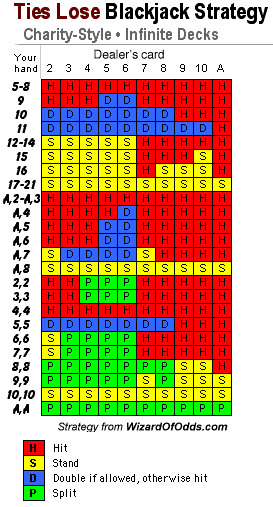
What is the basic strategy for "charity blackjack" where the dealer wins on ties?
Here it is. I assumed the dealer stands on soft 17 and double after a split is allowed. I assumed an infinite number of decks for the sake of simplicity. Any differences between this strategy and 8 or fewer decks would be very borderline. The house edge assuming infinite decks is 9.36%.
I live next to a local casino that doesn’t use 50-cent chips for the Surrender Option so I get back more than half when I place an odd-numbered bet. In particular the surrender value of a $3 bet is $2. What is the effect of this rule and what are the strategy changes, if any?
This is a great rule! Only losing one-third of your $3 bet by surrendering adds 2.25% to your expected return. You didn’t tell me the other rules but if we assume a house edge of 0.5% before the surrender rule then the player edge afterward would be 1.75%. Here are the hands you should surrender on based on a six deck game (hit or stand on soft 17 doesn’t matter).
- Player 6 against 10.
- Player 12 or 13 against dealer 9, 10, ace.
- Player 14 or 17 against dealer 8, 9, 10, or ace.
- Player 15 or 16 against dealer 7, 8, 9, 10, or ace.
The only hand you would normally split that favors surrendering is 8,8 against a 10. This advice only holds true for a $3 bet. The value of surrendering diminishes as the odd-numbered bet gets higher.
Is the Super Sevens side bet countable?
Yes! If you count sevens as -12 and all other cards as +1 then the odds on the side bet swing to the player’s advantage with a true count (running count divided by remaining decks) of 5 or greater. According to my simulations in six-deck game with no three-card guarantee and 75% penetration the true count is 5 or greater 23.2% of the time and the player advantage at these times averages 27.3%. In the game with a three-card guarantee the average advantage goes up to 29.1%.
In San Juan, Puerto Rico, at blackjack, a number of casinos do not deal the dealers "hole card" until after the players have taken their cards. I am reasonably sure that they don’t take your doubled/split bet if they get a blackjack. What changes, if any should be made to basic strategy.
Assuming you are right that they don’t take your double/split bet on a dealer blackjack then make no changes to the U.S. basic strategy.
I read about how your Ties Win Blackjack is on field trial in Laughlin, Nevada. What kind of permit is required and how much did it cost?
A new game trial period permit was required. This is opposed to a "variation" permit, which is less expensive. For a new game the cost is $3000, I had to fill out lots of forms, including an employment and residence history going back 20 years. The waiting time was six months, which was shorter than what I was expecting.
What is the advantage to a player to add one ace to and remove one 2 from a 6-deck BJ game with AC rules?
My blackjack appendix 7 can be used to approximate the answer to this question. Adding the ace would favor the player by 0.005816/24 = 0.00024. Removing a two would favor the player by 0.003875/24 = 0.000161. So the total effect would be 0.000404, or a decrease in the house edge of 0.04%.
My local casino has a rule where if the initial 2 cards, for example a pair of 4s, are split to form 2 hands and then the next card is another 4, if the player opts not to split again he will not be given the option to split should a 4 come out as the next card on the second hand of his initial split. My question is: does this rule give the house an advantage and if so, how?
No. If splitting is the right play you should do it every time, and if not never. So this rule is moot if you play properly.
A popular option in Blackjack type games here in Washington State is called "Double Down Rescue." If you double down, and don’t like your double down card you may surrender your double down portion, but receive your original bet back. As I understand your BJ Appendix 9, you should take this option if your double down results in a 0-16 versus a dealer 8 through Ace; since your expected loss by standing is greater than your -0.5 loss by rescuing? Fantastic site BTW. It should be required reading for any gambler.
Thanks for the kind words. You are right, if the expected value is less than -1 then you should opt to take the double down surrender. As you said if the expected value for standing in my blackjack appendix 9 is less than -0.5 you should surrender, because you are betting two units. I would only add to your strategy that if the dealer hits a soft 17 then you should also surrender 17 against an ace.
I am currently playing your Ties Win BJ at Harrods. I really love it. Great game. My question is about a promo Harrods is having at the moment where if I win five hands/bets in a row I win back the lowest bet in that sequence. As I flat-bet I will win back one of my bets, effectively. Should I have chosen another game to play for this promo? Roulette is excluded but all other games at Harrods are permitted. Thanks,
Thanks for playing it. Yes, Ties Win Blackjack was a good choice for this promotion. The probability of a full win is 43.314%, a half win is 8.75%, and a loss is 47.936%. So the probability of any win is 52.064%. The probability of five consecutive wins is 0.520645 = 3.825%. Flat betting this results in an extra 3.825% of return for the player. The house edge normally is 0.247%, so the player advantage under this promotion would be 3.5785%. However I find no mention of this promotion on the casino web site and given my usual 2-3 week delay to answer e-mail it is probably over.
How can I get a directory or which casinos (worldwide) offer double deck "pitch" blackjack? I have scoured the internet and even most of the casino's websites do not specify.
For Las Vegas why not use my own blackjack survey at the Wizard of Vegas. For the rest of the United States and Canada, I highly recommend Stanford Wong's Current Blackjack News. That will tell you the exact blackjack rules at almost every casino in both countries.
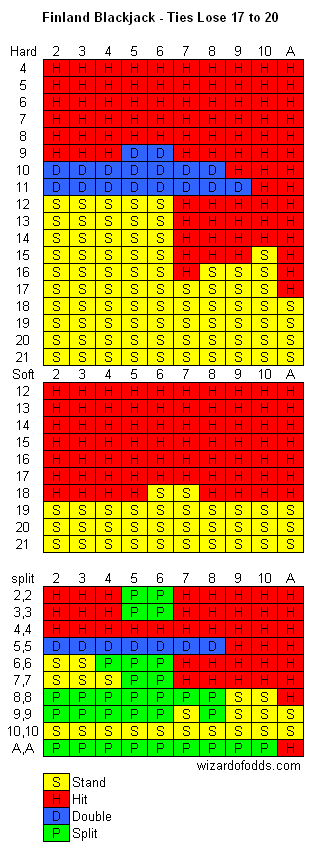
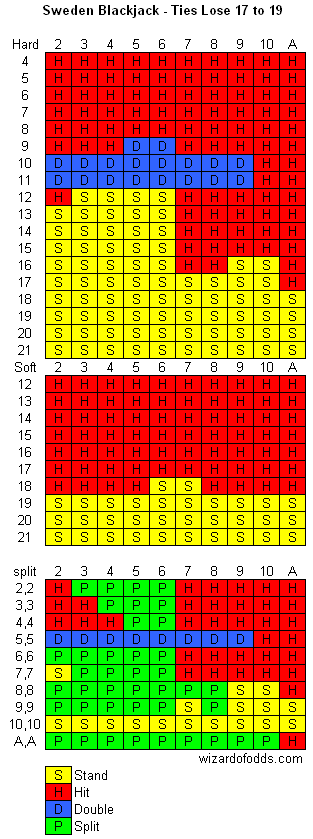
Sir! What is or where we can find the best basic strategy for Club Blackjack as played in Finland, Sweden and Baltic Ferries. 6d, NHC, DD9-11,1Spl, NDAS,dealer wins ties 17-20 (17-19 in Swd). We understand that this is a complete suckers game with house edge of nearly 9% but it is the only game in town and since we cannot win we would at least die fighting as good soldiers are expected to do. Thank You!
I’ve actually seen those rules when I went to Helsinki in 1986. I was only 20 at the time and I’m embarrassed to say I actually played the game, because I still underage in the U.S., and was still years away from becoming the Wizard. In fact it would have been the first legal game of blackjack I ever played. Meanwhile there was a single-zero roulette table right next to it.
I assume the dealer stands on soft 17 in both cases. It is my understanding that double after a split is allowed in Sweden but not Finland. Assuming that I get a house edge of 5.99% in Sweden and 8.93% in Finland. Here are the basic strategy charts.
 |  |
In a recent Ask the Wizard column, a reader wrote asking about a $2 video BJ game in North Carolina that pays $13 for a BJ and $1 for any other win. What the reader did not understand is that the payouts are NOT 13:2 for BJ and 1:2 for other wins... instead the payouts are 13 for 2 on BJ and 1 for 2 on all other wins. Like a slot or video poker machine, this machine takes your bet as soon as you hit the "Deal" button. Then, if you "win", it pays $13 for BJ or $1 for OW. In other words, the player actually loses money on any non-BJ win. Given these payouts, what is the EV for a single deck game?
And I thought the rules in Finland were bad. I’m assuming that ties lose. It wouldn’t make any sense for ties to push, which would be better than a win. So if ties lose, wins lose half, and blackjacks pay 11 to 2 the house edge would be 51%!
I deal blackjack at my church festival and I’d love to run a basic strategy scenario for our rules...
4 decks
Dealer stands on soft 17
Double on 9,10,11
Split any cards
Double after split
PLAYER LOSES PUSHES
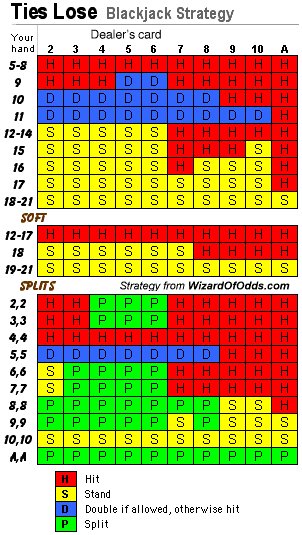
The last rule is what I call’s "God’s House Advantage" and is the one rule that obviously is not in any of the strategy generators I’ve found online. I’m convinced that the push loses rule might make hitting a 17 a basic strategy play in some cases. Best regards and keep up the great work.
Isn’t there a commandment in the bible about stealing? I show the house edge of that game is 9.3% (ouch!). Here is the appropriate basic strategy for this variation of Ties Lose Blackjack. See column #110 for the version where the player can double on soft hands.
Fantastic site — A gambling bible no less. Which would be the better rule for the player in an otherwise normal blackjack game with six decks. The first rule is the insertion of two jokers in the shoe. If the player gets a joker in his first two cards it is an automatic winner, paying even money. If a joker comes out at any other time, including to the dealer, it is burned. The second rule is a Five-Card Charlie.
Thanks. The probability of getting at least one joker in two cards dealt from a 314-card shoe is 1-(combin(312,2)/combin(314,2)) = 1.27%. So the probability is 1.27% of turning an average hand into an automatic winner. If we assume an average hand has an expected value of −0.005 then the value of the first rule is 0.0127*(1-(-0.005)) = 1.28%. You can see from my blackjack section that the five-card Charlie rule is worth 1.46%. Assuming the cards are shuffled after every hand, or you are forced to flat bet, then given the choice as a player I would pick the five-card Charlie rule. However, the joker rule would be very easy to exploit further. The greater the ratio of jokers to cards in the shoe the more you should bet. With at least 50% deck penetration, this should easily be enough to make it the better rule.
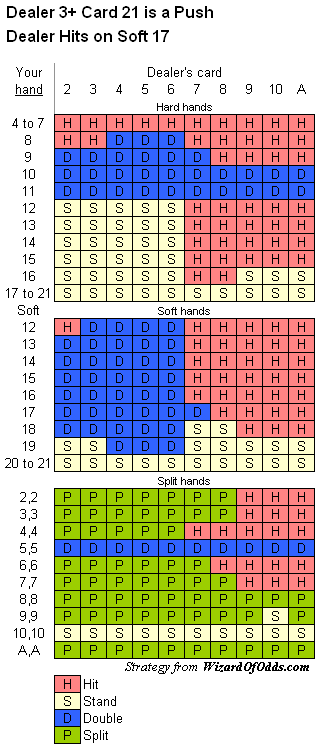
In Reno there is a new type of positive EV promotion. The dealer pushes all “dealer draw to 21s”. Dealer naturals still win. (Any strategy suggestions? Table limits are $5-$25, I always play the max. The basic game is 6-Deck H17 DAS RSA to 4 hands.
Wow! According to my calculations this results in a player advantage of 6.4%. I’m assuming that the rule applies after doubling and splitting. Here is the basic strategy for that rule.
If blackjack switch has a lower house percentage than regular black jack, why would casinos allow it?
The reason is players make more mistakes in Blackjack Switch.
Hi Wizard, always love your columns and miss those personals. I have a question about a blackjack variation. The following is the "on fire" blackjack rule from an online casino I have recently played at.
In order to be "On Fire" you must win three hands in a row. You will notice the On Fire gauge at the bottom of the game screen. When this gauge fills up, you will be on fire. Once you have accomplished this, all winning blackjack hands pay you at 2-1 odds instead of 3-2 odds, dramatically increasing your potential pay out. However, if you are on fire and you lose a hand, you lose your current on fire status and must go back and try to win three hands in a row. Pushed hands do not affect your On Fire status.
How much does this lower the house edge? Would it be +EV if you raised your stakes every time you were On Fire? Would love to hear your thoughts. The casino is jonwoodgaming.com, by the way. Thanks
My blackjack appendix 4 shows the probability of a net win, loss, and draw in blackjack are 40.59%, 42.69%, and 12.44% respectively, assuming Atlantic City rules. The probability of a win, not counting ties is 40.59%/(40.59%+46.97%) = 46.36%. The probability of three consecutive wins, skipping ties, is 0.46363 = 9.96%. Assuming six decks, blackjack paying 2 to 1 is worth an extra 0.02267. So this gives the player 0.0996*0.02267 = 0.002258. The house edge is usually higher than that, but it is a nice reduction. All this assumes you are flat betting. If you could bet more on the "on fire" hands you could destroy them with a house edge of 1.5% to 2.0%, depending on the specific rules.
Sir! There is a private game variation of blackjack played with a Spanish-style 40-card deck with no 8s, 9s & pip tens. Where can one get or what would be the basic strategies for those games? This game is played in Finland, usually played with a bottle of spirits and one’s personal knife close at hand. Thank you for your time!
First the dealer wins ties and now this. Finland has got to be the world leader for unusual and lousy blackjack rules. Here is your basic strategy.
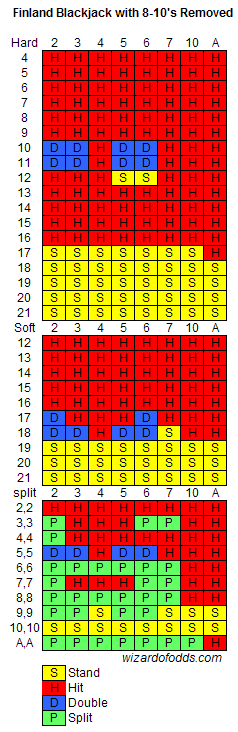
Assuming six decks, no dealer hole card, dealer stands on soft 17, no surrender, double after split allowed, and resplitting aces allowed, I get a house edge of 1.86%.
What is the exact house edge and basic strategy for Betfair’s "Zero Lounge" blackjack? Do their other games really have no house edge?
For the benefit of other readers, the blackjack rules are as follows.
- 8 decks
- Dealer stands on soft 17
- Dealer always peeks for blackjack
- Double on hard 8 to 11 only
- Double after split allowed
- Shuffle after every hand
- Aces may not be split. All other matching ranks may be split only once.
- Suited blackjack pays 2 to 1
- A 5-card 21 automatically wins and pays 2 to 1
I get a house edge of 0.02% under these rules. Following is the basic strategy.
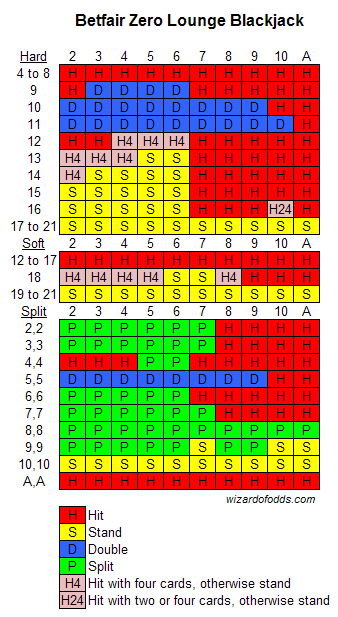
Regarding the other games, the 2.75% commission on the banker bet in baccarat results in a house edge of 0.03%. The roulette and video poker have zero house edge.
The bet limits are £5-£50 in blackjack, baccarat, and roulette, and the coinage is £1 in video poker, with a max bet of five coins.
In your column #185 there was a question about a private blackjack variation and its basic strategy. Let me kindly inform you that this kind of game can NOT be played in any public places here, it is only some kind of private game. There are only two different public variations of BJ, operated by Raha-automaattiyhdistys ("Finnish slotmachine association" in English), shortly, that can be played here.
The first one, which is played in some night clubs, "Täyspotti" — gaming halls and bars since 1982 has the lousy "dealer wins all ties except 21 and BJ" — rule as you have mentioned before. The second version is the "normal" BJ game and can be played only at the only international casino here, Grand Casino Helsinki (yes, shuffling machines are in use...).
BJ in bars etc:
- European "No hole card" rule is in use
- All cards are dealt face up
- Dealer stands on all 17’s
- Six decks, dealt from the shoe
- Player may only double on hard totals of 9 - 11
- No surrender
- Double down or split is not allowed if player places an insurange bet
- Player can split only once
- No DAS
- Dealer wins all ties except 21-21 and bj-bj
- Player can not be barred if card counting is suspected
BJ at the Casino:
- European "No hole card" rule is in use
- All cards are dealed face up
- Dealer stands on all 17’s
- Six decks
- Player may only double on hard totals of 9 - 11
- No surrender
- Perfect Pairs side bet is available (Paytable B)
- Double after split allowed
- Player can make max three hands by splitting
- Aces can be resplit
- Casino can not bar a player if card counting is suspected
Regards,
Risto H.
Editor-in-Chief rahapeliopas.fi
Thank you for this information. It is good to know there is at least one normal blackjack game in Finland.
I was reading the Blackjack entry on Wikipedia, and it said that when blackjack was not that popular, casinos added a bonus payout of 10 to 1 for the ace of spades and any black jack, hence the name. It goes on to say that the bonus was quickly removed, but the name stuck. I was wondering what the house edge was with a 10-1 payout for that hand.
In a six-deck shoe, the probability of such a blackjack is 2 × (6/312) × (12/311) = 0.001484. I’m going to assume that if the dealer has a blackjack also, then the hand is a push. That said, the probability of the dealer not getting blackjack, given that the player did, is 1 - 2 × (23/310) × (95/309) = 0.954379. So the probability of winning such a blackjack is 0.001484 × 0.954379 = 0.001416. The value of an additional 8.5 units whenever that happened is worth 8.5* 0.001416 = 1.2039%. Assuming otherwise liberal Vegas Strip rules, with a house edge of 0.28%, the player edge with the 10 to 1 rule would be 0.92%.
I recently made a trip out to Vegas, where I came upon a game called the "World’s Most Liberal Blackjack" at the Las Vegas Club. In this game you are allowed to: double down with any 2, 3 or 4 card combination, split & re-split aces as often as you choose, split & re-split any pair as often as you like, surrender your first two cards for half of your original bet and any hand with six cards automatically wins. The caveat is blackjack pays even money unless it’s suited in which case it pays 2 to 1. Is this a better game than a 3 to 2 BJ with 6 decks and the dealer standing on a soft 17? Also, in this case, would it be beneficial to double down since the BJ only pays even money?
The house edge of this game is 1.30% or 1.33%, as shown in my survey of Las Vegas blackjack rules, depending on whether the number of decks is five or eight. The odds are better in ANY game where blackjack pays 3 to 2. If you were to play this game, which you shouldn’t, you should still always stand on blackjack. Personally, I think the "World’s Most Liberal Blackjack" claim on the marquee is false advertising.
Bally Gaming has a single-deck, multi-hand, blackjack game. The player plays seven hands against a single dealer hand. There is an interesting rule in that if the game runs out of cards, all unbusted player hands automatically win. What is the probability of running out of cards? Can have suggest any strategy changes to run out the deck?
For the benefit of other readers, the full set of rules is:
- Single deck.
- Dealer stands on soft 17.
- Winning blackjack pays even money.
- Player may double any first two cards.
- No double after split.
- Player may resplit to four hands, including aces.
- No draw to split aces.
- No surrender.
- Six-card Charlie (player unbusted six cards automatically wins).
- Cards shuffled after every hand.
- If game runs out of cards, all unbusted player hands automatically win.
The house edge using total-dependent basic strategy is 2.13%. I ran a 7-player simulation, using total-dependent basic strategy, and the average number of cards used per round was 21.65, with a standard deviation of 2.72. In almost 190 million rounds played, the most cards ever used was 42, which happened 7 times.
It is my educated opinion that even with computer perfect composition-dependent strategy the player would still realistically never see the last card. You could cut down the house edge much more using composition-dependent strategy, according to all the cards seen as you go along. However bucking 2.13% house edge to start with, you’ll never get anywhere near break-even, regardless of how hard you try.
Here in Pennsylvania we have blackjack games, made by Shufflemaster, where the players use terminals to play against a video screen of a dealer. Technically, only "slots" are legal in Pennsylvania. I heard that the game was "retrofitted" to fit the definition of a slot. What does that mean? If this is just a glorified slot machine, do I really have any control over my fate?
Yes, you do. I’m told by Shufflemaster that to meet the definition of a slot machine, one player’s actions can not affect the other players, as is the case in live blackjack. To get around this law, each player and the dealer are dealt cards from a unique six-deck shoe. So, you are in control of your own fate, but not that of the other players or the dealer. I understand that the game is programmed with six-deck shoes. According to my simulations, using separate shoes for the player and dealer adds 0.06% to the house edge.
Recently casinos have started an option for the player called "Automatic Win," which means if the player has 20, and the dealer has a 10 showing, the player could win half of his wager right away, without taking the chance of the dealer having a 20 or pulling a 21 somehow. The person who came up with this says that it happens more than half of the time that the player’s 20 will either be a push or lose. I don’t know if I can agree with his math, please let me know, thank you! P.S. Keep up the good work!
That is not true about pushing or losing more than half the time. From my blackjack appendix 2 you can see that when the dealer has a 20 the possible outcomes are as follows, after the dealer peeks for blackjack, and based on six decks.
Dealer gets 17-19 or busts: 59.4%
Dealer gets 20: 36.8%
Dealer gets 21: 3.8%
So, the player will push or lose only 40.6% of the time. The value of a 20 against a dealer 10 is prob(win)-prob(loss) = 59.4% - 3.8% = 55.6%. That is more than the 50% you get by invoking the automatic half win, so you should decline the option. I address this option in my blackjack appendix 8, under the title casino surrender.
For the same reason, you should also decline “even money” when you have a blackjack against a dealer ace. In both cases two birds in the bush ARE worth more than a bird in hand.
Most to all of our casinos here in OK require a blackjack player to ante $0.50 every hand. Obviously, this gives the house a huge (probably insurmountable) edge. The rules they play by are generally hit on 16, stand on soft 17, blackjack pays 3-2, no surrender, double after split. What effect does this have on house edge and is the only way to reduce that edge to increase your bet? I was estimating 10% (because you’re really betting $5.50 to only win $5). Is the math really that simple?
If you are wagering $5, not including the 50-cent fee, that increases the house edge by 9.09%! The general formula for the increase is c/(b+c), where b=bet, and c=commission. Assuming 60 hands an hour, the commission will cost you $30 an hour (ouch!).
For the benefit of other readers, the Oklahoma casinos are much like those in the Los Angeles area, where players take turns banking. If you can afford the risk of paying off all other wagers at the table, then by all means, do so. When it isn’t your turn to bank, don’t bet.
A local casino has a "special" blackjack table at which one can advance reserve the table for $20 for an hour of play. The table is a $5 minimum with standard blackjack rules except the house hits a soft 17. How lousy of a game is this, taking into account the nonrefundable reservation fee?
If we assume 70 hands per hour, a house edge of 0.64%, and a $5 bet, the cost of playing before the fee would be $5 × 70 × 0.0064 = $2.24. That $20 fee is pretty high in comparison. Considering you would bet $350 per hour, the total expected loss would be $22.24, for a house edge of $22.24/$350 = 6.35% (ouch!).
I was playing 6-5 blackjack at a Strip casino a while back and had consumed just enough free booze that I doubled every time I got a blackjack against a dealer 2-6. Fortunately, I won every time. But, I wonder how bad my decision was. Would it make sense if blackjack paid even money?
My blackjack appendix 9 is useful to answer questions like this. For example, assuming six decks and the dealer hits a soft 17, the expected value of doubling on a blackjack against a dealer 5 is 0.622136 and against a 6 is 0.667063. Both are much less than 1.2, costing over half a bet. Even if a blackjack only pays even money, as is unfortunately sometimes the case now, you should stand on the blackjack. The only game where you should not stand on a blackjack is in Triple Up 21, where the player should triple on a blackjack against a dealer 6.
This question was raised and discussed in the forum of my companion site Wizard of Vegas.
At the Bighorn and Longhorn in Las Vegas, they allow doubling on three cards in blackjack. Are there any strategy changes I should make under this rule?
A reader of my Wizard of Vegas site says the following changes should be made, relative to the standard multi-deck strategy where the dealer hits a soft 17:
- Hit soft 13 vs. 5 or 6
- Hit 2-card soft 15 vs. 4
- Hit 3,3 vs. 2
The reason for hitting the soft hands is you might get a better soft double after the hit. The value of hitting the threes is higher under this rule, because getting an ace would be a good 3-card double.
This question was raised and discussed in the forum of my companion site Wizard of Vegas.
Are there any surveys or numbers out there that detail what percentage of blackjack games in Las Vegas are 6-5 or any other "carnival" type variation?
According to the September 2010 Current Blackjack Newsletter, there were 2099 blackjack tables in Las Vegas. The following table shows how many were the biggest four variations.
Blackjack Variants in Las Vegas
| Game | Tables | Percent |
| 6 to 5 | 467 | 22.2% |
| Blackjack Switch | 42 | 2.0% |
| Super Fun 21 | 41 | 2.0% |
| Spanish 21 | 6 | 0.3% |
| Total | 556 | 26.5% |
This question was raised and discussed in the forum of my companion site Wizard of Vegas.
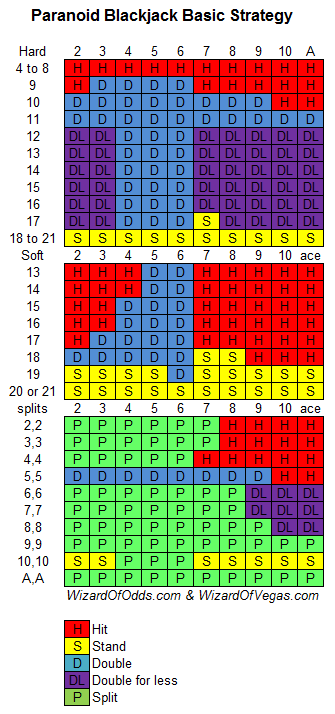
I heard of a casino where if the dealer busts then he assumes all players left standing won. The game is dealt face up, except double down cards are dealt face down. So if the double down card caused the player to bust, but the dealer also busted, then the player would win. The casino does this because it is paranoid about card counters, and doesn’t want players to see cards they think are irrelevant. What would be the correct basic strategy under this rule, and the house edge?
I’m going to assume six decks, dealer hits a soft 17, double after split, surrender, and re-splitting aces. If double for less is not allowed then I get a player edge of 4.9%. Here is that correct strategy. Obviously, this strategy may set off some red flags.
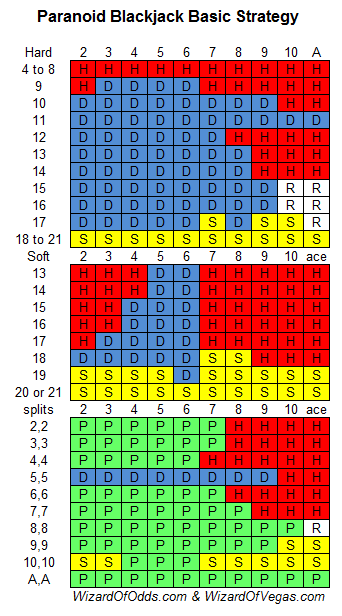
If double for less is allowed, then I get a maximum player edge of 9.4% with the following strategy. When doubling for less, bet as little extra as possible, preferably just one penny. My 9.4% figure assumes a tiny double down wager. In reality, most casinos require doubling with at least the table minimum.
This question was raised and discussed in the forum of my companion site Wizard of Vegas.