





On this page
’Wizard Way’ for Pai Gow
Introduction
The following is the "Wizard Way" for pai gow. Following this strategy will lower the house edge by 0.56% when the player is not banking, and by 0.51% when banking, compared to the house way and assuming a 5% commission. This strategy will cover 73% of the gap in house edge between the house way and optimal. The following table provides more details.
I also have a printer friendly version of the strategy on this page.
Pai Gow House Edge
| Your Strategy |
Opponent Strategy |
Banking? | Commission | Prob. Win |
Prob. Loss |
Prob. Push |
House Edge |
|---|---|---|---|---|---|---|---|
| House Way | House Way | No | 5% | 29.21% | 30.18% | 40.61% | 2.44% |
| House Way | House Way | Yes | 5% | 30.18% | 29.21% | 40.61% | 0.53% |
| House Way | House Way | No | 4.76% | 29.21% | 30.18% | 40.61% | 2.37% |
| House Way | House Way | Yes | 4.76% | 30.18% | 29.21% | 40.61% | 0.46% |
| Wizard Way | House Way | No | 5% | 29.07% | 29.5% | 41.43% | 1.88% |
| Wizard Way | House Way | Yes | 5% | 30.03% | 28.55% | 41.42% | 0.02% |
| Wizard Way | House Way | No | 4.76% | 29.07% | 29.5% | 41.43% | 1.81% |
| Wizard Way | House Way | Yes | 4.76% | 30.03% | 28.55% | 41.42% | -0.05% |
| Optimal | House Way | No | 5% | 29.27% | 29.48% | 41.26% | 1.67% |
| Optimal | House Way | Yes | 5% | 30.17% | 28.46% | 41.37% | -0.2% |
| Optimal | House Way | No | 4.76% | 29.27% | 29.48% | 41.26% | 1.6% |
| Optimal | House Way | Yes | 4.76% | 30.17% | 28.46% | 41.37% | -0.27% |
In other words, this strategy is a substantial improvement over the house way. To use the strategy, use the first rule that applies.
If one setting results in an equal or higher high and low hand than all alternatives, then play it. For example, with 6-6, 6-6, 1-2, and 1-3, playing 7/teen pair is the obvious best play. This supersedes the rule to split a 6-6 pair to make 6/8 or better.
Note that splitting a 6 pair is the only difference with the Foxwoods house way.
If a pair is not possible, or declined by rule 2, the you will score the maximum number of points between both pairs of tiles as follows. Pairs of 0 to 9 count according the number of points. A gong shall count as 10 points, and a wong as 11 points. For example, 6-6, 4-4, 3-6, 2-3 could be arranged as 4/gong (4+10=14 points), 3/wong (3+11=14 points), or 7/7 (7+7=14 points). It is thus a 14-point hand.
After scoring the hand, look up the highest way to play it according to the number of points. The highest play listed is the one you should play. For example, of the three possible plays in the 14-point hand above, 7-7 is listed highest, and is thus what you should play.
When given the choice whether to play the 1-1 or 6-6 tile in a wong, gong, or high 9, play the 6-6.
- Obvious Rule
- Pair
- Gee joon pair: Split only with 6-6, 6-5, or 6-4.
- 2,12 pair: Split to make 6/8 or better, or with 9 and 11.
- 6 pair: With any combination of 2, 11, and 12 tiles.
- 7 pair: With any combination of 2, 10, 11, or 12 tiles.
- 8 pair: With any combination of 2, 10, 11, or 12 tiles. Also split with 9 and 11.
- 9 pair: With any combination of 2, 10, and 12 tiles.
- No Pair
1. 7/low 8 gong
2. 6/wong
3. 8/high 9
4. 7/high 8 gong
5. 8/91. 7/high 9
2. 6/low 8 gong
3. 7/9
4. 6/high 8 gong
5. 8/8
6. 5/wong1. 6/high 9
2. 5/low 8 gong
3. 7/8
4. 4/wong
5. 6/9
6. 5/high 8 gong1. 5/high 9
2. 4/low 8 gong
3. 7/7
4. 3/wong
5. 4/high 8 gong
6. 6/8
7. 5/91. 2/wong
2. 6/7
3. 3/low 8 gong
4. 4/high 9
5. 3/high 8 gong
6. 5/8
7. 4/91. 1/wong
2. 2/gong
3. 6/6
4. 5/7
5. 3/9
6. 4/81. 0/wong
2. 1/gong
3. 2/high 9
4. 5/6
5. 2/9
6. 4/7
7. 3/81. 0/gong
3. 1/9
4. 5/5
5. 2/8
6. 3/7
7. 4/61. 0/9
2. 1/8
3. 2/7
4. 4/5
5. 3/61. 0/8
2. 1/7
3. 4/4
4. 2/6
5. 3/5Maximize the low pair.
- 20 Points or More: Maximize high hand
- 18, 19 Points: Maximize low hand
- 17 Points:
- 16 Points:
- 15 Points:
- 14 Points:
- 13 Points:
- 12 Points:
- 11 Points:
- 10 Points:
- 9 Points:
- 8 Points:
- 7 Points:
- With 7-point hands, do not play highest two ranking tiles in the same hand.
1. 0/7
2. 3/4
3. 2/5
4. 1/6 - 6 Points or Less:
Graphic Version
The following strategy is taken from a combinations of the strategies on this site, but mostly the Wizard Way.
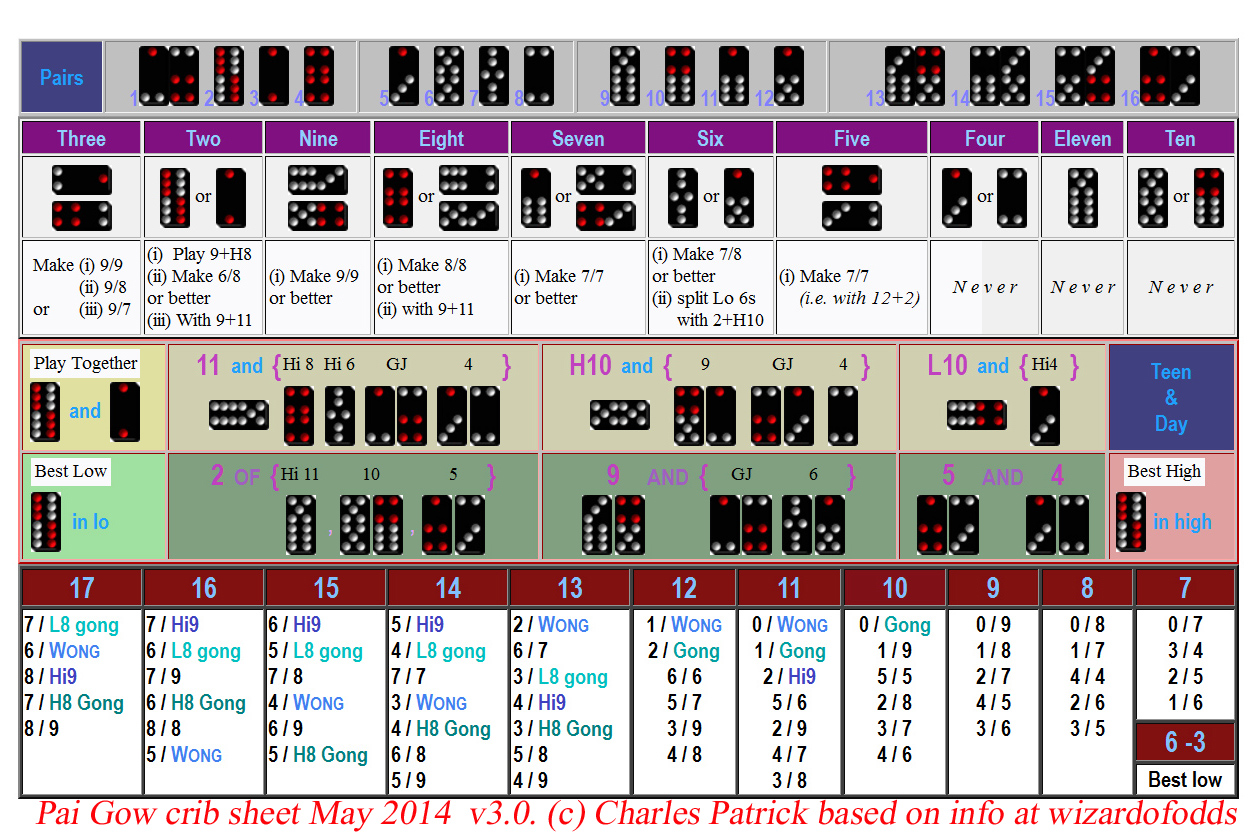
For a graphic version, click the image above for a larger version. I also have a PDF version (149K).
Since I created this strategy in 2007, I commissioned the JB strategy, which is easier to use.