Wiz, You are the man! You have far and away the best gambling site on the 'net. Being an
actuary myself (ACAS), I love to see someone putting their math skills to good use.
My question — When late surrender is allowed, do you still want to split eights with a ten showing? I'm guessing yes, but one of the hardest plays in BJ is splitting eights vs a ten.
As a side note, I just spent three days in Vegas, if you haven't done so already, you must try the Las Vegas Club and the World's Most Liberal blackjack Rules. Doubling is allowed on 3 or 4 cards, 6 cards <= 21 is an automatic winner, and late surrender. At six decks, I figured the house advantage to be 0.14%. Thanks for all of your hard work!!
Jim from Bloomington, US
Thanks for the kind words, Jim. Yes, you still want to split eights, even if late surrender is offered. Even if you can't double after a split you should still decline to surrender. Based on a two-deck game, where you can not double after splitting, the expected value of splitting 8,s against a 10 is -0.480673, better than the -0.5 by surrendering.
Contrary to their claim of having the "World's Most Liberal Blackjack Rules" there are better single-deck games right across the street at the Horseshoe or the Golden Gate. It is the six decks at the Las Vegas Club which work against the player. Don't feel badly about falling for their marquee, I fell for it myself in my younger days before I knew the effects of rule variations.
Update: After this question, the Las Vegas Club changed their rules to pay 6 to 5 on a blackjack in their so-called "World's Most Liberal Blackjack Rules." The 6 to 5 does not even make it a legitimate blackjack game. You are much better off at any ordinary 3-2 game, which are easy to find elsewhere.
Here in Natchez we have a river boat casino that allows the
Royal Match (version 1) with blackjack, using six decks. They also have an added bonus that if the player and dealer both get a royal match on the same hand, then the player is paid an additional $1,000. How does this affect the house edge?
Robert from Natchez, Mississippi
This $1000 bonus lowers the house edge from 6.67% to 6.00%, assuming a $1 bet.
First off, great web site! I love it! In Reno I saw a game with the following rules: six decks, dealer hits soft 17, double after a split, re-split anything except aces, and the player could double on any number of cards. For example, the player could draw to a four-card total of 11 and then double. What is the house edge on this game?
Andrew from Solovay
You didn't state the surrender rule, so I'll assume it isn't allowed. According to my
blackjack house edge calculator, and before considering the double any number of cards rule, the house edge is 0.64%. According to my list of
rule variations, being allowed to double on any number of cards (a rule commonly found in Panama) is worth 0.23%. So, the house edge over the overall game is 0.64% - 0.23% = 0.41%.
Can blackjack be beaten under the following casino conditions:
- The game is dealt face up from an 8 deck shoe, with the cut card appearing after 5 decks have been dealt (3 decks behind the cut).
- Dealer stands on soft 17.
- No surrender.
- Can double down on any 2 card total without an ace.
- Can split aces once only, one card on each.
- Can split any other pair to a maximum of 3 hands.
- Can double after split.
- Dealer takes original bets only on blackjack.
- Can take even money on blackjack when dealer’s upcard is an ace.
- Table max is 50 times table min.
- Card counting is permitted if the counter plays the first hand of the shoe, and plays every hand. Counter can play any number of boxes, and any bet amount. Counter can stop at any time, but cannot rejoin a shoe after missing a hand, or join a shoe that is partway through.
Alex from Auckland, New Zealand
I haven't done any simulations, but my educated option is a definite yes, this game can be beaten. The strategy to use in this game would be to bet the minimum when the odds are against you and the maximum when they are in your favor. Normally a sudden 50 times increase in bet size would set off a huge red flag but it seems the counter could do this with impunity in your game. When Atlantic City first opened the casinos could not ask card counters to leave and entire tables were filled with people jumping suddenly from a $5 bet to $300, or whatever the minimums and maximums were. After taking a huge beating, the Atlantic City casinos begged the gaming authorities for a change in the rules, which they got. Not only could this be beaten, but I think it would be a card counters dream.
Do you have basic strategy for the following rules? Dealer takes 17-17, 18-18 and 19-19 ties, doubling after split is allowed, 3 resplits, no-peek, player can double 7-11 totals (soft and hard), dealer stands on soft 17, six decks.
Jari from Turku, Finland
Stanford Wong's
Blackjack Count Analyzer is perfect for questions like this. Just plug in the rules and it produces an immediately basic strategy and is ready to run a simulation. Following is his basis strategy under these rules. I did a 31-million hand simulation using Blackjack Count Analyzer, which shows a house edge of 4.13%, under these rules. When I was in Finland they had single zero roulette, which has a much lower house edge than this game. Why the blackjack rules are so stingy in Finland I would like to know.
PLR DEALER PLR DEALER
23456789XA 23456789XA
21 ---------- soft 21 ----------
20 ---------- soft 20 ----------
19 ---------- soft 19 ----------
18 ---------- soft 18 +DDDd-++++
17 ---------+ soft 17 +++DD+++++
16 -----++--+ soft 16 +++DD+++++
15 -----+++++ soft 15 +++DD+++++
14 -----+++++ soft 14 ++++D+++++
13 -----+++++ soft 13 ++++++++++
12 +----+++++
11 DDDDDDDD++ pair A /////////+
10 DDDDDDDD++ pair 10 ----------
 9 ++DDD+++++ pair 9 /////-/---
 8 ++++++++++ pair 8 ///////--+
 7 ++++++++++ pair 7 -////+++++
 6 ++++++++++ pair 6 /////+++++
 5 ++++++++++ pair 5 DDDDDDDD++
 4 ++++++++++ pair 4 +++//+++++
              pair 3 +////+++++
              pair 2 +////+++++
Insurance: No

+ = hit
- = stand
D = Double if allowed otherwise hit
d = Double if allowed otherwise stand, / = split.
I was visiting an Indian casino the other day where the blackjack minimum bet was $2, but for each bet, they asked for an additional 25 cents (they did this by giving you 4 special 25 cent chips for each dollar chip you had) so essentially, you bet $2.25 to win back $2. While I was still able to walk away with a bit of a profit, I was wondering if there was a quick and easy way to calculate just how much of a house edge this "commission" gave them? I know that compared to dealer hitting on soft 17, it's gotta be a killer.
SM
The total house edge is [fee + (house edge)*(bet)]/[fee + bet]. Let's say the house edge is 0.8%. Then the house edge including the fee would be [$0.25 + $2.00*0.008][$0.25 + $2.00] = 11.82%.
However, a quick and easy estimate is to simply divide the fee by the bet as the increase in house edge due to the fee.
Your web site is awesome! I enjoy your advice and am amazed at the simple way you explain things about gaming in a way I can understand. My question is this -- while playing a benefit blackjack game where they have from what I could tell, all the "Vegas" rules, I found out they were paying two to one for a blackjack. This seems like a big benefit to the player; just how big is it? (this is no joke or prank, I actually played at the table where they were doing this!)
Bob from Canton, Ohio
Thanks for the compliment. If I had been at this game I would have played it hard. Assuming six-decks and otherwise Vegas rules, the player edge would have been 1.94%. The 2 to 1 on blackjack adds 2.37% to the player's expected return in a six-deck game.
The Flamingo is offering a single deck blackjack game with regular downtown rules (hs17). The only difference is that they altered the natural payoff to 6 to 5 instead on the normal 3 to 2. My questions are; How does that affect the starting advantage on this game? What would it be? How would it affect the insurance wager? Specifically what would Insurance have to pay in order for the player to get "even money" and be square to the 6 to 5 payoff?
DW from Las Vegas, USA
Using my good ol'
blackjack house edge calculator normal downtown rules result in a house edge of 0.1896%. In single deck the probability of a player blackjack and no dealer blackjack is 2*(16/52)*(4/51)*(1-2*(15/50)*(3/49))= 0.046492. Reducing the BJ win from 1.5 to 1.2 results in increasing the house edge by 0.046492*(1.5-1.2)= 1.3948%. So the house edge of this game would be 1.3948%+0.1896%=1.5844% (ouch!). For insurance to result in even money, it would have to pay 5-1 but the player could only bet 20% of the original bet on it.
How is the house advantage affected by "free Ace" coupons (promotional tools) used with a continuous shuffler?
anonymous
I have been asked this enough time to add a section about it. The short answer is that the coupon is worth just over half of its face value. Visit my
blackjack appendix 14 for all the details.
I have a coupon from LVA #115 Free Blackjack Insurance up to $25.00 at Slots of Fun. What’s its value?
anonymous
I have that coupon too, and am running out of time to use it. Let’s assume a single deck game. The probability the dealer has blackjack with an ace showing is 16/51 = 31.37%. So if you bet $50 the value of this coupon is (16/51)*$50 = $14.71. However I estimate you will lose $1.23 due to the house edge waiting for the opportunity to use it. So the coupon itself is worth $14.71 - $1.23 = $13.48.
The Hollywood casino in Tunica started offering a FREE progressive side bet on two $5 tables. The rules are six decks and dealer hits a soft 17, all other rules are standard. They swear there are no rule changes to the game (Dealer hits, DAS, 4 splits, 6 decks). Suited sevens of diamonds gets the progressive, which starts at $1,000. All other triple sevens pay $50. So how high would the progressive need to be to get to breakeven?
anonymous
The probability of three seven of diamonds is
combin(6,3)/combin(312,3) = 0.00000398937. The probability of three unsuited sevens is (combin(24,3)-combin(6,3))/combin(312,3) = 0.000399735. According to my
blackjack calculator the house edge is 0.6233%. The expected loss on a $5 bet would be 3.12 cents. Just the value of the $50 for three unsuited sevens is $50*0.000399735=2.00 cents. To make up the other 1.12 cents the meter would need to reach $2802.
What changes should one make to blackjack basic strategy when playing just a single hand when the objective is to maximize the chance of winning that hand (for example when using a match play coupon)?
anonymous
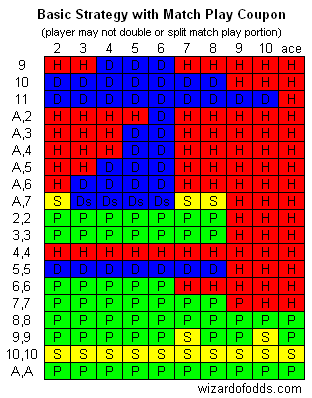
It depends if the player is allowed to double and split the match play portion of the bet. Usually the player is not allowed to, which works against the player. The following chart shows how to adjust your double and splitting strategy, assuming the player may not double the match play and if the player splits the match play rides on the first hand played, based on infinite decks and the dealer standing on soft 17. The hit/stand strategy is the same.
Great site! I would call it the best among all the gambling sites I have seen on the web. A question about surrender in blackjack. Some casinos (for example Foxwoods) give
match play coupons for blackjack. One good thing about the coupon is that when you surrender, you only lose half of your own money, and are allowed to keep the whole coupon. (But you lose your coupon no matter you win or lose.) I guess you want to surrender more in this situation, but was wondering what is the correct strategy? Thanks!
Austin from Cambridge, MA
Thanks. You should be doing a lot of surrendering if you can keep the match play. My blackjack appendix 9 is good for questions such as this. A match play is worth just about half of face value. So if the expected value of the hand is less than -1/3 you should surrender. Assuming the dealer hits a soft 17 here are those times.
- Player 6 vs. 10-A
- Player 12 vs. 9-A
- Player 13 vs. 8-A
- Player 14 vs. 8-A
- Player 15 vs. 7-A
- Player 16 vs. 7-A
- Player 17 vs. 8-A
- Player 8,8 vs. 9-A
The strategy is the same if the dealer stands on a soft 17, except the player will not surrender 6 against an ace.
A local casino had a promotion on their over/under 13 side bet in blackjack. If your first two cards are suited you receive a $5 "action chip." If your first two cards and the dealer’s up card are suited you receive a $10 action chip. The action chips are good for one bet only, the player keeps any winnings but always loses the action chips. The minimum bet is $10. Six decks of cards are used. What is the house edge on the over/under 13 bet?
John from Shakopee, NM
Before considering the bonuses, the house edge is lower on the over bet at 6.55%, as I show in my
blackjack appendix 8. The probability of three suited cards is 4×combin(78,3)/combin(312,3) = 4×76076/5013320 = 0.060699. The probability the player’s two cards are suited, but the dealer’s card is not, is (4×combin(78,2)×234)/(combin(312,2)×310) = 2810808/15039960 = 0.186889. Let’s assume the action chips are worth 49.5% of face value. Then the bonuses are worth 0.495×(0.060699×$10 + 0.186889×$5) = $0.76301. The expected loss on the over bet is $10×0.0655 = $0.655. So each $10 over 13 bet is worth $0.76301 - $0.655 = 10.8 cents. The overall player advantage is 1.08% on a $10 over 13 bet.
I'd like your advice on a blackjack coupon. As I understand the rules, the coupon doubles any win, up to $25, and can be presented any time. If I bet $16.50, and wait for a blackjack to use it, the coupon will double the blackjack win of $24.75. Or should I bet $25, and use it on the first win of any kind? What is the expected loss both ways? Please assume a house edge of 0.64%.
Jim from Dallas, Texas
First let's calculate the expected loss if you bet $16.50, and wait until a winning blackjack to use the coupon. The probability of a player blackjack is the number of aces × number of tens / combinations of ways to choose two cards out of the 312 in the shoe. That comes to 24×96/
combin(312,2) = 0.0474895. If both of you have a blackjack, the coupon does you no good. Assuming the player has a blackjack, the probability of a dealer blackjack is 23 × 95 / combin(310,2) = 0.045621. So, the probability of the player having a winning blackjack is 0.0474895 * (1-0.045621) = 0.045323, or once in 22.06 hands. So, your way of playing 22.06 hands at $16.50 each would have an expected loss of 22.06 × $16.50 × .0064=$2.33.
Next, let’s calculate the expected loss if you bet $25, and wait until the first win to use the coupon. The probability of any win is 42.42%, as found in my blackjack appendix 4. This is not exactly the applicable statistic for this situation, due to complications in splitting, but close enough. So, the expected number of hands to play to have a winning hand is 1/0.4242 = 2.36. The expected loss of betting 2.36 hands of $25 each is 2.36 × $25 × .0064=$0.38, which has a cost 84% less than waiting for a blackjack.
There is a “Bad — It’s the New Good” promotion running in the high-limit room at the
Barona casino. If the dealer in blackjack gets a 7-card 21, then all players actively wagering at the table will get $500. Also, if the dealer gets an 8-card 21, then all players at the table will split a progressive jackpot, which starts at $25,000, plus players at the other high-limit tables will each get $500. What is the probability of these events, and what is the value per hand to the player?
Larry from Las Vegas, NV
The following table shows the probability of a dealer 21-point hand according to the number of cards and number of decks.
Probability of Dealer 21-Point Hand
| Cards |
1 Deck |
2 Decks |
6 Decks |
| 2 |
0.0482655 |
0.0477969 |
0.0474895 |
| 3 |
0.0537557 |
0.0530246 |
0.0525656 |
| 4 |
0.0184049 |
0.0184945 |
0.0185388 |
| 5 |
0.00310576 |
0.00326001 |
0.00335881 |
| 6 |
0.000291717 |
0.000344559 |
0.000380387 |
| 7 |
0.0000160093 |
0.0000234897 |
0.000029251 |
| 8 |
0.000000456411 |
0.000000997325 |
0.00000152356 |
| 9 |
0.00000000466991 |
0.0000000239012 |
0.0000000526866 |
| 10 |
0.0000000000064214 |
0.000000000262229 |
0.00000000115152 |
| 11 |
0 |
0.0000000000009179 |
0.0000000000148827 |
| 12 |
0 |
0 |
0.0000000000001003 |
| 13 |
0 |
0 |
0.0000000000000003 |
The next table shows the value in cents of the three prizes. The row for the 7-card prize is the value per hand of the $500 bonus for a dealer 7-card 21. The row for the 8-card prize is the value per hand of a $25,000 prize for a dealer 8-card 21. That should be multiplied by the ratio of the current jackpot to $25,000, for the value at any given moment. The row for the envy prize is the value per hand dealt at all other tables in the room of the $500 prizes for the jackpot hitting at another table.
Value of Prizes per Hand Dealt
| Prize |
1 Deck |
2 Decks |
6 Decks |
| 7-card $500 win |
0.80¢ |
1.17¢ |
1.46¢ |
| 8-card $25,000 win |
1.14¢ |
2.49¢ |
3.81¢ |
| 8-card $500 envy bonus |
0.02¢ |
0.05¢ |
0.08¢ |
Assuming a total of 8 active tables in the room, and 60 rounds per hour, and a $25,000 jackpot, the value of this promotion is $1.26 per hour at a single-deck table, $2.41 at double-deck, and $3.48 at six-deck.
Recently, the Tuscany casino ran a promotion where if you got 30 blackjacks in a 30-day period, you would win a $100 bonus. At first, the minimum bet was $5 to get your card stamped. However, I later heard the minimum for a stamp was raised to $15. I wrote a letter of complaint about it to the casino manager, stating in part:
I just wanted to express my disappointment in this change, if it is true. I never had a chance to take advantage of the promotion and doubt I will be able to now. The amount of time necessary to receive 30 blackjacks (I’m told about 8 hours of continuous play) seems unreasonable at $15/hand when the promotion still offers only $100.
Here is the reply I received:
In response to your e-mail on the blackjack blackout promotion, I’m not sure where you received your information on how long it takes to complete the blackout card. We’ve seen players complete the card in less than four hours. Also, you have thirty days in which to complete the card. I hope you understand this is not a task that is unreachable with that much time. I THANK YOU for your letter. It’s good to hear feedback from our customers. Hope you can give it a try and win some money!
What is the probability of getting 30 blackjacks in four hours?
nyuhoosier
According to my
game comparison, blackjack players play about 70 hands per hour. The probability of a blackjack in a six-deck game is 24*96/combin(312,2)=4.75%. I assume a blackjack tie still gets a stamp. So it should take about 30/0.0475=632 hands to fill the card, or 9.02 hours.
The probability of filling the card in 4 hours, assuming 280 hands, is 1 in 30,000 playing one hand at a time. I suspect any player achieving the goal in four hours was playing at least two hands at a time.
This question was raised and discussed in the forum of my companion site Wizard of Vegas.
A local Connecticut casino is having a one-day promotion, in the middle of July, where the player can triple down in Blackjack. What would be the appropriate basic strategy and house edge?
zeppelin
I know about it. The Mohegan Sun is running a "triple down" promotion for 24 hours, starting at 6:00 AM on July 15. It is valid on all blackjack and Spanish 21 tables, and the maximum additional wager is $500. Information can be found on both the Mohegan Sun’s
promotions page. The
newsroom used to have the following statement, but it was removed:
Showing an eleven and looking to double down? On Thursday, July 15th, guests who play Spanish 21 or Blackjack will be eligible to triple down on their bet f.rom 6:00am on July 15th to 5:59am on July 16th. After a player receives their first two cards, they may make an additional wager up to triple the amount of the original wager. All tables will make tripling down available up to a $500.00 maximum bet. Standard double down rules apply.
The removed content indicates that the player may quadruple down, because the total wager would be four times as much as the initial wager. Maybe it was removed because it was a misprint.
I’m told in blackjack they use six decks, stand on a soft 17, allow surrender and double after a split, but don’t allow re-splitting aces. Normally the house edge under those rules would be 0.36%. I’m not sure if the player will be allowed to triple/quadruple after a split. Here is the player edge under various sets of rules:
- Player may triple down on first two cards, double down after split: 1.39%
- Player may triple down on first two cards, triple down after split: 1.59%
- Player may quadruple down on first two cards, double down after split: 3.20%
- Player may quadruple down on first two cards, quadruple down after split: 3.62%
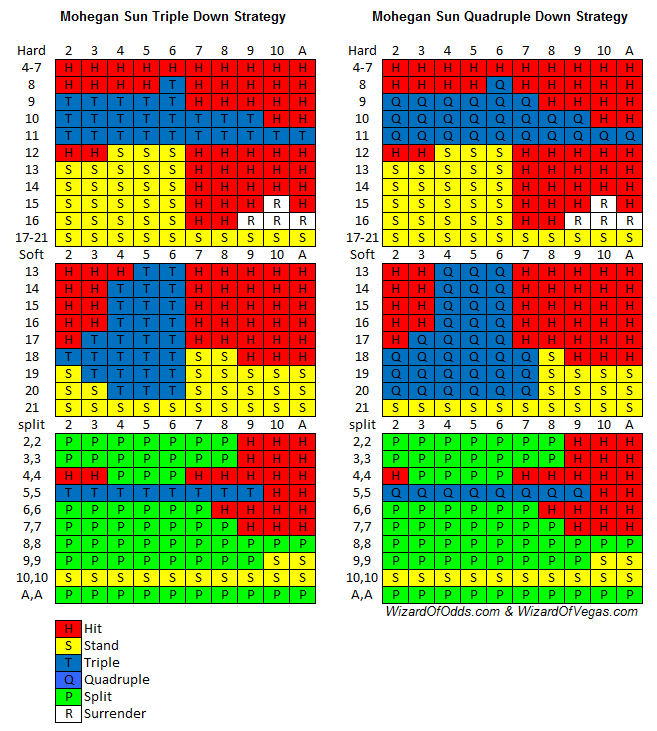
Following are strategies for triple and quadruple down, assuming each is allowed after a split. If the player may only double after a split, then the player should following the
conventional splitting strategy, except if the player can quadruple down, but only double after a split, then the player should quadruple on 4,4 vs. 6.
This question was raised and discussed in the forum of my companion site
Wizard of Vegas.
For your information, the Alamo casino changed their blackjack game from one deck to four. Given this rule change, who now has the most liberal blackjack rules in Vegas?
Greasyjohn
Thank you for that information. I just updated my
blackjack survey to reflect that rule change.
You're right that with this change the Alamo no longer has the honor of having the most liberal blackjack in Las Vegas. That honor now belongs to the single-deck game at the
El Cortez. There are still a few legitimate (meaning paying 3-2 on a blackjack) games in Vegas, but the El Cortez is the only one that allows doubling on any two first cards. The other properties follow the northern Nevada rule of restricting doubling to totals of 10 and 11. The full El Cortez single-deck rules are:
- Single deck.
- Blackjack pays 3-2.
- Dealer hits soft 17.
- Double on any first two cards.
- No double after split.
- No surrender.
- No re-splitting aces.
- No cut card.
Assigning a house edge depends on specifically the dealer's behavior in deciding when to shuffle. The cut-card effect is important in a single-deck game, lowering the house edge by 0.11% if there is isn't one.
It is my understanding the dealer's shuffle after a certain number of rounds, according to the number of players at the table. Usually, the single-deck game at the El Cortez has at least four players, which equates to the dealer shuffling after two rounds. As long as the dealer deals exactly x rounds per deck, that is good for the player. Given this policy, and the usual crowded table, I put the "realistic" house edge at 0.19%, which is what the basic strategy player can expect.
So, congratulations and kudos to the El Cortez for the new best blackjack game in Vegas!
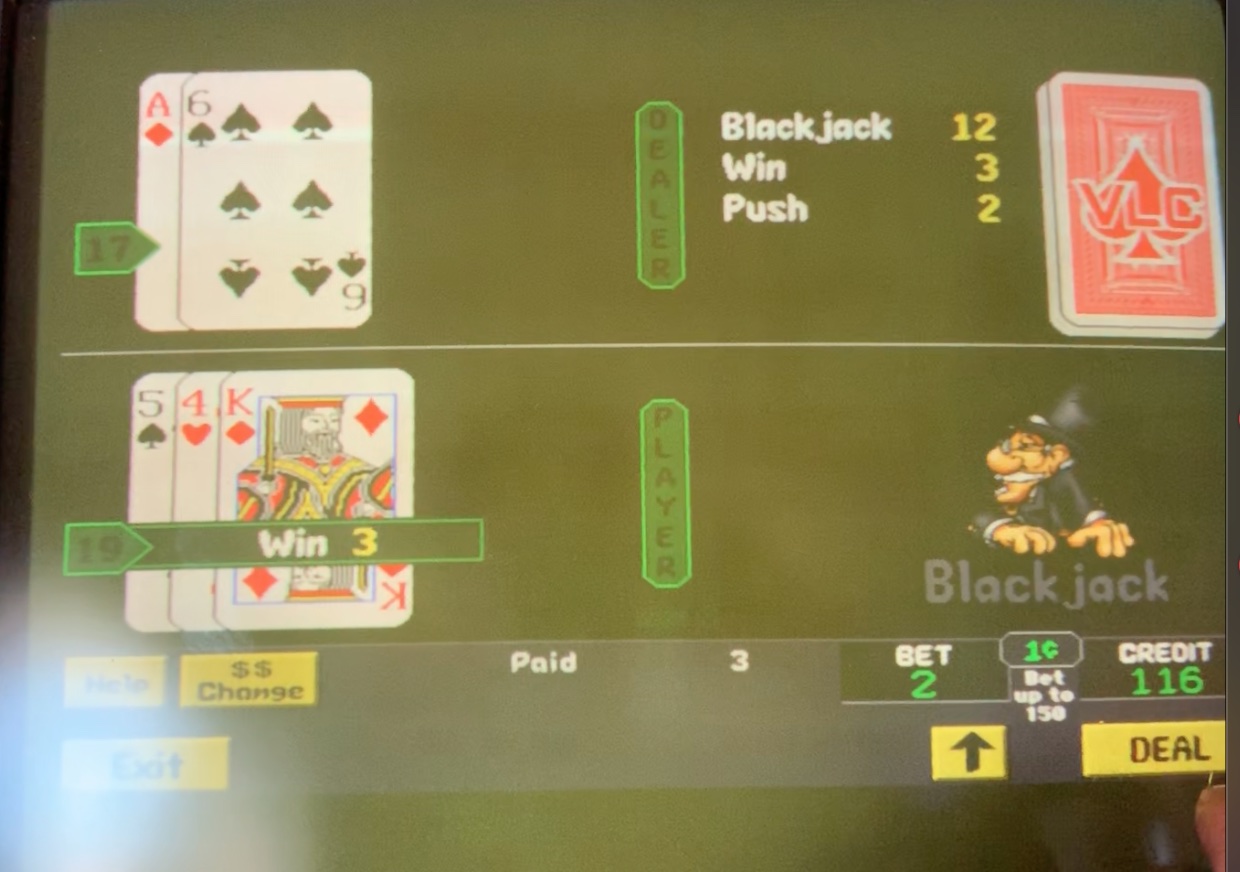
There is an old electronic blackjack game at the casino in Cal Nev Ari with the following rules:
- Wins, except blackjack, pays 3 for 2 (or 1 to 2)
- Blackjacks pay 6 for 1 (or 5 to 1)
- Single deck
- Dealer stands on soft 17
- Double on any initial two cards down offered
- Splitting allowed
- Do double after split
- No re-splitting
- No surrender
Rosebud
Interesting. I assume if the player doubles and wins he still only is paid 1 to 2 on the total amount bet.
First, here is the basic strategy for these rules:
- Hard hands: Never double. Otherwise, play like conventional basic strategy, except stand on 12 vs. 3 and 16 vs. 10.
- Soft hands: Never double. Hit soft 17 or less and soft 18 vs. 9. Otherwise, stand.
- Pairs: Only split 8's against a 6 to 8. Always hit two aces. Otherwise, follow strategy for hard totals.
Under these rules and strategy, I get a house edge of 7.88%.

 $11000 Welcome Bonus
 $3000 Welcome Bonus
 UP TO $777 BONUS