
Wizard Recommends
-
 $11000 Welcome Bonus
 -
 $3000 Welcome Bonus
 -
 UP TO $777 BONUS
On this page
Vegas Three Card Rummy
Introduction
Vegas Three Card Rummy is a poker variation found at Internet casinos using Cryptologic and Real Time Gaming software. The rules are similar to Three Card Poker, except hands are scored much differently and there is no ante bonus. Additionally, the raise bet pays up to 4 to 1 for premium hands.
Rules
- The game is played with a single 52-card deck.
- All cards are ranked according to their poker value, except aces are always low.
- The object is to have fewer points than the dealer.
- Play starts with the player making an ante bet plus an optional bonus bet.
- The player and dealer will each receive three cards. The dealer cards will be dealt face down. Both hands will be scored according to the table below. In the event a hand may be scored more than one way the lower total will be used.
- Singleton aces count as 1 point, 2 to 10 count according to pip value, and faces cards are 10 points.
- Pairs, three of a kind, and runs of at least 2 suited cards count as zero points.
Raise Pay Table
| Player Points | Pays |
|---|---|
| 0 | 4 to 1 |
| 1 to 5 | 2 to 1 |
| 6 or more | 1 to 1 |
Bonus Bet Pay Table
| Event | Pays |
|---|---|
| Suited A23 | 100 to 1 |
| 0 points | 25 to 1 |
| 1 to 6 points | 2 to 1 |
| 7 to 10 points | 1 to 1 |
| 11 to 12 points | 4 to 1 |
| 13 to 30 points | Loss |
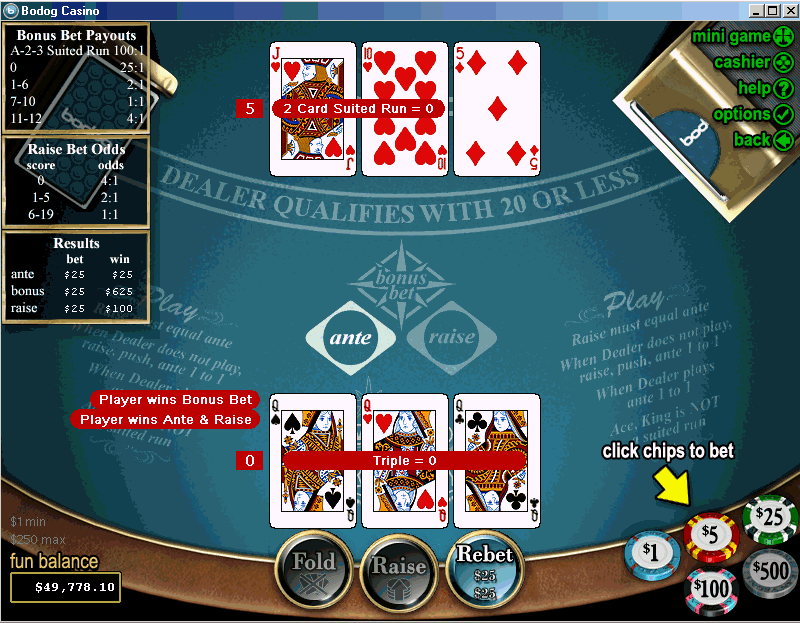
In the following picture I bet $25 each on the ante and bonus bet. I then bet $25 on the raise bet. With a three of a kind my score was 0. The dealer's suited 10-jack is worth 0 points and the singleton 5 is worth 5, for a total of 5. My 0 beats the dealer's 5 so I won 1 to 1 or $25 on the ante, 4 to 1 or $100 on the raise, and 25 to 1 or $625 on the bonus bet, for a total win of $750.
If these rules were not clear please have a look at how they are expressed at Bovada.
Ante Bet Analysis
The following table shows the possible outcomes of the ante bet assuming optimal player strategy. The lower right cell shows a house edge of 3.23%.
Ante Bet Return Table
| Event | Pays | Combinations | Probability | Return |
|---|---|---|---|---|
| Player beats dealer with 0 points | 5 | 1188508 | 0.002919 | 0.014595 |
| Player beats dealer with 1-5 points | 3 | 24911320 | 0.061182 | 0.183545 |
| Player beats dealer with 6 or more points | 2 | 59776920 | 0.146811 | 0.293621 |
| Dealer doesn't qualify | 1 | 91156848 | 0.223879 | 0.223879 |
| Tie | 0 | 11459864 | 0.028145 | 0 |
| Player folds | -1 | 132800192 | 0.326154 | -0.326154 |
| Dealer beats player | -2 | 85876748 | 0.210911 | -0.421822 |
| Total | 407170400 | 1 | -0.032337 |
The player will raise 67.38% of the time, for an average bet of 1.6738 units. The element of risk is thus 3.2337%/1.6738 = 1.93%.
Bonus Bet Analysis
The following table shows the possible outcomes of the bonus bet. The lower right cell shows a house edge of 3.46%.
Bonus Bet Return Table
| Event | Pays | Combinations | Probability | Return |
|---|---|---|---|---|
| Suited A23 | 100 | 4 | 0.000181 | 0.0181 |
| 0 points | 25 | 92 | 0.004163 | 0.104072 |
| 1 to 6 points | 2 | 2712 | 0.122715 | 0.24543 |
| 7 to 10 points | 1 | 3592 | 0.162534 | 0.162534 |
| 11 to 12 points | 4 | 644 | 0.02914 | 0.116561 |
| 13 to 30 points | -1 | 15056 | 0.681267 | -0.681267 |
| Total | 22100 | 1 | -0.03457 |
The bonus bet is always one unit so the element of risk is the same as the house edge at 3.54%.
Strategy
On the ante bet the player should have the same folding point as the dealer, raising with 20 or fewer points, and folding with 21 or more.
In my opinion for purposes of comparing one bet to another the element or risk should be used, which is 1.96% for the ante bet, and 3.46% for the bonus bet. So between the two the ante is the better bet.