




On this page
High Card Flush
Introduction
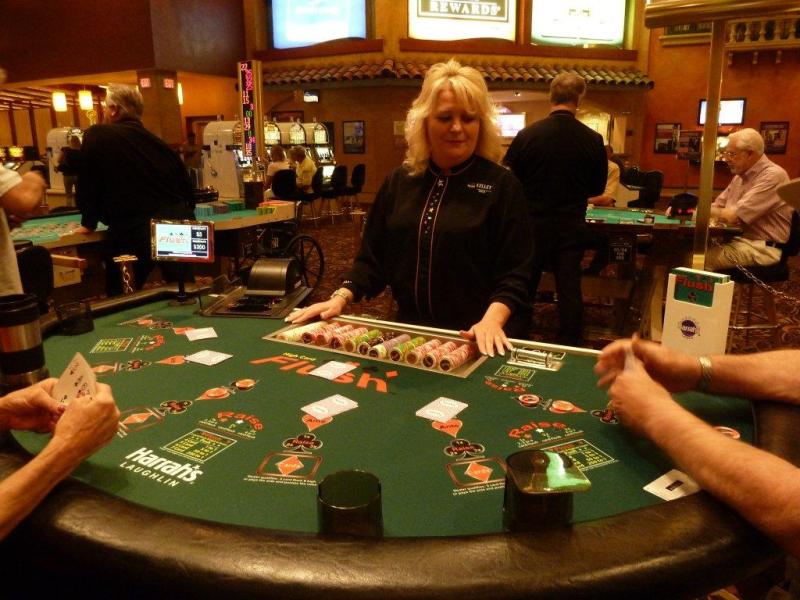
High Card Flush made its debut at Harrah's Laughlin in summer 2011. In February 2013 it found another placement at the M in Las Vegas. After that slow beginning the game caught on and today has lots of placements.
The game follows a fold or raise structure, like Caribbean Stud Poker and Three Card Poker. Where it differs is in the hand ranking, which is all about making the highest possible flush out of seven cards.
Rules
- High Card Flush is played with a standard 52-card deck of playing cards.
- To begin play, each player makes the mandatory Ante wager, and if desired, the optional flush, straight flush, and Bonus Jackpot side bets.
- The player and dealer each receive seven cards face down.
- Hands are evaluated in the following fashion:
- The first ranking criteria is the greatest number of cards in any one suit. This is referred to as the "maximum flush." For instance, any hand with a maximum four-card flush beats any hand with a maximum three-card flush, but loses to any hand with a maximum five-card flush.
- The second ranking criteria is the standard poker-rankings for flushes; that is, a hand with a maximum four-card flush of K-Q-J-T would beat a hand with a maximum four-card flush of K-Q-J-9, but lose to a hand with a maximum four-card flush of A-4-3-2.
- Each player then decides upon one of the following options:
- Fold, and surrender the Ante.
- Raise, placing a second bet equal to at least the Ante. The maximum amount of the Raise wager depends on the rank of the player?s hand:
- With a two-, three- or four-card flush, the maximum Raise wager is equal to the Ante wager.
- With a five-card flush, the maximum Raise wager is double the Ante wager.
- With a six- or seven-card flush, the maximum Raise wager is triple the Ante wager.
- Once all players have decided, the dealer turns over his seven cards and evaluates his hand in a similar fashion as described above.
- If the dealer does not have at least a three-card flush, nine-high, all remaining players have their Antes paid, and the Raise bets are pushed.
- If the dealer has at least a three-card flush, nine-high, his hand is compared to each other player:
- All players with a higher-ranking hand win, and have their Ante and Raise wagers paid at even money.
- All players with a lower-ranking hand lose, and have their Ante and Raise wagers collected.
- Players with the exact same ranking hand as the dealer push both their Ante and Raise wagers.
- Finally, any player who made the Bonus wager has his hand evaluated against the Bonus paytable, and the Bonus wager is either paid or collected as necessary.
Mousseau Strategy
Charles Mousseau determined that without regard to cards not part of the highest flush, a close to perfect strategy is to raise on T-8-6 or higher. The player should always make the largest allowed Raise bet. This strategy has a house edge of 0.06% higher than optimal strategy.
That means to raise any four-card or higher flush, and any three-card flush of rank T-8-6 or greater. For example, you would raise J-3-2, but fold T-7-5.
The following table shows the probability and return for each possible event under the Mousseau strategy. The lower right cell shows a house edge of 2.71%.
Mousseau Strategy Return Table
| Event | Pays | Probability | Return |
|---|---|---|---|
| Player raises 3x, dealer qualifies, player wins | 4 | 0.001604 | 0.006416 |
| Player raises 2x, dealer qualifies, player wins | 3 | 0.021374 | 0.064121 |
| Player raises 1x, dealer qualifies, player wins | 2 | 0.258352 | 0.516703 |
| Player raises 1x, dealer does not qualify | 1 | 0.160076 | 0.160076 |
| Player raises 2x, dealer does not qualify | 1 | 0.006590 | 0.006590 |
| Player raises 3x, dealer does not qualify | 1 | 0.000444 | 0.000444 |
| Player raises 1x, dealer qualifies, player pushes | 0 | 0.000839 | 0.000000 |
| Player raises 2x, dealer qualifies, player pushes | 0 | 0.000001 | 0.000000 |
| Player raises 3x, dealer qualifies, player pushes | 0 | 0.000000 | 0.000000 |
| Player folds | -1 | 0.320589 | -0.320589 |
| Player raises 1x, dealer qualifies, player loses | -2 | 0.229568 | -0.459136 |
| Player raises 2x, dealer qualifies, player loses | -3 | 0.000559 | -0.001678 |
| Player raises 3x, dealer qualifies, player loses | -4 | 0.000003 | -0.000013 |
| Totals | 1.000000 | -0.027065 |
Under the Mousseau strategy, the average final wager is 1.712 units. Thus, the element of risk is 2.706%/1.712 = 1.581%.
High Card Flush Advanced Strategy
Wizard of Odds contributor Gordon Michaels has published a High Card Flush Advanced Strategy. His strategy considers the suit distribution of the penalty cards with T-3-2 to T-9-8. The bottom line is a house edge of 2.6855%. Please click the link for the specifics.
Optimal Strategy
An optimal strategy has yet to be put in writing. However, we can narrow it down, as follows.
- Make maximum raise bet with J-9-6 or higher.
- Fold 9-7-4 or lower.
- You're on your own with 9-7-5 to J-9-5.
The following table shows that under the unknown optimal strategy the house edge is 2.64%.
Optimal Strategy Return Table
| Event | Pays | Probability | Return |
|---|---|---|---|
| Player raises 3x, dealer qualifies, player wins | 4 | 0.001618 | 0.006473 |
| Player raises 2x, dealer qualifies, player wins | 3 | 0.021472 | 0.064417 |
| Player raises 1x, dealer qualifies, player wins | 2 | 0.258181 | 0.516361 |
| Player raises 1x, dealer does not qualify | 1 | 0.160038 | 0.160038 |
| Player raises 2x, dealer does not qualify | 1 | 0.006617 | 0.006617 |
| Player raises 3x, dealer does not qualify | 1 | 0.000448 | 0.000448 |
| Player raises 1x, dealer qualifies, player pushes | 0 | 0.000840 | 0.000000 |
| Player raises 2x, dealer qualifies, player pushes | 0 | 0.000001 | 0.000000 |
| Player raises 3x, dealer qualifies, player pushes | 0 | 0.000000 | 0.000000 |
| Player folds | -1 | 0.321365 | -0.321365 |
| Player raises 1x, dealer qualifies, player loses | -2 | 0.228857 | -0.457715 |
| Player raises 2x, dealer qualifies, player loses | -3 | 0.000560 | -0.001679 |
| Player raises 3x, dealer qualifies, player loses | -4 | 0.000003 | -0.000013 |
| Totals | 1.000000 | -0.026418 |
Under the Mousseau strategy, the average final wager is 1.711 units. Thus, the element of risk is 2.642%/1.711 = 1.544%.
Miscellaneous statistics:
- All told, when the player plays optimally, the player will raise 67.86% of the time.
- The dealer will have a qualifying hand 75.36% of the time.
- The player and dealer will tie 0.08% of the time.
- The standard deviation is 1.63.
Flush Bet
I have heard of two pay tables for the Flush bet. The following three tables show the details.
Pay Table 1
| Cards | Pays | Combinations | Probability | Return |
|---|---|---|---|---|
| 7 | 300 | 6,864 | 0.000051 | 0.015392 |
| 6 | 100 | 267,696 | 0.002001 | 0.200095 |
| 5 | 10 | 3,814,668 | 0.028514 | 0.285135 |
| 4 | 1 | 26,137,540 | 0.195370 | 0.195370 |
| 3 or less | -1 | 103,557,792 | 0.774064 | -0.774064 |
| Total | 133,784,560 | 1.000000 | -0.078072 |
Pay Table 2
| Cards | Pays | Combinations | Probability | Return |
|---|---|---|---|---|
| 7 | 300 | 6,864 | 0.000051 | 0.015392 |
| 6 | 75 | 267,696 | 0.002001 | 0.150071 |
| 5 | 5 | 3,814,668 | 0.028514 | 0.142568 |
| 4 | 2 | 26,137,540 | 0.195370 | 0.390741 |
| 3 or less | -1 | 103,557,792 | 0.774064 | -0.774064 |
| Total | 133,784,560 | 1.000000 | -0.075292 |
Straight Flush Bet
The Straight Flush side bet pays according to the longest straight flush the player can make. I observed it only at the Planet Hollywood. The lower right cell shows a house edge of 13.11%.
Straight Flush Side Wager
| Cards | Pays | Combinations | Probability | Return |
|---|---|---|---|---|
| 7 | 8000 | 32 | 0.000000 | 0.001914 |
| 6 | 1000 | 1,592 | 0.000012 | 0.011900 |
| 5 | 100 | 39,960 | 0.000299 | 0.029869 |
| 4 | 60 | 676,196 | 0.005054 | 0.303262 |
| 3 | 7 | 8,642,932 | 0.064603 | 0.452224 |
| 2 or less | -1 | 124,423,848 | 0.930031 | -0.930031 |
| Total | 133,784,560 | 1.000000 | -0.130864 |
Internal Links
Bonus Jackpot
The following table shows my analysis of the $1 progressive side bet Bonus Jackpot.
Bonus Jackpot
| Event | Pays | Combinations | Probability | Return |
|---|---|---|---|---|
| 7-card straight flush | 100% Jackpot | 32 | 0.000000 | ? |
| 6-card straight flush, ace-high | 100% Jackpot | 180 | 0.000001 | ? |
| 6-card straight flush, king-high or less | 10% Jackpot | 1,412 | 0.000011 | ? |
| 5-card straight flush | 300 | 39,960 | 0.000299 | 0.089607 |
| 4-card straight flush | 50 | 676,196 | 0.005054 | 0.252718 |
| 3-card straight flush | 3 | 8,642,932 | 0.064603 | 0.193810 |
| All other | 0 | 124,423,848 | 0.930031 | 0.000000 |
| Total | 133,784,560 | 1.000000 | 0.536135 |
The lower right cell of the table above shows fixed wins return 53.61% to the player. Each $1,000 in the meter increases the return by 1.69%. The side bet reaches breakeven at $175,702.05. At the jackpot reset value of $5,000 the return is 54.93%.
Acknowledgements
- Thanks for Charles Mousseau for providing the math for this game, except on the Straight Flush side bet. Charles' web site is tgscience.com.
- Gordon Michaels for his High Card Flush Advanced Strategy.