




On this page
Dealer Bluff
Introduction
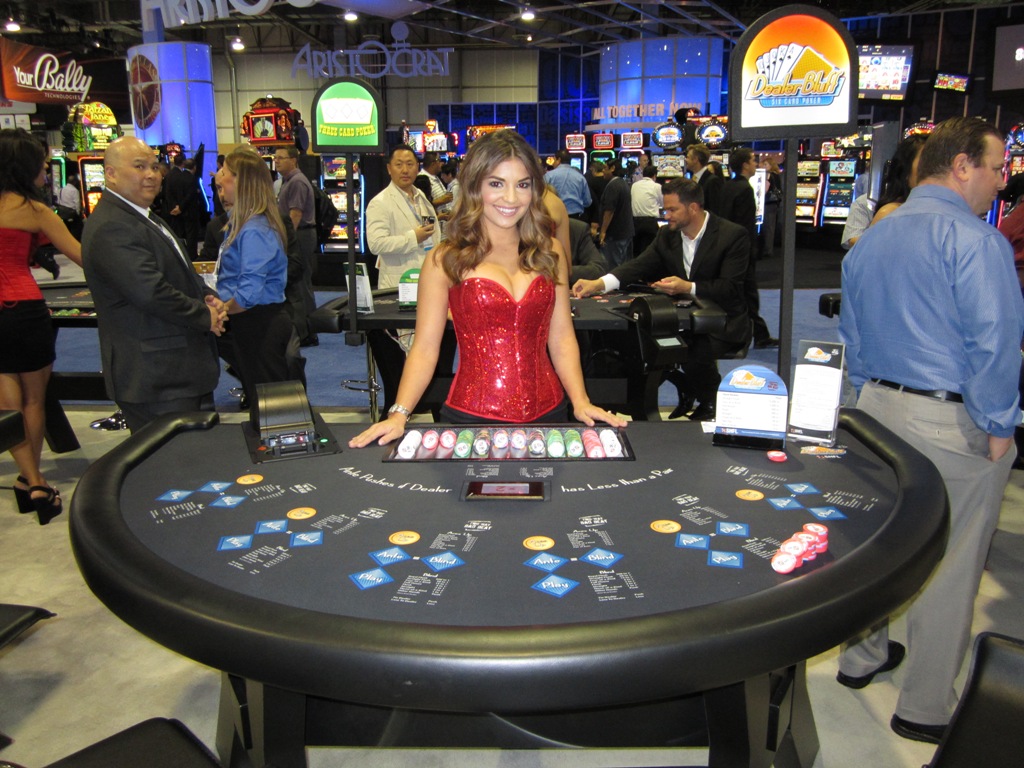
Dealer Bluff is a new poker-based variant I noticed at the Wynn on September 25, 2009. Since then it was removed, the rules were tweaked, and in September 2012 it was put back in the Wynn. In January, 2013, it appeared at the Red Rock.
What sets Dealer Bluff apart from all other poker variants to date is that the dealer makes the first move and the player reacts to what the dealer does. To prevent cheating or reading the dealer's face, this is done with the aid of an electronic card reader, which determines how much the dealer bets.
Rules
- Player makes equal Ante and Blind bets. The player may also make optional Aces Up and/or Two Way Bad Beat side bets.
- The dealer gives six cards each to the player and dealer. The dealer's cards are dealt face down.
- Using a card reader, and the random number-based strategy indicated below, game signage will indicate whether the dealer wishes to raise. The raise will either be equal to the ante, double the ante, or triple the ante.
- The player may either fold, call or raise. If the player folds, then he loses his Ante and Blind wagers. If the player calls, then he should make an additional Play wager equal to the dealer's raise. If the player raises, then he should make an additional Play wager equal to two times the dealer's raise.
- If the player calls or raises, then the player and dealer hands will be turned over. Both will make the best five-card poker hand out of his six cards.
- If the dealer has less than a pair, then the Ante wager is a push.
- If the player beats the dealer, then the Ante and Play bets pay even money and the Blind bet pays according to the pay table below.
- If the dealer beats the player, then the Ante, Play, and Blind bets lose.
- In the event of a tie, the Ante, Play, and Blind bets push.
- The Aces Up bet shall pay according the player's hand only. The Aces Up pay table is below.
- The Two Way Bad Beat bet shall pay according the poker value of the losing hand. The pay table is below.
Note: Under the California rules, the dealer has the option to call, among other rules differences.
Blind Bet Pay Table
| Hand | Pays |
|---|---|
| Royal flush | 500 |
| Straight flush | 50 |
| Four of a kind | 15 |
| Full house | 4 |
| Flush | 3 |
| Straight | 1.5 |
| Three of a kind | 1 |
| All other | Push |
Dealer Strategy
The dealer will choose his raise according to his hand and the following probability table.
Dealer Raise Table
| Hand | 1X Raise | 2X Raise | 3X Raise |
|---|---|---|---|
| Royal Flush | 5% | 15% | 80% |
| Straight Flush | 5% | 20% | 75% |
| Quads | 5% | 25% | 70% |
| Full House | 5% | 30% | 65% |
| Flush | 10% | 30% | 60% |
| Straight | 15% | 30% | 55% |
| Trips | 20% | 40% | 40% |
| Two Pair | 30% | 50% | 20% |
| High Pair (10-A) | 35% | 50% | 15% |
| Mid Pair (6-9) | 50% | 40% | 10% |
| Low Pair (2-5) | 60% | 30% | 10% |
| Nothing | 80% | 15% | 5% |
Player Strategy
I have not done by own analysis of this game yet. Until then, I present the following strategy indicated in Shufflemaster's math report by Elliot Frome, which is used with permission.
Dealer wagers 1x
- Player should Fold if he has a K-J-8 or less.
- Player should Raise if he has a Pair of 3's or better
- Player should Call all other hands
Dealer wagers 2x
- Player should Fold if he has a Pair of 5's or Less
- Player should Fold if he has a Pair of 6's and at least one card below a 6
- Player should Raise if he has a Pair of Jacks or Better
- Player should Raise if he has a Pair of 10's and no more than 2 cards below a 10
- Player should Call all other hands
Dealer wagers 3x
- Player should Fold if he has a Pair of 9's or Less
- Player should Raise if he has a Pair of Kings with an Ace Kicker or Better
- Player should Call all other hands
House Edge
According to Elliot Frome, the total payback is 99.5391%. I believe that by "payback," he means what I refer to as the "element of risk." He also indicates the average wager per hand is 3.635 units. That would make the house edge 3.635×(1-0.995391) = 1.68%.
Aces Up
The following table shows the probability and return from each hand for the Aces Up side bet. The lower right cell shows a house edge of 6.62%.
Aces Up Return Table
| Hand | Pays | Combinations | Probability | Return |
|---|---|---|---|---|
| Royal flush | 200 | 188 | 0.000009 | 0.001847 |
| Straight flush | 50 | 1656 | 0.000081 | 0.004067 |
| Four of a kind | 30 | 14664 | 0.000720 | 0.021609 |
| Full house | 8 | 165984 | 0.008153 | 0.065224 |
| Flush | 7 | 205792 | 0.010108 | 0.070759 |
| Straight | 6 | 361620 | 0.017763 | 0.106576 |
| Three of a kind | 4 | 732160 | 0.035963 | 0.143853 |
| Two pair | 2 | 2532816 | 0.124411 | 0.248821 |
| Pair aces | 1 | 751332 | 0.036905 | 0.036905 |
| Loser | -1 | 15592308 | 0.765886 | -0.765886 |
| Total | 20358520 | 1.000000 | -0.066225 |
Two Way Bad Beat
The Two Way Bad Beat bet pays if the either the player or dealer gets a pair of aces or better and loses. The following table shows a house edge of 10.60%.
Two Way Bad Beat
| Losing Hand | Pays | Probability | Return |
|---|---|---|---|
| Straight Flush | 10,000 | 0.00000024 | 0.00240000 |
| Four of a Kind | 5,000 | 0.00000125 | 0.00625000 |
| Full House | 500 | 0.00009874 | 0.04937000 |
| Flush | 200 | 0.00030720 | 0.06144000 |
| Straight | 100 | 0.00097168 | 0.09716800 |
| Three of a Kind | 35 | 0.00405615 | 0.14196525 |
| Two Pair | 10 | 0.03451272 | 0.34512720 |
| Pair of Aces | 9 | 0.01503648 | 0.13532832 |
| All other | -1 | 0.94501554 | -0.94501554 |
| Total | 1.00000000 | -0.10596677 |
Acknowledgement
I would like to thank Shufflemaster for providing the math report for this game. All credit for the math goes to Elliot Frome. I have personally verified the math is correct on the Aces Up side bet. The probability of a straight flush losing in the Two Way Bad Beat bet is based on my Bad Beat Jackpot Odds page.
Outside Links
At the Pala casino in California they had a different version of the rules of Dealer Bluff, as covered by Discount Gambling.