




On this page
Caribbean 21
Introduction
Caribbean 21 is a blackjack variant offered by RealTime Gaming Internet casinos. The game offers the player the ability to split any two initial cards and to hit and redouble after doubling. Of course nothing is ever free and the player loses all ties. There are several other rule changes from blackjack so read carefully before playing. Following the basic strategy below the game offers a house edge lower than most blackjack games.
Rules
Following are the complete rules for Caribbean 21:
- I do not know if this rule is configurable by RTG, but I am told by Bodog that they use 255 decks.
- All cards are valued as in blackjack, except an ace is always one point.
- Play starts with the player making an initial wager.
- The player shall receive two cards face up and the dealer one card face up. The dealer does not take a hole card.
- The player may hit, stand, double, split, or surrender. The hit and stand option are the same as in conventional blackjack.
- The player may double at any time with two or more cards. This includes redoubling and doubling after a split.
- Splitting is allowed on any two cards. Aces have no special restrictions as in blackjack and have the same splitting rules as other cards. After the player splits,each single card hand in turn shall immediately get an additional card.
- The player may surrender at any time. If the player surrenders he forfeits half his total bet at that time.Surrender is allowed after splitting on a hand by hand basis.
- An ace and two 10-point cards is called a "Caribbean 21" and is ranked higher than all other 21 point hands, including after splitting.
- The dealer shall win all ties.
- A winning player bet shall pay even money, except for a Caribbean 21 which pays 3:2 on the initial hand only.
- If the dealer's up card is an ace then the player may take insurance against the dealer having a Caribbean 21. Insurance may be taken at any time and for any amount up to half the total bet at the time insurance is taken. Insurance shall pay 9 to 1 if the dealer does get two 10-point cards as the second and third cards. The insurance bet shall be adjudicated at the end of the hand. The player may also add to the insurance bet at anytime, so that the total insurance bet does not exceed half the total wager.
Strategy
Table 1 shows the player's strategy on the first two cards. To use the table, look up the player's first two cards along the left and find the dealer's up card along the top.
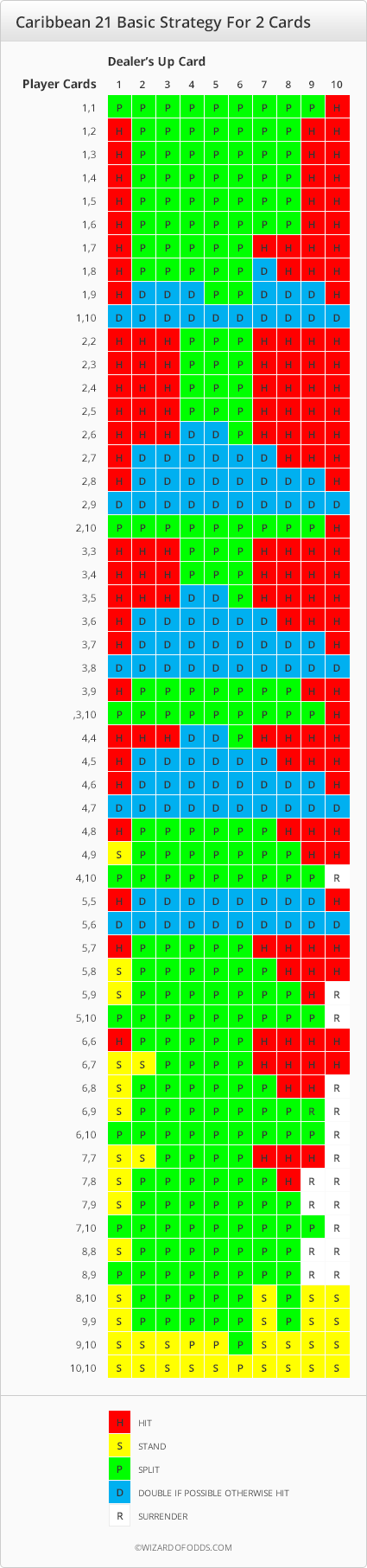
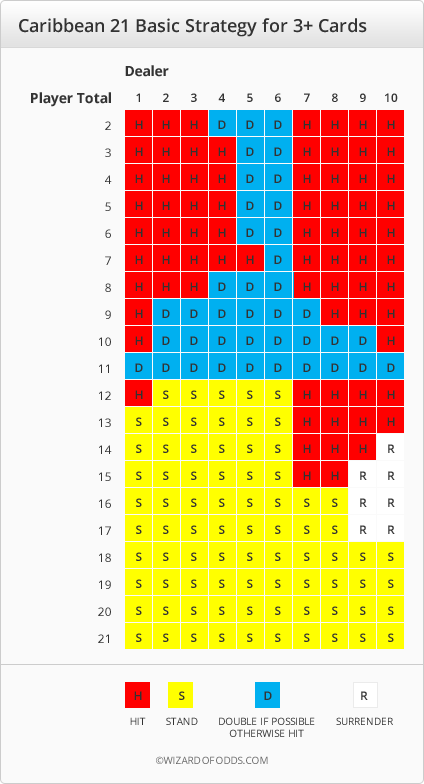
Table 2 shows the basic strategy when the option to split is no longer available.
House Edge
The house edge following the basic strategy above is 0.19%. The average final bet size is 1.8 units so the element of risk is 0.11%. The standard deviation is 1.62.
The house edge on insurance is 5.38%.
Caribbean 21 in the Media
In late 2003, a player won $1.3 million playing Caribbean 21, mostly at Hampton Casino. Was he lucky, cheating, or playing a flawed game? MSNBC did an article on what may be the largest table game win in Internet casino history. Visit www.msnbc.msn.com/id/4449401/ for the story.