
Wizard Recommends
-
 $11000 Welcome Bonus
 -
 $3000 Welcome Bonus
 -
 UP TO $777 BONUS
Sports - FAQ
Loser pays: One could say it is an even-money bet, with a $1 refundable fee if you win. So, only the losers end up paying the fee.
Winner pays: A fair even-money bet would win $11 for an $11 bet. However, if the bet wins, the winner gets only $10. The missing dollar could be viewed as a commission or fee.
Personally, I view it as both pay in the form of a 4.54% house edge, assuming a 50% probability of winning.
I am taking for granted that you know the type of pool that I am referring to. Each box costs $5 and pay outs are each quarter. If your box wins you win $125 and it is possible to win all 4 quarters if the last numbers remain the same winning $500 for a payout of 100 to 1.
The person soliciting the bet was trying to tell me that the odds of winning the $500 are 100 to 1. I disagree. First the box that has 0 + 7 stands a much better chance of winning than the 2 + 9 box. However, the odds of 0 + 7 remaining the last 2 numbers throughout the game must be high. If the boxes are chosen for you through a random process, can you tell me the approximate odds of winning the $500 prize?
Probability of Handicapping Percentages in the NFL
| Ratio | 1 Seasons | 2 Seasons | 3 Seasons | 4 Seasons | 5 Seasons |
| 0.5 | 0.5 | 0.517523 | 0.5 | 0.512393 | 0.5 |
| 0.51 | 0.354641 | 0.314437 | 0.282985 | 0.257059 | 0.234993 |
| 0.52 | 0.267178 | 0.178085 | 0.125486 | 0.101366 | 0.074229 |
| 0.53 | 0.160065 | 0.086589 | 0.049447 | 0.025155 | 0.015098 |
| 0.54 | 0.106982 | 0.035817 | 0.013066 | 0.004959 | 0.001926 |
| 0.55 | 0.053095 | 0.012519 | 0.002569 | 0.000687 | 0.000152 |
| 0.56 | 0.023385 | 0.00282 | 0.000373 | 0.000051 | 0.000007 |
| 0.57 | 0.012645 | 0.00067 | 0.000053 | 0.000003 | 0 |
| 0.58 | 0.00453 | 0.000133 | 0.000004 | 0 | 0 |
| 0.59 | 0.00213 | 0.000022 | 0 | 0 | 0 |
| 0.6 | 0.000617 | 0.000003 | 0 | 0 | 0 |
NFL Terminal Digits per Side
|
Digit |
Frequency |
Probability |
|
0 |
1887 |
17.75% |
|
1 |
1097 |
10.32% |
|
2 |
348 |
3.27% |
|
3 |
1382 |
13.00% |
|
4 |
1608 |
15.13% |
|
5 |
396 |
3.73% |
|
6 |
848 |
7.98% |
|
7 |
1945 |
18.30% |
|
8 |
631 |
5.94% |
|
9 |
488 |
4.59% |
|
Total |
10630 |
100% |
So this table shows 7 is the best choice, followed by 0, 4, and 3.
Favorite wins against spread: 2554 games
Underdog wins against spread: 2724 games
Game ends exactly on spread: 150 games
So on resolved bets the underdog have won 51.61% of the time. It is also well known that square bettors prefer to bet favorites, creating value on the underdogs.
The following table shows the frequency of each combination in every NFL game from the 1983 to 2005 seasons. It should be noted that the 2-point conversion rule came along about 1998, which would have the effect of smoothing out the distribution a bit.
Terminal Digit in the NFL - Away by Home Total
| Away Team | Home Team | Total | |||||||||
|---|---|---|---|---|---|---|---|---|---|---|---|
| 0 | 1 | 2 | 3 | 4 | 5 | 6 | 7 | 8 | 9 | ||
| 0 | 126 | 104 | 34 | 160 | 138 | 37 | 99 | 237 | 64 | 32 | 1031 |
| 1 | 73 | 40 | 17 | 41 | 103 | 21 | 36 | 117 | 67 | 31 | 546 |
| 2 | 25 | 15 | 1 | 20 | 30 | 9 | 13 | 33 | 9 | 12 | 167 |
| 3 | 194 | 69 | 33 | 66 | 102 | 40 | 102 | 132 | 43 | 40 | 821 |
| 4 | 122 | 133 | 27 | 78 | 108 | 27 | 48 | 215 | 59 | 35 | 852 |
| 5 | 32 | 12 | 12 | 21 | 21 | 9 | 13 | 36 | 22 | 5 | 183 |
| 6 | 91 | 47 | 17 | 75 | 57 | 7 | 28 | 57 | 25 | 39 | 443 |
| 7 | 217 | 115 | 35 | 135 | 195 | 47 | 65 | 125 | 69 | 47 | 1050 |
| 8 | 43 | 59 | 12 | 24 | 41 | 23 | 20 | 38 | 15 | 7 | 282 |
| 9 | 48 | 28 | 17 | 33 | 40 | 14 | 29 | 33 | 14 | 7 | 263 |
| Total | 971 | 622 | 205 | 653 | 835 | 234 | 453 | 1023 | 387 | 255 | 5638 |
The next table shows the probability of each combination based on the totals in the table above.
Terminal Digit in the NFL — Away by Home Probability
| Away Team | Home Team | Total | |||||||||
|---|---|---|---|---|---|---|---|---|---|---|---|
| 0 | 1 | 2 | 3 | 4 | 5 | 6 | 7 | 8 | 9 | ||
| 0 | 0.0223 | 0.0184 | 0.006 | 0.0284 | 0.0245 | 0.0066 | 0.0176 | 0.042 | 0.0114 | 0.0057 | 0.1829 |
| 1 | 0.0129 | 0.0071 | 0.003 | 0.0073 | 0.0183 | 0.0037 | 0.0064 | 0.0208 | 0.0119 | 0.0055 | 0.0968 |
| 2 | 0.0044 | 0.0027 | 0.0002 | 0.0035 | 0.0053 | 0.0016 | 0.0023 | 0.0059 | 0.0016 | 0.0021 | 0.0296 |
| 3 | 0.0344 | 0.0122 | 0.0059 | 0.0117 | 0.0181 | 0.0071 | 0.0181 | 0.0234 | 0.0076 | 0.0071 | 0.1456 |
| 4 | 0.0216 | 0.0236 | 0.0048 | 0.0138 | 0.0192 | 0.0048 | 0.0085 | 0.0381 | 0.0105 | 0.0062 | 0.1511 |
| 5 | 0.0057 | 0.0021 | 0.0021 | 0.0037 | 0.0037 | 0.0016 | 0.0023 | 0.0064 | 0.0039 | 0.0009 | 0.0325 |
| 6 | 0.0161 | 0.0083 | 0.003 | 0.0133 | 0.0101 | 0.0012 | 0.005 | 0.0101 | 0.0044 | 0.0069 | 0.0786 |
| 7 | 0.0385 | 0.0204 | 0.0062 | 0.0239 | 0.0346 | 0.0083 | 0.0115 | 0.0222 | 0.0122 | 0.0083 | 0.1862 |
| 8 | 0.0076 | 0.0105 | 0.0021 | 0.0043 | 0.0073 | 0.0041 | 0.0035 | 0.0067 | 0.0027 | 0.0012 | 0.05 |
| 9 | 0.0085 | 0.005 | 0.003 | 0.0059 | 0.0071 | 0.0025 | 0.0051 | 0.0059 | 0.0025 | 0.0012 | 0.0466 |
| Total | 0.1722 | 0.1103 | 0.0364 | 0.1158 | 0.1481 | 0.0415 | 0.0803 | 0.1814 | 0.0686 | 0.0452 | 1 |
Although there is a ceremonial home team in the Super Bowl, I think we can ignore that. Let's also ignore everything about both teams and go strictly off of the historical averages above. Finally, let’s ignore the fact that the Super Bowl can not end in a tie, which would make a match like 4/4 a little less likely to win. So let's take an average when the terminal digits are different. For example the probability of your Pittsburgh 7, Seattle 4 square would be the average of Away 7, Home 4; and Away 4, Home 7. Doing so results in the following probability for each of your squares.
Pitts 7, Sea 4: (0.0346+0.0381)/2 = 0.0364
Pitts 7, Sea 0: (0.0385+0.0420)/2 = 0.0403
Pitts 4, Sea 4: 0.0192
Pitts 4, Sea 0: (0.0216+0.0245)/2 = 0.0231
So your total probability of winning one of these is 11.90%. Considering you only covered 4% of the squares you made out well.
Although you didn't specifically ask, here is how often each terminal digit occurred. It shows that overall from most the frequent the order is 7043168952.
Terminal Digit in the NFL — Away and Home Totals
| Terminal Digit |
Away Team | Home Team | Total |
|---|---|---|---|
| 0 | 1031 | 971 | 2002 |
| 1 | 546 | 622 | 1168 |
| 2 | 167 | 205 | 372 |
| 3 | 821 | 653 | 1474 |
| 4 | 852 | 835 | 1687 |
| 5 | 183 | 234 | 417 |
| 6 | 443 | 453 | 896 |
| 7 | 1050 | 1023 | 2073 |
| 8 | 282 | 387 | 669 |
| 9 | 263 | 255 | 518 |
Finally, here is the probability of each terminal digit.
Terminal Digit in the NFL — Away and Home Probabilities
| Terminal Digit |
Away Team | Home Team | Total |
|---|---|---|---|
| 0 | 0.1829 | 0.1722 | 0.1775 |
| 1 | 0.0968 | 0.1103 | 0.1036 |
| 2 | 0.0296 | 0.0364 | 0.033 |
| 3 | 0.1456 | 0.1158 | 0.1307 |
| 4 | 0.1511 | 0.1481 | 0.1496 |
| 5 | 0.0325 | 0.0415 | 0.037 |
| 6 | 0.0786 | 0.0803 | 0.0795 |
| 7 | 0.1862 | 0.1814 | 0.1838 |
| 8 | 0.05 | 0.0686 | 0.0593 |
| 9 | 0.0466 | 0.0452 | 0.0459 |
For more on this topic, visit Football Squares Mathematical and Statistical Strategy.
NFL side: $50,000
NFL total: $5000
MLB money line: $10,000
MLB total: $2000
NBA side: $10,000
NBA total: $2,000
NFL 13.31 (based on 2000 to 2007 seasons)
College Football 15.72 (based on 1993 to 2007 seasons)
NBA 11.39 (based on 1987 to 2003 seasons)
So, the 2008 Super Bowl finished 15/13.31 = 1.13 standard deviations away from expectations. I’m ignoring the adjustment factor for a discrete distribution, to keep things as simple as possible. The probability of being 1.13 standard deviations or more from expectations, in either direction is 25.85%. This can be found in Excel, using the formula 2 × normsdist(-1.13).
Not that you asked, but if you lay 120, you can buy a half point at most sports books. If you were prepared to bet a game against the spread anyway, is the extra half point a good value? Laying 110, the house edge for a random picker is 4.45%, including ties. Laying 120, the house edge with the half point is 4.50%. So, buying a half point is marginally not worth the price.
The value of buying a half point in football depends a great deal on the point spread, because some margins of victory are much more likely than others. The only time it is worth buying the half point in the NFL is off of a point spread of 3. Unfortunately, the sports books know this too, and won’t let you do it off of 3, most of the time.
1) A will score more than B
2) B will score more than A
3) Game finishes as a tie.
Is the information provided enough to calculate the probabilities for each outcome?
The first step is to use the Poisson distribution to estimate the probability of each number of goals for each team. The general formula is the probability that a team has g goals, with a mean of m, is e-m × mg/g!. In Excel, you can use the formula poisson(g,m,0). The following table shows the probability for 0 to 10 goals of both teams, using this formula.
Probabilities for 0 to 8 Goals for each Team
| Goals | Team A | Team B |
| 0 | 0.223130 | 0.301194 |
| 1 | 0.334695 | 0.361433 |
| 2 | 0.251021 | 0.216860 |
| 3 | 0.125511 | 0.086744 |
| 4 | 0.047067 | 0.026023 |
| 5 | 0.014120 | 0.006246 |
| 6 | 0.003530 | 0.001249 |
| 7 | 0.000756 | 0.000214 |
| 8 | 0.000142 | 0.000032 |
The next step is rather mundane, but you have to make a matrix of all the 81 possible combinations of 0 to 8 scores for each team. This is done by multiplying the probability of x scores for team A and y scores for team B, from the table above. The following table shows the probability of every score combination from 0-0 to 8-8.
The next table shows the winner according to each combination of goals, where T represents a tie.
Winner Combinations for Both Teams
| Goals Team A | Goals Team B | ||||||||
| 0 | 1 | 2 | 3 | 4 | 5 | 6 | 7 | 8 | |
| 0 | T | B | B | B | B | B | B | B | B |
| 1 | A | T | B | B | B | B | B | B | B |
| 2 | A | A | T | B | B | B | B | B | B |
| 3 | A | A | A | T | B | B | B | B | B |
| 4 | A | A | A | A | T | B | B | B | B |
| 5 | A | A | A | A | A | T | B | B | B |
| 6 | A | A | A | A | A | A | T | B | B |
| 7 | A | A | A | A | A | A | A | T | B |
| 8 | A | A | A | A | A | A | A | A | T |
Finally, you can use the sumif function in Excel to add the corresponding cells for all three possible outcomes of the bet. In this case the probabilities are:
A wins = 44.14%
B wins = 30.37%
Tie = 25.48%
Appendix C in Sharp Sports Betting by Stanford Wong gives the win/lose/tie probabilities for bets like this. For this case he lists 44%, 30%, and 25%. If anyone knows a simple formula for this kind of problem, I’m all ears.
Follow Up: I received an e-mail from Bob P., who always keeps me on my toes when it comes to math. Here is what he wrote.
Looked up the distrib of the difference between 2 uncorrelated Poissons. It’s a Skellam (new to me).Anyway, the question can then be posed as P(Z=0), P(Z>0), and P(Z<0) where Z is a Skellam with parameters 1.5 and 1.2.
If you haven’t already done it, you’ll be pleased to know
P(Tie) = P(Z=0) = .254817
P(A beats B) = P(Z>0) = .441465
P(B beats A) = P(Z<0) = 1 - .254817 - .441465 = .303718
almost exactly your answers.
The Wikipedia entry for a Skellam mentioned Bessel functions, which is about the point in calculus where I get scared to go further. So, I’m going to take Bob’s word on this one.
So, assuming 52% of resolved bets win, the overall probabilities are:
Win: 50.44%
Draw: 3.00%
Loss: 46.56%
Using basic statistics, it is easy to see that the expected win per pick, laying -110, is -0.0078. The standard deviation per pick is 1.0333. The expected win over 70 picks is -0.5432, and the standard deviation is 701/2×1.0333 = 8.6452. A win of 8.5 units is 9.0432 units above expectations, or 9.0432/8.6452=1.0460 standard deviations to the right of expectations on the Gaussian Curve. I think we can ignore the adjustment for a discrete distribution because of the pushes, and some games not being -110/-110, will result in a fairly smooth curve down the a factor of 0.05 units.
So, the probability of any one player finishing more than 1.046 standard deviations above expectations is 14.77%. That figure can be found in any table of the Gaussian curve, or with the formula =1-normsdist(1.046) in Excel. The probability of all six players finishing under 1.046 is (1-0.1477)6=38.31%. Thus, the probability of at least one player finishing above 1.046 standard deviations up is 61.69%. That makes the over look like a solid bet laying -110. I show it is fair at -161.
The following table shows the probability of the over 8.5 winning given various values of p. Perhaps the person setting the prop was assuming a value closer to 51% for p.
NFL Handicapping Prop
| Prob. Correct Pick | Prob. Over Wins |
| 50.0% | 41.16% |
| 50.5% | 46.18% |
| 51.0% | 51.33% |
| 51.5% | 56.53% |
| 52.0% | 61.69% |
| 52.5% | 66.72% |
| 53.0% | 71.52% |
There is a good column about this in the Las Vegas Review Journal. It quotes professional gambler and fellow actuary Steve Fezzik as saying that the odds favored going for the first down. I agree completely. In general, I think that other coaches punt too often, and too afraid of taking risks. To argue my position I asked fellow math head and sports bettor Joel B., who is much better than me at analyzing football odds mid-game. He offered the following odds:
- Patriot’s probability of making the first down: 60%
- Patriot’s probability of winning, given they make the first down: 100%
- Patriot’s probability of winning, given they miss the first down: 50%
- Patriot’s probability of winning, given they punt: 75%
So, the probability of winning by going for the first down is 60%×100% + 40%× 50% = 60% + 20% = 80%. That is greater than the 75% by punting.
The Monday morning quarterbacks can vilify Belichick all they want, but I applaud his decision. He shouldn’t be judged by the outcome of the game, but by whether or not the odds favored what he did at the time. I strongly feel that they did. A week later in the Ravens/Steelers game the Ravens went for it on 4th and 5, and made it. Although it was a different kind of situation, I’ve yet to hear anybody second-guess that decision.
In the interests of fairness, I am providing a link to an article taking the opposite point of view, titled Belichick’s fourth-and-reckless by Bill Simmons at ESPN.com
However, the variance is greater as a parlay. If you are following the Kelly Criterion, then you will have to protect your bankroll for the parlay with a smaller wager. In this example, the optimal Kelly bet straight up is 5.48% of bankroll if the two games overlap, 5.50% if you first game ends before you bet on the second game, and 3.88% for the parlay. Multiplying the wager times the advantage, we get 0.00275 straight up (based on a 5.50% advantage) and 0.00397 for the parlay. Thus, the parlay results in the greater profit.
I considered the general case for this kind of question, looking also at 3-team and 4-team parlays and money line wagers. Assuming a small advantage for all bets, as a rule of thumb, if the probability of each event winning is less than 33%, then you should bet straight up. If each probability is between 33% and 52%, then you should do a 2-team parlay. If each probability is between 52% and 64%, then you should do a 3-team parlay. If each probability is greater than 64%, then you should do a 4-team parlay. If you are doing straight up wagers, then you are about equally well off doing 2-team or 3-team parlays, again assuming you have an advantage to begin with.
I should stress that if you are a recreational gambler going against a house edge (what sports bettor will admit to that?), then betting straight up minimizes the house advantage.
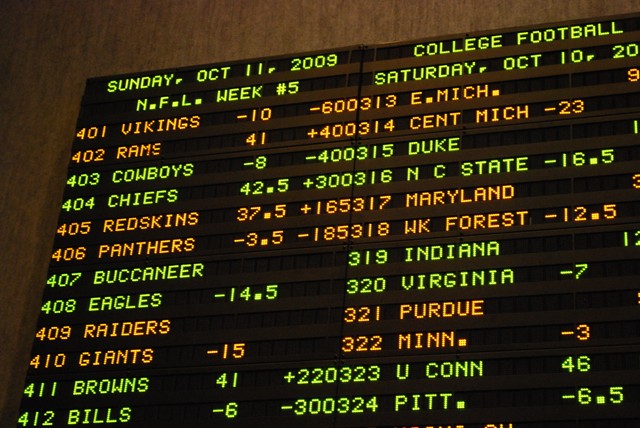
It is also unusual to offer money lines on significantly lopsided games, for example the Eastern Michigan vs. Central Michigan with a 23-point spread. It is difficult to set accurate money lines with such games, and the risk of unbalanced action is greater. The best casino for betting money lines on games with big spreads is the Hilton. Finally, if the point spread is very small, like 1 or 1.5, then most sports books don’t bother to post a money line at all, because betting against the spread would likely result in the same outcome.
This question was raised and discussed in the forum of my companion site Wizard of Vegas.
- Using the total and spread, estimate the total points of each team. For example, if we use a total of 57 and a spread of -5 for the Super Bowl, letting c=Colts points, and s=Saints points then...
(1) c+s=57
(2) c-5=s
Substituting equation (2) in equation (1):
c+(c-5)=57
2c-5=57
2c=62
c=31
s=31-5=26
The problem with stopping here is sometimes you get values that are unlikely to be scored by a single team. For example, the probability of a single-team total of 24 is 6.5%, but the probability of 25 is only 0.9%. The table below shows the single-team total probability, based on the 2000-2009 seasons. So we’re going to estimate the total points for each team based on realistic combinations of field goals and touchdowns.
- Assume the favorite kicks 2 field goals.
- Assume the underdog kicks 1 field goal.
- Subtract the field goal points from each. In the Super Bowl example, this would leave Colts = 25 touchdown points, Saints = 23 touchdown points.
- Divide touchdown points by 7, to get estimated touchdowns. c=3.57 TD, s=3.29 TD
- Round the estimated touchdowns to the nearest integer. c=4, s=3.
- Following this method, we get for total points c=(4×7)+(2×3)=34, s=(3×7)+(1×3)=24.
Using this method on all 6,707 games from the 1983 through the 2009 seasons would have resulted in 69 correct picks, for a success rate of 1.03%. The last time it would have been right was the Titans/Colts game in week 13 of 2009. That game had a spread of Colts -6.5, and a total of 46. The score was Titans 17, Colts 27.
One critic thought a better and simpler strategy would be to pick the nearest significant one-team total for both teams. Using such a method resulted in 51 wins only, for a win rate of 0.76%. In my opinion, splitting the field goals 2 and 1 between the stronger and weaker teams is important.Single-Team Totals in the NFL2000-2009 Seasons
| One-Team Total | Total in Sample | Probability |
| 0 | 93 | 1.75% |
| 1 | 0 | 0.00% |
| 2 | 0 | 0.00% |
| 3 | 148 | 2.79% |
| 4 | 0 | 0.00% |
| 5 | 2 | 0.04% |
| 6 | 114 | 2.15% |
| 7 | 210 | 3.96% |
| 8 | 9 | 0.17% |
| 9 | 76 | 1.43% |
| 10 | 316 | 5.96% |
| 11 | 9 | 0.17% |
| 12 | 49 | 0.92% |
| 13 | 289 | 5.45% |
| 14 | 238 | 4.49% |
| 15 | 55 | 1.04% |
| 16 | 170 | 3.21% |
| 17 | 373 | 7.03% |
| 18 | 33 | 0.62% |
| 19 | 92 | 1.73% |
| 20 | 368 | 6.94% |
| 21 | 234 | 4.41% |
| 22 | 64 | 1.21% |
| 23 | 218 | 4.11% |
| 24 | 347 | 6.54% |
| 25 | 47 | 0.89% |
| 26 | 103 | 1.94% |
| 27 | 282 | 5.32% |
| 28 | 159 | 3.00% |
| 29 | 52 | 0.98% |
| 30 | 127 | 2.39% |
| 31 | 242 | 4.56% |
| 32 | 23 | 0.43% |
| 33 | 57 | 1.07% |
| 34 | 164 | 3.09% |
| 35 | 76 | 1.43% |
| 36 | 27 | 0.51% |
| 37 | 68 | 1.28% |
| 38 | 108 | 2.04% |
| 39 | 11 | 0.21% |
| 40 | 21 | 0.40% |
| 41 | 62 | 1.17% |
| 42 | 31 | 0.58% |
| 43 | 6 | 0.11% |
| 44 | 24 | 0.45% |
| 45 | 33 | 0.62% |
| 46 | 1 | 0.02% |
| 47 | 7 | 0.13% |
| 48 | 28 | 0.53% |
| 49 | 15 | 0.28% |
| 50 | 1 | 0.02% |
| 51 | 5 | 0.09% |
| 52 | 7 | 0.13% |
| 53 | 0 | 0.00% |
| 54 | 2 | 0.04% |
| 55 | 1 | 0.02% |
| 56 | 4 | 0.08% |
| 57 | 1 | 0.02% |
| 58 | 1 | 0.02% |
| 59 | 1 | 0.02% |
| Total | 5304 | 100.00% |
This question was raised and discussed in the forum of my companion site Wizard of Vegas.
This question was raised and discussed in the forum of my companion site Wizard of Vegas.
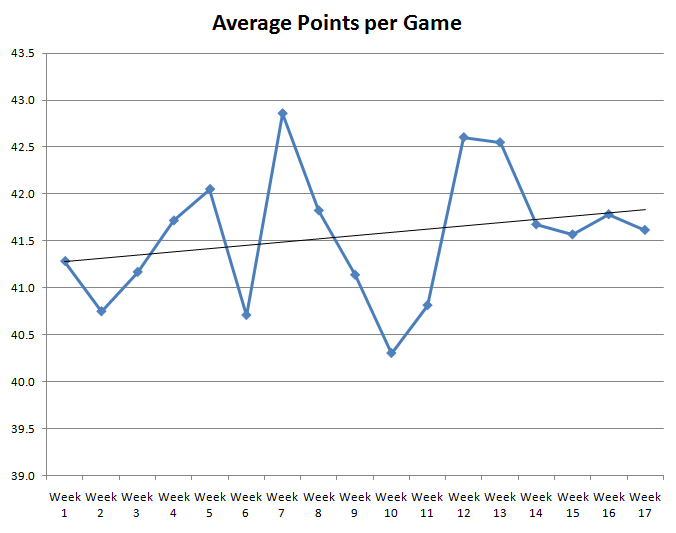
As you can see, the line goes up and down a lot. The thin black line is a least-squared best fit line, which shows a general trend upward. So as the seasons progresses, and temperatures drop, average points scored increases slightly, but that could easily be random variation.
That is about as far as I can take it. For a general opinion about how weather affects sports betting in general, I turned to my friend Jason Been, who is an expert on the topic. Here is what he said:
In most cases, wind is the predominant aspect of weather that most affects a game; but, it is not the only one. In baseball and other outdoor sports, shadows can have an equal affect, especially during early- and late-season baseball afternoon games. Rain or snow isn’t as big of a factor as most people think in football, as it generally affects both the offense and defense equally. An example would be a defensive back against a wide receiver. The rain and snow would slow them down equally, thus giving neither side an edge. Wind can simply eliminate a passing game in football along with kicking. I have seen games where a passing team has been forced to run the ball almost every play due to a strong crosswind. It doesn’t happen often, but on occasion the wind is the ultimate decider of a game.This question was raised and discussed in the forum of my companion site Wizard of Vegas.
Win, Loss, or Tie Against Spread According to Margin of Victory or Defeat the Previous Game
| Previous Game Outcome | Win Against Spread | Loss Against Spread | Tie Against Spread | Win Ratio | Standard Deviation |
| Win by 21 or more | 233 | 247 | 17 | 48.54% | 2.28% |
| Win by 14 to 20 | 235 | 219 | 11 | 51.76% | 2.35% |
| Win by 10 to 13 | 188 | 180 | 8 | 51.09% | 2.61% |
| Win by 7 to 9 | 198 | 181 | 12 | 52.24% | 2.57% |
| Win by 4 to 6 | 164 | 170 | 12 | 49.10% | 2.74% |
| Win by 3 | 202 | 212 | 14 | 48.79% | 2.46% |
| Loss by 2 to win by 2 | 184 | 188 | 14 | 49.46% | 2.59% |
| Loss by 3 | 209 | 207 | 12 | 50.24% | 2.45% |
| Loss by 4 to 6 | 174 | 163 | 9 | 51.63% | 2.72% |
| Loss by 7 to 9 | 187 | 195 | 9 | 48.95% | 2.56% |
| Loss by 10 to 13 | 173 | 189 | 14 | 47.79% | 2.63% |
| Loss by 14 to 20 | 220 | 232 | 15 | 48.67% | 2.35% |
| Loss by 21 or more | 249 | 233 | 15 | 51.66% | 2.28% |
Table based on every NFL game from week 1 of the 2000 season to week 4 of the 2010 season.
New York Giants 2.750
Dallas Cowboys 1.513
Both figures represent what you will get back for one unit wagered if you win, including your original wager. When the decimal odds are greater than or equal to 2, then the translation is easy: just subtract one, and then multiply by 100. If the odds are less than 2, then (1) subtract 1, (2) take the inverse, and (3) multiply by -100.
For those of you who prefer a formula, if the decimal odds pay x, here is the calculation for the equivalent American odds:
If x>=2: 100*(x-1)
If x<2: -100/(x-1)
In the example above, the lines in the American format are:
New York Giants: 100*(2.750-1) = +175
Dallas Cowboys: -100/(1.513-1) = -195
You can also automatically convert all the lines by selecting "American Odds" in the pulldown menu in the upper left of Pinnacle’s web site, above the logo.
At the time of this writing, 95 games have been played out of 256 in the regular season. Using the binomial distribution, I show your probability of winning is 99.87%. A fair settlement price would be $998.02.
This question was raised and discussed in the forum of my companion site Wizard of Vegas.
"A book may not unilaterally rescind any wager without the prior written approval of the chairman." -- Nevada Regulation 22.115
While this right exists, based on anecdotal evidence, it is very seldom invoked. Let me know what happens.
p.s. I was notified later by the questioner that he was paid without much trouble.
Going by the mean, the over looks to be the right side. Going player by player, the probability of 11 or more Scrabble points is 0.641894, which converts to a fair line of -179. So that makes the over at -115 an outstanding bet. Laying 115, the player has a 20% advantage on the over.
Unfortunately, by the time I went to bet it the line had moved to -180.
Scrabble Points in First Player to Score a Touchdown in Super Bowl
| Name | Posted Odds | Fair Probability | Adjusted Probability | Total Scrabble Points | Expected Scrabble Points |
|---|---|---|---|---|---|
| Mendenhall | 4 | 0.200000 | 0.120421 | 20 | 2.408416 |
| Jennings | 4.5 | 0.181818 | 0.109473 | 22 | 2.408416 |
| Starks | 5 | 0.166667 | 0.100351 | 10 | 1.003507 |
| Wallace | 7 | 0.125000 | 0.075263 | 15 | 1.128945 |
| Ward | 8 | 0.111111 | 0.066900 | 8 | 0.535204 |
| Rodgers | 8 | 0.111111 | 0.066900 | 10 | 0.669005 |
| Nelson | 8 | 0.111111 | 0.066900 | 9 | 0.602104 |
| Miller | 10 | 0.090909 | 0.054737 | 11 | 0.602104 |
| Driver | 10 | 0.090909 | 0.054737 | 11 | 0.602104 |
| Jones | 12 | 0.076923 | 0.046316 | 15 | 0.694735 |
| Roethlisberger | 12 | 0.076923 | 0.046316 | 22 | 1.018945 |
| Sanders | 15 | 0.062500 | 0.037632 | 9 | 0.338684 |
| Brown | 18 | 0.052632 | 0.031690 | 12 | 0.380276 |
| Redman | 18 | 0.052632 | 0.031690 | 11 | 0.348587 |
| Quarless | 20 | 0.047619 | 0.028672 | 19 | 0.544761 |
| Kuhn | 25 | 0.038462 | 0.023158 | 12 | 0.277894 |
| Jackson | 30 | 0.032258 | 0.019423 | 24 | 0.466145 |
| Moore | 30 | 0.032258 | 0.019423 | 8 | 0.155382 |
| Totals | 1.660842 | 1.000000 | 14.185214 | ||
Unfortunately, by the time I went back to the casino to bet it the line had moved to -180.
P.S. Hours before the game I got in a bet at -170. Unfortunately, it lost. The first player to score a touchdown was Jordy Nelson. Nelson has 9 Scrabble points.
What is more interesting is the overs and unders. The over won 148, the under 114, and 5 landed on a push. Of bets resolved, the over won 56.5% of the time. The probability of the under winning 114 games or less out of 262 resolved is 2.1%.
The probability of at least one safety per game is 5.77%, based on historical experience.
The expected number of safeties per game would be -ln(1-0.0577) = 0.0594.
The expected number per quarter per team would be 0.0594/8 = 0.0074.
The probability of exactly two safeties by the same team in a single quarter would be e-0.0074×0.00742/fact(2) = 1 in 36,505.
In an NFL season there are 267 games, and 267×8=2,136 team quarters. So, according to my estimate, this will occur on average once every 36,505/2,136 = 17.1 years.
This should be considered as just a rough guess. There are factors to the game that I'm not taking into account, in the interest of simplicity.
- Bills +3.5 (+3)
- Chargers +7.5 (+7)
- Cardinals -2.5 (-3)
- Dolphins -2.5 (-3)
- Bears +2.5 (0)
What is my advantage on this bet?
The table below shows the line you got and the market price line.
First, the probability of an underdog beating the spread is 51.6%. That equates to a fair line of -106.6 on the underdog. So, you're getting 6.6 basis points on the underdogs, and losing them on the favorites.
Second, my table on buying a half point in the NFL shows the fair price to pay for each extra half point. For example, getting the extra half point off of 3 is worth laying -121.4, or 21.4 basis points.
The table breaks down how many basis points you're getting. For the Bears, I doubled the basis points for 1 and 2, since you're turning a loss into a win if you cross those numbers.
The table then converts the total basis points to a probability of winning. The formula is p = (100+b)/(200+b), where p = probability of winning and b = number of basis points.
The bottom row takes the product of each leg winning, for a probability of winning the parlay of 0.046751. At odds of 25 for 1, that bet has an expected return of 0.046751*25-1=0.168783. In other words, a 16.9% advantage. Well done!
Rudeboyoi Parlay Card
| Team | Parlay Card |
Fair | Underdog Basis Points |
Total Extra Points |
Total | Probability |
|---|---|---|---|---|---|---|
| Bills | 3.5 | 3 | 6.6 | 20.8 | 27.4 | 0.560246 |
| Chargers | 7.5 | 7 | 6.6 | 11.9 | 18.5 | 0.542334 |
| Cardinals | -2.5 | -3 | -6.6 | 20.8 | 14.2 | 0.533147 |
| Dolphins | -2.5 | -3 | -6.6 | 20.8 | 14.2 | 0.533147 |
| Bears | 2.5 | 0 | 0 | 18.0 | 18.0 | 0.541321 |
| Product | 0.046751 | |||||
Based on every NFL game from the 1983 to 2012 seasons, a specific side of any given game was shut out. However, as a seven-point underdog, in a game with an average over/under, I would argue the probability of the Giants being shutout were higher than average. The over/under in that game was 41. Let's do a little algebra to solve for the expected number of Giants points.
Let:
s=Seahawks points
g=Giants points
We know that s+g=41 and s=g+7, based on the point spread and over/under total.
Substituting the second equation into the first:
(g+7) + g = 41
2g +7 = 41
2g = 34
g = 17
Next, let's look at the probability of a shutout by the estimated number of points of each team, based on the 1983 to 2012 seasons. I skipped any rows where the sample size was zero.
Probability of Shutout
| Estimated Points |
Sample Size | Shutouts | Ratio |
|---|---|---|---|
| 5.25 | 1 | 0 | 0.0% |
| 6.50 | 1 | 0 | 0.0% |
| 7.75 | 1 | 0 | 0.0% |
| 8.00 | 1 | 0 | 0.0% |
| 8.25 | 3 | 0 | 0.0% |
| 8.50 | 2 | 0 | 0.0% |
| 8.75 | 2 | 0 | 0.0% |
| 9.00 | 2 | 0 | 0.0% |
| 9.50 | 4 | 0 | 0.0% |
| 9.75 | 6 | 1 | 16.7% |
| 10.00 | 10 | 1 | 10.0% |
| 10.25 | 7 | 0 | 0.0% |
| 10.50 | 14 | 2 | 14.3% |
| 10.75 | 7 | 1 | 14.3% |
| 11.00 | 13 | 1 | 7.7% |
| 11.25 | 21 | 1 | 4.8% |
| 11.50 | 22 | 3 | 13.6% |
| 11.75 | 23 | 1 | 4.3% |
| 12.00 | 34 | 2 | 5.9% |
| 12.25 | 36 | 7 | 19.4% |
| 12.50 | 41 | 3 | 7.3% |
| 12.75 | 39 | 4 | 10.3% |
| 13.00 | 55 | 1 | 1.8% |
| 13.25 | 58 | 5 | 8.6% |
| 13.50 | 78 | 1 | 1.3% |
| 13.75 | 89 | 5 | 5.6% |
| 14.00 | 92 | 4 | 4.3% |
| 14.25 | 108 | 7 | 6.5% |
| 14.50 | 117 | 8 | 6.8% |
| 14.75 | 141 | 7 | 5.0% |
| 15.00 | 160 | 7 | 4.4% |
| 15.25 | 160 | 7 | 4.4% |
| 15.50 | 213 | 7 | 3.3% |
| 15.75 | 198 | 11 | 5.6% |
| 16.00 | 206 | 6 | 2.9% |
| 16.25 | 221 | 12 | 5.4% |
| 16.50 | 241 | 10 | 4.1% |
| 16.75 | 273 | 7 | 2.6% |
| 17.00 | 306 | 8 | 2.6% |
| 17.25 | 305 | 8 | 2.6% |
| 17.50 | 306 | 10 | 3.3% |
| 17.75 | 323 | 4 | 1.2% |
| 18.00 | 299 | 8 | 2.7% |
| 18.25 | 332 | 8 | 2.4% |
| 18.50 | 309 | 9 | 2.9% |
| 18.75 | 307 | 7 | 2.3% |
| 19.00 | 356 | 8 | 2.2% |
| 19.25 | 389 | 5 | 1.3% |
| 19.50 | 361 | 5 | 1.4% |
| 19.75 | 343 | 6 | 1.7% |
| 20.00 | 402 | 8 | 2.0% |
| 20.25 | 379 | 6 | 1.6% |
| 20.50 | 359 | 3 | 0.8% |
| 20.75 | 353 | 5 | 1.4% |
| 21.00 | 344 | 1 | 0.3% |
| 21.25 | 317 | 3 | 0.9% |
| 21.50 | 341 | 2 | 0.6% |
| 21.75 | 331 | 1 | 0.3% |
| 22.00 | 369 | 1 | 0.3% |
| 22.25 | 336 | 0 | 0.0% |
| 22.50 | 316 | 2 | 0.6% |
| 22.75 | 280 | 3 | 1.1% |
| 23.00 | 311 | 1 | 0.3% |
| 23.25 | 290 | 3 | 1.0% |
| 23.50 | 279 | 1 | 0.4% |
| 23.75 | 255 | 1 | 0.4% |
| 24.00 | 246 | 1 | 0.4% |
| 24.25 | 219 | 0 | 0.0% |
| 24.50 | 230 | 2 | 0.9% |
| 24.75 | 230 | 1 | 0.4% |
| 25.00 | 212 | 2 | 0.9% |
| 25.25 | 207 | 0 | 0.0% |
| 25.50 | 176 | 1 | 0.6% |
| 25.75 | 154 | 0 | 0.0% |
| 26.00 | 154 | 1 | 0.6% |
| 26.25 | 113 | 0 | 0.0% |
| 26.50 | 137 | 0 | 0.0% |
| 26.75 | 122 | 0 | 0.0% |
| 27.00 | 95 | 0 | 0.0% |
| 27.25 | 98 | 0 | 0.0% |
| 27.50 | 83 | 0 | 0.0% |
| 27.75 | 81 | 0 | 0.0% |
| 28.00 | 82 | 0 | 0.0% |
| 28.25 | 55 | 1 | 1.8% |
| 28.50 | 56 | 0 | 0.0% |
| 28.75 | 51 | 0 | 0.0% |
| 29.00 | 48 | 0 | 0.0% |
| 29.25 | 34 | 0 | 0.0% |
| 29.50 | 24 | 0 | 0.0% |
| 29.75 | 25 | 0 | 0.0% |
| 30.00 | 24 | 0 | 0.0% |
| 30.25 | 21 | 0 | 0.0% |
| 30.50 | 18 | 0 | 0.0% |
| 30.75 | 23 | 0 | 0.0% |
| 31.00 | 16 | 0 | 0.0% |
| 31.25 | 15 | 0 | 0.0% |
| 31.50 | 8 | 0 | 0.0% |
| 31.75 | 3 | 0 | 0.0% |
| 32.00 | 6 | 0 | 0.0% |
| 32.25 | 7 | 0 | 0.0% |
| 32.50 | 6 | 0 | 0.0% |
| 32.75 | 3 | 0 | 0.0% |
| 33.00 | 4 | 0 | 0.0% |
| 33.25 | 6 | 0 | 0.0% |
| 33.50 | 5 | 0 | 0.0% |
| 34.75 | 4 | 0 | 0.0% |
| 35.00 | 2 | 0 | 0.0% |
| 35.50 | 1 | 0 | 0.0% |
| 36.00 | 2 | 0 | 0.0% |
| 36.25 | 1 | 0 | 0.0% |
| 36.50 | 1 | 0 | 0.0% |
| 37.25 | 1 | 0 | 0.0% |
| 37.75 | 2 | 0 | 0.0% |
| 42.25 | 1 | 0 | 0.0% |
The next steps are too involved to explain here, but I developed a formula for the probability of a shutout, given the number of estimated points.
p = Estimated points.
x = 1.562545 -0.302485 * p
probability of shutout = ex/(1+ex)
The following chart shows the actual and estimated probability of a shutout for 14 to 22 points.
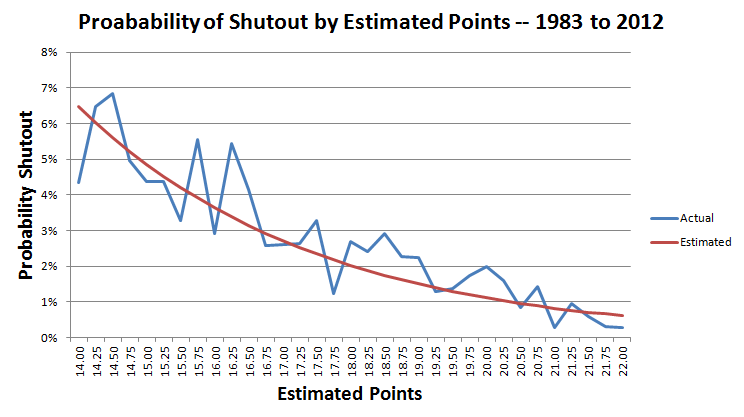
In the game in question the Giants expected to score 17 points.
Using the formula above the table:
x = 1.562545 -0.302485 * 17 = -3.579706
Probability of a shutout = exp(-3.579706)/( exp(-3.579706)+1) = 2.71%. To be exact, 0.0271275.
Given that the dealership would have had to pay $420,000 in the event of a Giants shutout, the fair cost of the policy would have been $420,000 × 0.0271275 = $11,394. Normally insurance companies that insure unusual promotions like this double the fair cost, so I would have expected to see a premium of $22,788. So, the $7,000 premium the dealership paid was a steal. Assuming the boss reviews the math, I wouldn't want to be in the shoes of the whoever calculated that $7,000 premium.
This question was raised and discussed in my forum at Wizard of Vegas.
House Edge in Sports Futures
| Sports Book | House Edge |
|---|---|
| CG Technology | 21.90% |
| William Hill | 26.63% |
| Wynn | 27.96% |
| Caesars | 35.49% |
| Stations/El Cortez | 38.33% |
| Golden Nugget | 39.75% |
| MGM | 40.88% |
| Boyd/Coast | 49.35% |
| TI | 57.93% |
To calculate the average house edge on any set of futures bets, please use my Sports Futures Calculator.
You can find all the current parlay and teasers odds around Vegas at my sports book survey at Wizard of Vegas.com.
For more on football teasers in general, please see my page on Teaser Bets in the NFL.
Let's assume that the fair over/under line is 51. The first table shows that the probability of winning betting under 52.5 is 54.4%, assuming no tie. The third table shows that the probability of winning betting over is 53.5%.
To beat the 10% juice, you need to have a probability of winning of 11/21 = 52.38%. The average of these two bets is 53.95%, so, yes, play that middle. Your advantage is 3.0%.
Don't you think I could lock in a win betting Carolina to win the NFC and hedging along the way, betting the money line on whoever they play?
First of all, the Panthers are only in the playoffs because they are the least bad team in an awful division (the NFC South). Their record is 7-8, and they have given up 35 more points than they have scored all season.
If they are so bad, why are they six point favorites against the Arizona Cardinals, you might ask? Arizona made the playoffs mostly on the efforts of Carson Palmer in the first six games. He was injured in the sixth game, but they still managed to squeak into the playoffs anyway. Plus, Carolina enjoys home field advantage.
Given that Carolina is a six-point favorite against Arizona, I show their probability of winning that game is 70.3%.
Assuming they win, they will mostly likely have to beat both Green Bay and Seattle to win the NFC. What are the odds of beating those two teams? Keep in mind, given the playoff rules, they will be the visiting team both times.
There is an easy way to get a close estimate of the point spread in any game. Here is my Wizard formula for the point spread on the home team:
(Net points per game of away team) - (Net points per game of home team) - 2.67.
Let's look at a hypothetical match-up between Arizona and Green Bay.
During the 2014 season, Carolina has -35 net points all season. For Green Bay, it is +138. Divide both numbers by 16, because there are 16 played games in the season, for an average margin of victory per game of:
Carolina: -2.1875
Green Bay: +8.6250
Using my formula, the home team, Green Bay, should have a spread of -2.1875 - 8.6250 - 2.67 = -13.4825.
So, Green Bay would be about a 13.5-point favorite against Carolina. I'll skip the math over this step, but I show the probability of Carolina winning as a 13.5-point underdog is 14.3%.
Seattle has just about as strong a record as Green Bay, with 140 net points all season. So Carolina would also have about a 14.3% chance of winning that game.
The odds of Carolina winning all three games are 70.3% × 14.3% × 14.3% = 1.44%. So, a fair futures bet at that probability is 68.6 to 1!
Yes, you could argue that Detroit or Dallas might get lucky and make the Conference Championship. You could also argue that the odds of Carolina beating Green Bay and Seattle are positively correlated. However, those are minor considerations against the fact that my rough fair line is 68.6 and you're getting only 18.
You also have to consider the expense of betting the favorites on the money line as you go. This is generally an awful bet. Square bettors love to bet big favorites on the money line, creating value in the other direction. It is roughly a fair bet to take underdogs of seven points or more on the money line, meaning that the favorite bettors are paying all the juice.
Let's be generous and assume you could get +250 on Arizona and lay 5 to 1 in the following two games. Let's also say you bet $100 on Carolina at 18 to 1.
First, you bet $40 on Arizona at +250 as a hedge. If they win you win $100 on that bet and lose $100 on the futures bet and break even.
If Carolina beats Arizona you bet $700 to win $140 on Seattle. If Seattle wins, which they should, you'll be up $140, which will recoup your losses on Arizona and the futures bet, so you'll be even.
If Carolina should upset Carolina you will have to bet $4,200 to win the $840 you will have lost betting on Arizona, Seattle, and the futures bet. If Carolina loses, you'll be even. If they win you'll be down $40+$700+$4,200=$4,940. The $1,800 you'll win on the futures bet will not be enough to recoup that.
In closing, your idea of taking Carolina to win the NFC and hedge along the way is highly ill-advised.
- Every player pays the same amount to play.
- Every week every player must predict the winner of one game that week. All games are scored straight up, not against the spread.
- If a player is ever wrong he is immediately eliminated from the contest.
- No player may choose the same team more than once.
- The last man standing wins the pot.
There may be additional rules, like the person running the pool getting a cut, and splitting the pot once it gets down to a few people, if and only if by mutual agreement.
Before going further, here are the results from last season from officefootballpool.com.
Office Football Pool — 2014 Season
| Week | Team | Spread | Picks |
|---|---|---|---|
| 1 | Phil | -10.5 | 54 |
| 1 | Chic | -7 | 29 |
| 1 | Pit | -6.5 | 14 |
| 1 | Det | -6 | 6 |
| 1 | KC | -3 | 5 |
| 1 | NYJ | -5.5 | 5 |
| 1 | NE | -4 | 1 |
| 1 | SF | -4.5 | 1 |
| 1 | StL | -3.5 | 1 |
| 2 | Den | -12.5 | 38 |
| 2 | GB | -8 | 23 |
| 2 | NO | -6.5 | 7 |
| 2 | SF | -7 | 5 |
| 2 | TB | -5.5 | 3 |
| 2 | Wash | -6 | 2 |
| 2 | Cin | -5.5 | 1 |
| 2 | NE | -5.5 | 1 |
| 3 | NE | -14 | 44 |
| 3 | NO | -10 | 16 |
| 3 | Atl | -6.5 | 3 |
| 3 | Cin | -6.5 | 1 |
| 3 | Ind | -6 | 1 |
| 4 | SD | -13 | 34 |
| 4 | Ind | -7.5 | 20 |
| 4 | Pit | -7.5 | 10 |
| 4 | Bal | -3 | 1 |
| 5 | NO | -10 | 21 |
| 5 | GB | -8 | 13 |
| 5 | Den | -7.5 | 6 |
| 5 | Det | -6.5 | 5 |
| 5 | Phil | -6.5 | 3 |
| 5 | Dal | -6.5 | 2 |
| 5 | Pit | -6 | 2 |
| 5 | SD | -6.5 | 1 |
| 5 | Sea | -7 | 1 |
| 5 | SF | -5 | 1 |
| 6 | Sea | -8.5 | 21 |
| 6 | Den | -9.5 | 13 |
| 6 | SD | -7 | 7 |
| 6 | Cin | -6.5 | 5 |
| 6 | Ten | -4 | 2 |
| 6 | Atl | -3 | 1 |
| 6 | SF | -3 | 1 |
| 7 | NE | -9.5 | 9 |
| 7 | Sea | -6.5 | 9 |
| 7 | GB | -6.5 | 3 |
| 7 | Bal | -6.5 | 2 |
| 7 | Buf | -5.5 | 2 |
| 7 | Wash | -5 | 2 |
| 7 | Dal | -6.5 | 1 |
| 8 | Dal | -9.5 | 12 |
| 8 | KC | -7 | 5 |
| 8 | Clev | -7 | 1 |
| 8 | Mia | -6 | 1 |
| 9 | SF | -10 | 3 |
| 9 | Cin | -10.5 | 2 |
| 9 | Sea | -14.5 | 2 |
| 10 | Bal | -9.5 | 2 |
| 10 | Cin | -6 | 1 |
| 10 | Sea | -9 | 1 |
| 11 | GB | -5.5 | 1 |
| 11 | Mia | -6 | 1 |
| 11 | NO | -7 | 1 |
| 12 | Ind | -14 | 2 |
| 13 | Bal | -6.5 | 1 |
| 13 | Det | -7 | 1 |
| 14 | NO | -10 | 1 |
The "picks" column refers to the number of players who picked that team.
Note that not once did anybody ever pick an underdog. In the 497 picks made, the average point spread was 9.3.
I do not know why they recorded a pick in week 14, because there was only one player left at that point.
Based on this study of other player behavior, here is my basic strategy for suicide pools. These are all just general guidelines and not hard and fast rules that you must follow every week.
- Remember that your enemy is the other players. Don't focus too much on handicapping the NFL but on beating your competition.
- Don't pick the biggest favorite. That is what most other people will do. Hopefully that big favorite will lose and the field will be significantly thinned down. You want to be a survivor rather than a victim when a huge favorite loses.
- Don't forget the rule that you can't pick the same team twice. That said, you can't always pick great teams. At times you should pick average teams playing awful teams, to preserve the easy wins on the best teams.
- Don't bother handicapping. Just use the point spread as an indicator of your chances to win any given pick.
- If a week has exactly two huge favorites, I would avoid both of them. Remember that you're trying to balance picking games likely to win while not following the masses. As a very general rule, I think picking the third highest spread is a good idea, especially if you're not wasting one of the best teams.
This question is raised and discussed in my forum at Wizard of Vegas.
The new rule moves back the extra kick to the 15-yard line. This should lower the probability of success of the kick and induce more two-point conversion attempts. With more two-point conversion attempts, whether successful or not, there should not be as many games decided by three or seven points, thus lowering the value of getting the extra half point off these key numbers on half point parlay cards. Should we be worried? Let's see.
First, we should worry, but necessarily for this reason. Other rule changes have hampered the aggressiveness of the defense, leading to higher scoring games. The following graph shows the average number of points scored per game for each season from 1994 to 2014.
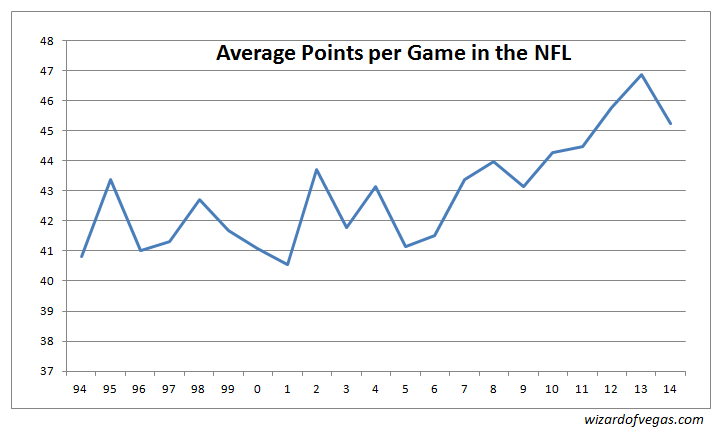
As the graph shows, the average points per game held close to 42 through 2006. However, starting in 2007, the average has been going up by about half a point per year. This leads to the question of whether this increase in the average score tends to flatten out the margin of victory distribution, especially for the magic numbers of 3 and 7. The next graph shows the probability of a three- and seven-point margin of victory by year.
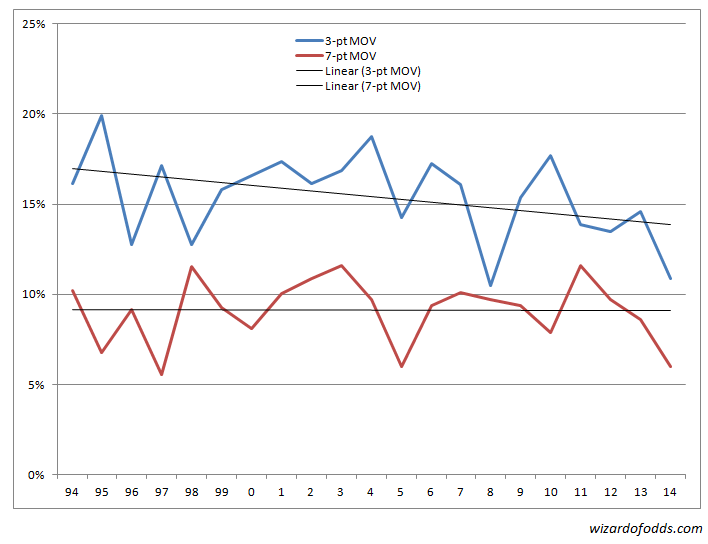
As you can see, the probability of a seven-point margin of victory is holding steady at 9.1%. However, the probability of a three-point margin of victory has been steadily declining, especially since 2004. This is bad because there are so many points spreads of three in the NFL.
Whatever the cause of the fewer three-point margins of victory, the value of the half point parlay cards is declining. Is it going to get even worse with the new extra point rule?
My answer is that it should hurt but not by much. Before the rule change, I calculate about 4.8% of touchdowns were followed by a two-point conversion attempt. As I write this, there have only been two weeks of games played since the rule change. In the first two weeks of the 2015 season, there were 167 touchdowns and 15 were followed by a two-point conversion attempt, for an attempt rate of 9.0%.
Mathematically speaking, I think going for the two-point conversion should be much more common, especially for variance-seeking weaker teams, and I don't understand why it isn't. That isn't what you asked, but I just had to get it off my chest.
However, remember that the optimal strategy for bankroll growth with any advantage play is to use the Kelly Criterion. According to Kelly, the optimal bet size is that which maximizes the expected log of the bankroll after the bet. For bets with just two possible outcomes, the optimal bet size is conveniently the advantage divided by what the bet pays on a "to one" basis.
Straight bets pay 10 to 11. That would make the optimal bet size 0.030909/(10/11) = 0.034000. At a player advantage of 3.09%, you can expect to win 0.001051 times your bankroll per game straight betting.
The optimal bet size on the parlay is 0.102248/6 = 0.017041. At a player advantage of 0.102248, you can expect to win 0.001742 times your bankroll per game straight betting .
However, straight betting is better because you get to bet three times. So multiply the expected gain per bet of flat betting by three to get 3 × 0.001051 = 0.003153. This is 81% more than the bankroll growth of parlay bets.
If your bankroll is so great that you bump against maximum bet limits, then you probably should make a parlay bet first, which tend to not move lines, and then get in your straight bets.
This question is raised and discussed in my forum at Wizard of Vegas.
- Probability of success by kicking.
- Probability of success by going for the two-point conversion.
- Overall chances of each team winning.
Late in the game, it is also critical to consider the key numbers. For example, if it is very late in the game and you just scored a touchdown to put your team ahead by three points, then you should kick. If you make it, you will be up by four points and force the other team to score a touchdown to win. If you go for two points, and miss, the other team can tie with only a field goal. So, I am going to limit my discussion to early in the game, when key numbers are not a big factor.
To answer your question, I wrote a simulation program. While it is rather crude, I think it is fairly accurate at reflecting the nature of the NFL in terms of field goals, touchdowns, and turnovers.
According to the article What Effect Will Moving Extra Points to the 15 Yard Line Have? by Kevin Rudy, the probability of making the extra point from the 15-yard line is 94.2%. I put into my program 94%, to keep the numbers nice and round.
There is more disagreement on the probability of making a two-point conversion. It would seem obvious this would also vary significantly according to the particular defense and offense. What I did was run simulations at two-point conversion success of 46% to 50%, in groups of 1%.
In each simulation, I had one team always kick and the opponent go for the conversion at each probability of success. I also ran simulations where both teams always kicked, to have something to compare the two-point conversion results against.
Table 1 below shows the results of two equally skilled teams. Team A always kicks after a touchdown. The table shows the probability team B winning and average additional points scored per game according to whether team B kicks or goes for the two-point conversion (2PC) and its probability of success.
Table 1 — Equal Teams
| Team B Strategy |
Team B Prob. Win |
Avg. Additional Points |
|---|---|---|
| Kick | 50.00% | 0.0001 |
| 2PC -- 46% | 49.76% | 0.0491 |
| 2PC -- 47% | 49.90% | 0.0000 |
| 2PC -- 48% | 50.05% | 0.0492 |
| 2PC -- 49% | 50.19% | 0.0980 |
| 2PC -- 50% | 50.33% | 0.1461 |
Note that with a probability of success of 47%, the expected additional points is 0.94 whether kicking or going for two points. However, the probability of winning is 0.1% less going for two points. I figure that is because if you miss, then the other team has the chance to tie with two field goals. It should be noted that this key number effect is quite small but does favor being conservative and kicking, all other things being equal. The bottom line is, with two equal teams, the probability of success with the two-point conversion should be at least 49% to go for it.
Table 2 below shows the results of two unequal teams, where team A is stronger. Team A always kicks after a touchdown. It shows the same statistics as table 1 above.
Table 2 — Team A Stronger
| Team B Strategy |
Team B Prob. Win |
Avg. Additional Points |
|---|---|---|
| Kick | 28.83% | -7.0039 |
| 2PC -- 46% | 29.01% | -7.0519 |
| 2PC -- 47% | 29.16% | -7.0039 |
| 2PC -- 48% | 29.30% | -6.9568 |
| 2PC -- 49% | 29.45% | -6.9083 |
| 2PC -- 50% | 29.60% | -6.8595 |
Table 2 shows the weaker team should go for the two-point conversion at all listed probabilities of success. Even at 45%, where the expected number of total points scored is less. Why is this, you might ask. This is because in any game, the weaker team should seek variance and the stronger team should abhor it.
Table 3 below shows the results of two unequal teams, where team B is stronger. Team A always kicks after a touchdown. It shows the same statistics as tables 1 and 2 above.Table 3 — Team B Stronger
| Team B Strategy |
Team B Prob. Win |
Avg. Additional Points |
|---|---|---|
| Kick | 71.17% | 7.0042 |
| 2PC -- 46% | 70.53% | 6.9349 |
| 2PC -- 47% | 70.67% | 7.0030 |
| 2PC -- 48% | 70.82% | 7.0725 |
| 2PC -- 49% | 70.97% | 7.1412 |
| 2PC -- 50% | 71.12% | 7.2109 |
Note that table 3 shows a probability of team B winning equal to 71.17% by kicking. It is less than that for all probabilities of success shown, even though the expected number of points is greater at a probability of success of 49% or 50%. The reason, again, is that weak teams should seek variance and strong ones should avoid it. The two-point conversion attempt adds volatility to the game, which is why weaker teams should be more inclined to attempt them, all other things being equal, than strong teams.
Yes +425?
No -550?
[(Average offensive points) + (Average points allowed by opposing team)]/2 + (1.5 if playing at home, otherwise -1.5).
The point spread will be (Expected visiting team points) - (Expected home team points).
Let's look at the week 13 game against the Saints as an example. The Panthers are the visiting team. The Panthers have scored 32.3 offensive points per game on average this season. The Saints have given up 30.8 per game, on average. Using my formula, the Panthers can expect to score (32.3+30.8)/2 - 1.5 = 30.05 points.
Then, do the same for the Saints. They have scored 23.7 offensive points per game on average this season. The Panthers have given up 18.6 per game, on average. My formula yields (23.7 + 18.6)/2 + 1.5 = 22.65 points scored by the Saints.
Therefore, the Panthers can expect to win by 30.05 - 22.65 = 7.4 points. Next, use my Prop Bet Calculator to determine the probability of winning each game. My calculator will ask for the over/under on the game, but I find for who will win straight up the only thing that really matters is the spread. For the total just put in an NFL average this season of 46. You'll see that for a point spread of 7.4 the fair line of the home team winning is +271. That means the fair line on the Panthers is -271. That equates to a probability of winning of 271/371 = 73.05%.
Then just do that for the other four games and take the product. Or you can just use the table below.
Panthers Weeks 13 to 17
| Week | Opposing Team |
Location | Expected Panther Points |
Expected Opponent Points |
Panthers Winning Margin |
Panthers Fair Line |
Probability Win |
|---|---|---|---|---|---|---|---|
| 13 | Saints | Away | 30.05 | 22.65 | 7.4 | -271 | 0.730458 |
| 14 | Falcons | Home | 28.3 | 19.6 | 8.7 | -323 | 0.763593 |
| 15 | Giants | Away | 27.05 | 23.85 | 3.2 | -154 | 0.606299 |
| 16 | Falcons | Away | 25.3 | 22.6 | 2.7 | -144 | 0.590164 |
| 17 | Buccaneers | Home | 30.35 | 19.05 | 11.3 | -458 | 0.820789 |
Taking the product of the probability column you get the probability of winning all five games, which is 0.163813. That corresponds to a fair line of +510. So, neither of those lines you quoted are good.
This question was raised and discussed in my forum at Wizard of Vegas.
This question was raised and discussed in my forum at Wizard of Vegas.
As you probably know, 16-seed UMBC beat 1-seed University of Virginia in the NCAA basketball championship tournament. This has never happened before in the 34-year history of March Madness in its present format. How does this affect the probability of filling out a perfect bracket.
After adjusting my model for that game and all others in the 2018 season, I get a probability of a perfect bracket of 1 in 42,743,890,552. You can read my strategy and how I arrived at that figure in my page Probability of a Perfect Bracket.
Let's let a be the odds expressed the American way and e the European way.
To go from American to European:
If a>0, then e=1+(a/100).
If a<0, then e=(a-100)/a.
To go from European to American:
If e>=2, then a=100×(e-1).
If e<2, then a=100/(1-e).
I've seen proposition bets at William Hill sports books on whether any Major League Baseball game will have a Grand Slam on a given day. What is the fair probability and line on this by the number of games played?
For the benefit of other readers, here are the lines for a Grand Slam for May 11, 2019. The column headings should say "yes" and "no," not "home" and "away."

To answer this question, I looked at every MLB game from the 2011 to 2018 seasons. In those eight seasons, there were 858 Grand Slams over 19,440 games. That makes the average number of Grand Slams per game 0.0441. This is not the same as the probability any given game will have a Grand Slam, because one game can have more than one. Using the Poisson distribution, the probability of any given game having at least one Grand Slam is 4.3176%.
With that probability it is easy to create the following table showing the probability and fair line for at least one Grand Slam by number of games.
Grand Slam Probability
| Games | Probability Grand Slam |
Fair Line |
|---|---|---|
| 1 | 4.32% | 2216 |
| 2 | 8.45% | 1084 |
| 3 | 12.40% | 706 |
| 4 | 16.18% | 518 |
| 5 | 19.80% | 405 |
| 6 | 23.27% | 330 |
| 7 | 26.58% | 276 |
| 8 | 29.75% | 236 |
| 9 | 32.78% | 205 |
| 10 | 35.68% | 180 |
| 11 | 38.46% | 160 |
| 12 | 41.12% | 143 |
| 13 | 43.66% | 129 |
| 14 | 46.09% | 117 |
| 15 | 48.42% | 107 |
| 16 | 50.65% | -103 |
I must add a caveat that my answer is based on MLB averages. For any given day, the player should factor in the specific games being played. In particular, the higher the over/under lines, the greater the chances of a Grand Slam.
A number of sports books, like the MGM in New Jersey, are offering a truly free bet — if the bet looses, they refund in CASH you can then withdraw. Like a 100% loss rebate for slots, but applied to sports betting. What kind of bet should I make under this promotion?
With any free-roll like this, you should shoot for the moon. If they allow parlays, then parlay bet as much as they allow under this promotion and parlay enough events to get up to whatever their maximum payout is, which in Las Vegas is typically around $100,000.
If you have to bet on a single event, then find the biggest long-shot you can.
As an example of why this strategy is best, consider the same promotion in double-zero roulette with a $100 bet. If you make an even-money bet, then the expected amount you'll get back is (18/38)×$200 + (20/38)×$100 = $147.37. However, if you bet on a single number, then you can expect to get back (1/38)×$3600 + (37/38)×$100 = $192.11.
I saw a promotion at an online sports book where a money line bet in the NFL would automatically be graded a winner if the chosen team was up by 17 or more points. What is the value of this?
This promotion will turn what would otherwise be a losing bet into a winner if the chosen team is up by 17 or more points and then loses. A good example of such a situation is a bet on the Atlanta Falcons in Super Bowl 51. At one point, in the third quarter, the Falcons were up 28 to 3, a lead of 25 points. However, they went onto lose 28 to 34.
To answer this question, I looked at 4,131 games played in every NFL season from 2000 to 2015. The following table shows the greatest deficit the winning team had during the course of the game. The probability column filters out the five games that ended in a tie.
Greatest Deficit Overcome
| Deficit | Games | Probability |
|---|---|---|
| Tie | 5 | 0.000000 |
| 0 | 1804 | 0.437227 |
| 1 | 100 | 0.024237 |
| 2 | 29 | 0.007029 |
| 3 | 560 | 0.135725 |
| 4 | 235 | 0.056956 |
| 5 | 23 | 0.005574 |
| 6 | 131 | 0.031750 |
| 7 | 622 | 0.150751 |
| 8 | 39 | 0.009452 |
| 9 | 34 | 0.008240 |
| 10 | 195 | 0.047261 |
| 11 | 84 | 0.020359 |
| 12 | 14 | 0.003393 |
| 13 | 49 | 0.011876 |
| 14 | 104 | 0.025206 |
| 15 | 10 | 0.002424 |
| 16 | 6 | 0.001454 |
| 17 | 36 | 0.008725 |
| 18 | 14 | 0.003393 |
| 19 | 2 | 0.000485 |
| 20 | 4 | 0.000969 |
| 21 | 22 | 0.005332 |
| 22 | 0 | 0.000000 |
| 23 | 2 | 0.000485 |
| 24 | 5 | 0.001212 |
| 25 | 1 | 0.000242 |
| 26 | 0 | 0.000000 |
| 27 | 0 | 0.000000 |
| 28 | 1 | 0.000242 |
| Total | 4131 | 1.000000 |
The "Tie" row represents the five games in the 16 seasons that ended in a tie, so let's not count those. The "0" row represents the 43.7% of games where the winning team was never behind.
The table shows 87 games saw a team losing by 17 or more and then went onto win. Over the 4126 games resolved (i.e. not counting the five ties), this probability is 2.11%.
Given these situations would flip a loss to a win, we double this probability to get a value of 4.22%. The house edge on money line bets is about the same as bets against the spread at 4.76%. Subtracting 4.22%, we get a very low house edge of 0.54% under this promotion.
Now that March Madness 2023 is over, how has your probability of a perfect bracket and expected wins by seed changed?
My strategy for a perfect bracket is to pick the higher seeded team (meaning a lower seed number) in every game. At the end, when it gets to 1 vs. 1 seed, pick randomly. Based on 38 seasons of data. Here are some probabilities for each possible game:
- 1 vs. 16 seed = 99.31%
- 2 vs. 15 seed = 93.06%
- 3 vs. 14 seed = 84.72%
- 4 vs. 13 seed = 78.47%
- 5 vs. 12 seed = 64.58%
- 6 vs. 11 seed = 62.50%
- 7 vs. 10 seed = 60.42%
- 8 vs. 9 seed = 51.39%
To survive the first round, you would need to win all eight of the games listed above four times each. The probability of that is 1/4354.
Here are the various matchups in round 2, assuming you make it that far using this strategy.
- 1 vs. 8 seed = 80.00%
- 2 vs. 7 seed = 69.51%
- 3 vs. 6 seed = 60.00%
- 4 vs. 5 seed = 56.00%
To survive the second round, you would need to win all four of these games listed above four times each. The probability of that is 1/811.
Here are the various matchups in round 3, assuming you make it that far using this strategy.
- 1 vs. 4 seed = 73.44%
- 2 vs. 3 seed = 60.71%
To survive the second round, you would need to win both of these games listed above four times each. The probability of that is 1/54.
In round 4 there will be 1 vs. 2 seed games. The probability of the 1 seed winning is 53.73%. The probability of that happening four times is 0.53734 = 0.112355.
In round 5, there will be two 1 vs. 1 games. The probability of winning each is 1/2, so the probability of winning two is 1/4.
In round 6, there will be one 1 vs. 1 games. The probability of winning is 1/2.
Taking the product of all these probabilities results in a probability of a perfect bracket of 1 in 13,569,150,522.
To answer your other questions, here are the average wins per team, by seed.
- 1 seed = 3.29 average wins
- 2 seed = 2.32 average wins
- 3 seed = 1.85 average wins
- 4 seed = 1.55 average wins
- 5 seed = 1.16 average wins
- 6 seed = 1.07 average wins
- 7 seed = 0.9 average wins
- 8 seed = 0.74 average wins
- 9 seed = 0.59 average wins
- 10 seed = 0.61 average wins
- 11 seed = 0.63 average wins
- 12 seed = 0.51 average wins
- 13 seed = 0.25 average wins
- 14 seed = 0.16 average wins
- 15 seed = 0.11 average wins
- 16 seed = 0.01 average wins