
Wizard Recommends
-
 $11000 Welcome Bonus
 -
 $3000 Welcome Bonus
 -
 UP TO $777 BONUS
Probability - Dice
These bets can be made in both sic bo and chuck a luck.
[Bluejay adds: Uh, yeah, but I think the point was that it was for charity. What’s more fun: Donating £1.00 to charity and getting nothing back but the good feeling of helping out, or donating £1.00 and getting the good feeling plus the longshot chance of winning a car?]
- Five of a kind: 6/65 = 0.08% (obvious)
- Four of a kind: 5*6*5 = 1.93% (five possible positions for the singleton * 6 ranks for the four of a kind * 5 ranks for the singleton).
- Full house: combin(5,3)*6*5/65 = 3.86% (combin(5,3) positions for the three of a kind * 6 ranks for the three of a kind * 2 ranks for the pair).
- Three of a kind: COMBIN(5,3)*COMBIN(2,1)*6*COMBIN(5,2) / 65 = 15.43%. (combin(5,3) positions for the three of a kind * combin(2,1) positions for the larger of the singletons * 6 ranks of the three of a kind * combin(5,2) ranks for the two singletons.
- Two pair: COMBIN(5,2)*COMBIN(3,2)*COMBIN(6,2)*4 / 65 = 23.15% (combin(5,2) positions for the higher pair * combin(3,2) positions for the lower pair * combin(6,4) ranks for the two pair * 4 ranks for the singleton.
- Pair: COMBIN(5,2)*fact(3)*6*combin(5,3) / 65 = 46.30% (combin(5,2) positions for the pair * fact(3) positions for the three singletons * 6 ranks for the pair * combin(5,3) ranks for the singletons.
- Straight: 2*fact(5) / 65 = 3.09% (2 spans for the straight {1-5 or 2-6} * fact(5) ways to arrange the order).
- Nothing: ((COMBIN(6,5)-2)*FACT(5)) / 65 = 6.17% (combin(6,5) ways to choose 5 ranks out of six, less 2 for the straights, * fact(5) ways to arrange the order.
w=1-(1-p)n
1-w = (1-p)n
log(1-w) = log((1-p)n)
log(1-w) = n*log(1-p)
n= log(1-w)/log(1-p)
So in your example n = log(1-.5) / log(1-(1/36)) = log(0.5) / log(35/36) = 24.6051. So if the probability of success is 50% in 24.6 rolls it must be slightly less in 24 rolls.
3 dice: 25.93%
4 dice: 48.77%
5 dice: 66.13%.
Let B = Rolling a 6 with randomly chosen die
Answer = Pr(A given B) = Pr(A and B)/pr(B) = ((2/3)*(1/6))/((2/3)*(1/6)+(1/3)*1) = (2/18)/((2/18)+(6/18)) = 1/4.
Ex(x) = 1 + (5/6)*ex(x) + (1/6)*ex(y), and
Ex(y) = 1 + (5/6)*ex(x)
Solving for these two equations...
Ex(x) = 1 + (5/6)*ex(x) + (1/6)*( 1 + (5/6)*Ex(x))
Ex(x) = 7/6 + (35/36)*Ex(x)
(1/36)*Ex(x) = 7/6
Ex(x) = 36*(7/6) = 42
So the average wait time for two consecutive twos is 42 rolls.
I have the same type of problem, only the expected flips to get two heads, in my site of math problems, see problem 128.
Probability of a Pair or More
| Rolls | Probability |
| 2 rolls | 16.67% |
| 3 rolls | 44.44% |
| 4 rolls | 72.22% |
| 5 rolls | 90.74% |
| 6 rolls | 98.46% |
(8/36)n = 1/41,400,000
log((8/36)n) = log(1/41,400,000)
n × log(8/36) = log(1/41,400,000)
n = log(1/41,400,000)/log(8/36)
n = -7.617 / -0.65321
n = 11.6608
So there you go, the probability of hitting the SuperLotto is the same as rolling a seven or eleven 11.66 times in a row. For those who can’t comprehend a partial throw I would rephrase as the probability falls between 11 and 12 consecutive rolls.
If two dice are rolled over and over, until either of the following events happen, then which is more likely to happen first:
- A total of six and eight is rolled, in either order, with duplicates allowed.
- A total of seven is rolled twice.
Somebody offered me a bet that that the six and eight would occur first. I accepted because seven is the most likely total. However, I lost $2,500 doing this over and over. What are the odds?
Two Sevens before Six and Eight Bet
| Relavant Rolls | Probability | Formula | Outcome |
| 6,8 | 0.142045 | (5/16)*(5/11) | Lose |
| 8,6 | 0.142045 | (5/16)*(5/11) | Lose |
| 6,7,8 | 0.077479 | (5/16)*(6/11)*(5/11) | Lose |
| 7,6,8 | 0.053267 | (6/16)*(5/16)*(5/11) | Lose |
| 8,7,6 | 0.077479 | (5/16)*(6/11)*(5/11) | Lose |
| 7,8,6 | 0.053267 | (6/16)*(5/16)*(5/11) | Lose |
| 7,7 | 0.140625 | (6/16)*(6/16) | Win |
| 6,7,7 | 0.092975 | (5/16)*(6/11)*(6/11) | Win |
| 8,7,7 | 0.092975 | (5/16)*(6/11)*(6/11) | Win |
| 7,6,7 | 0.06392 | (6/16)*(5/16)*(6/11) | Win |
| 7,8,7 | 0.06392 | (6/16)*(5/16)*(6/11) | Win |
Basically, the reason the 6 and 8 is the better side is you can hit those numbers in either order: 6 then 8, or 8 then 6. With two sevens there is only one order, a 7 and then another 7.
The question I have about this bet is that 14.41% still isn’t "statistically significant" [ i.e. p < 0.05 ] , which is usually taken to mean greater than two Standard Deviations from the Mean -- or a probability of less than a *combined* 5% of the event happening randomly on EITHER end of the series.
How many Sevens would have to be rolled in 500 rolls before you could say that there is a less than 2.5% chance that the outcome was entirely random (i.e. that the outcome was statistically significant) ?
Many Thanks & BTW , yours is ABSOLUTELY the BEST web site on the subject of gambling odds & probabilities that I’ve found .... keep up the good work !!!
The 2.5% level of significance is 1.96 standard deviations from expectations. This can be found with the formula =normsinv(0.025) in Excel. The standard deviation of 500 rolls is sqr(500*(1/6)*(5/6)) = 8.333. So 1.96 standard deviations is 1.96 * 8.333 = 16.333 rolls south of expectations. The expected number of sevens in 500 throws is 500*(1/6) = 83.333. So 1.96 standard deviations south of that is 83.333 − 16.333 = 67. Checking this using the binomial distribution, the exact probability of 67 or fewer sevens is 2.627%.
Yahtzee Experiment
| Rolls | Occurences | Probability |
| 1 | 63908 | 0.00077371 |
| 2 | 977954 | 0.0118396 |
| 3 | 2758635 | 0.0333975 |
| 4 | 4504806 | 0.0545376 |
| 5 | 5776444 | 0.0699327 |
| 6 | 6491538 | 0.0785901 |
| 7 | 6727992 | 0.0814527 |
| 8 | 6601612 | 0.0799227 |
| 9 | 6246388 | 0.0756221 |
| 10 | 5741778 | 0.0695131 |
| 11 | 5174553 | 0.0626459 |
| 12 | 4591986 | 0.0555931 |
| 13 | 4022755 | 0.0487016 |
| 14 | 3492745 | 0.042285 |
| 15 | 3008766 | 0.0364257 |
| 16 | 2577969 | 0.0312103 |
| 17 | 2193272 | 0.0265529 |
| 18 | 1864107 | 0.0225679 |
| 19 | 1575763 | 0.019077 |
| 20 | 1329971 | 0.0161013 |
| 21 | 1118788 | 0.0135446 |
| 22 | 940519 | 0.0113864 |
| 23 | 791107 | 0.00957757 |
| 24 | 661672 | 0.00801056 |
| 25 | 554937 | 0.00671837 |
| 26 | 463901 | 0.00561624 |
| 27 | 387339 | 0.00468933 |
| 28 | 324079 | 0.00392347 |
| 29 | 271321 | 0.00328476 |
| 30 | 225978 | 0.00273581 |
| 31 | 189012 | 0.00228828 |
| 32 | 157709 | 0.00190931 |
| 33 | 131845 | 0.00159619 |
| 34 | 109592 | 0.00132678 |
| 35 | 91327 | 0.00110565 |
| 36 | 76216 | 0.00092271 |
| 37 | 63433 | 0.00076795 |
| 38 | 52786 | 0.00063906 |
| 39 | 44122 | 0.00053417 |
| 40 | 36785 | 0.00044534 |
| 41 | 30834 | 0.00037329 |
| 42 | 25494 | 0.00030864 |
| 43 | 21170 | 0.0002563 |
| 44 | 17767 | 0.0002151 |
| 45 | 14657 | 0.00017745 |
| 46 | 12410 | 0.00015024 |
| 47 | 10299 | 0.00012469 |
| 48 | 8666 | 0.00010492 |
| 49 | 7355 | 0.00008904 |
| 50 | 5901 | 0.00007144 |
| 51 | 5017 | 0.00006074 |
| 52 | 4227 | 0.00005117 |
| 53 | 3452 | 0.00004179 |
| 54 | 2888 | 0.00003496 |
| 55 | 2470 | 0.0000299 |
| 56 | 2012 | 0.00002436 |
| 57 | 1626 | 0.00001969 |
| 58 | 1391 | 0.00001684 |
| 59 | 1135 | 0.00001374 |
| 60 | 924 | 0.00001119 |
| 61 | 840 | 0.00001017 |
| 62 | 694 | 0.0000084 |
| 63 | 534 | 0.00000646 |
| 64 | 498 | 0.00000603 |
| 65 | 372 | 0.0000045 |
| 66 | 316 | 0.00000383 |
| 67 | 286 | 0.00000346 |
| 68 | 224 | 0.00000271 |
| 69 | 197 | 0.00000238 |
| 70 | 160 | 0.00000194 |
| 71 | 125 | 0.00000151 |
| 72 | 86 | 0.00000104 |
| 73 | 79 | 0.00000096 |
| 74 | 94 | 0.00000114 |
| 75 | 70 | 0.00000085 |
| 76 | 64 | 0.00000077 |
| 77 | 38 | 0.00000046 |
| 78 | 42 | 0.00000051 |
| 79 | 27 | 0.00000033 |
| 80 | 33 | 0.0000004 |
| 81 | 16 | 0.00000019 |
| 82 | 18 | 0.00000022 |
| 83 | 19 | 0.00000023 |
| 84 | 14 | 0.00000017 |
| 85 | 6 | 0.00000007 |
| 86 | 4 | 0.00000005 |
| 87 | 9 | 0.00000011 |
| 88 | 4 | 0.00000005 |
| 89 | 5 | 0.00000006 |
| 90 | 5 | 0.00000006 |
| 91 | 1 | 0.00000001 |
| 92 | 6 | 0.00000007 |
| 93 | 1 | 0.00000001 |
| 94 | 3 | 0.00000004 |
| 95 | 1 | 0.00000001 |
| 96 | 1 | 0.00000001 |
| 97 | 2 | 0.00000002 |
| 102 | 1 | 0.00000001 |
| Total | 82600000 | 1 |
However, for practical purposes, there is some stopping point. This is because the happiness money brings is not proportional to the amount. While it is commonly accepted that more money brings more happiness, the richer you get, the less happiness each additional dollar brings you.
I believe a good way to answer this question is to apply the Kelly Criterion to the problem. According to Kelly, the player should make every decision with the goal of maximizing the expected log of his bankroll after the wager. To cut to the end of this (I cut out a lot of math), the player should keep doubling until the wager amount exceeds 96.5948% of his total wealth. Wealth should be defined as the sum of the amount won plus whatever money the player had before he made the first wager. For example, if the player had $100,000 to start with, he should keep doubling up to 23 times, to a win of $4,194,304. At that point the player’s total wealth will be $4,294,304. He will be asked to wager 4,194,304/4,294,304 = 96.67% of his total wealth, which is greater than the 96.5948% stopping point, so he should quit.
p = Prob(6 on first roll) + Prob(no 6 on first roll)*Prob(no 7 on second roll)*p.
This is because, if neither player wins after the first two rolls, the game is back to the original state, and the probability of player A winning remains the same.
So, we have:
p = (5/36) + (31/36)×(30/36)×p
p = 5/36 + (930/1296)×p
p * (1-(930/1296)) = 5/36.
p * (366/1296) = 5/36
p = (5/36)×(1296/366) = 30/61.
Non-Distinct Dice Combinations
| Dice | Combinations |
| 1 | 6 |
| 2 | 21 |
| 3 | 56 |
| 4 | 126 |
| 5 | 252 |
| 6 | 462 |
| 7 | 792 |
| 8 | 1287 |
| 9 | 2002 |
| 10 | 3003 |
| 11 | 4368 |
| 12 | 6188 |
| 13 | 8568 |
| 14 | 11628 |
| 15 | 15504 |
| 16 | 20349 |
| 17 | 26334 |
| 18 | 33649 |
| 19 | 42504 |
| 20 | 53130 |
| 21 | 65780 |
| 22 | 80730 |
| 23 | 98280 |
Credit to Alan Tucker, author of Applied Combinatorics.
Two sevens in a row?
Three sevens in a row?
Four sevens in a row?
Thanks for your time :-).
It is a little easier getting a specified sequence of sevens starting with the first roll, or ending with the last, because the sequence is bounded on one side. Specifically, the probability of getting a sequence of s sevens, starting with the first roll, or ending with the last, is (1/6)s × (5/6). The 5/6 term is because you have to get a non-7 at the open end of the sequence.
The probability of starting a sequence of s sevens at any point in the middle of the sequence is (1/6)s × (5/6)2. We square the 5/6 term, because the player must get a non-7 on both ends of the sequence.
If there are r rolls, there will be 2 places for an inside sequence, and r-n-1 places for a run of n sevens. Putting these equations in a table, here is the expected number of runs of sevens, from 1 to 10. The "inside" column is 2*(5/6)*(1/6)r, and the "outside" column is (179-r)*(5/6)2*(1/6)r, where r is the number of sevens in the run. So, we can expect 3.46 runs of two sevens, 0.57 runs of three sevens, and 0.10 runs of four sevens.
Expected Runs of Sevens in 180 Rolls
| Run | Inside | Outside | Total |
| 1 | 0.277778 | 20.601852 | 20.87963 |
| 2 | 0.046296 | 3.414352 | 3.460648 |
| 3 | 0.007716 | 0.565844 | 0.57356 |
| 4 | 0.001286 | 0.093771 | 0.095057 |
| 5 | 0.000214 | 0.015539 | 0.015754 |
| 6 | 0.000036 | 0.002575 | 0.002611 |
| 7 | 0.000006 | 0.000427 | 0.000433 |
| 8 | 0.000001 | 0.000071 | 0.000072 |
| 9 | 0 | 0.000012 | 0.000012 |
| 10 | 0 | 0.000002 | 0.000002 |
|
|

If you limit yourself to the regular polygons, and want every face to have the same probability, then you are limited to the platonic solids. However, if you can lift the regular polygon requirement, then you can add the 13 Catalan solids as well.
To answer your other question, no, I have never seen a game actually in a casino that used any dice other than cubes. About ten years ago I saw a game demonstrated at a gaming show in Atlantic City that I think used a Rhombic triacontahedron, one of the Catalan solids, but I don’t think it ever made it to a casino floor. There is a game I see year after year at the Global Gaming Expo that uses a spinning top (like a dreidel), but alas, I’ve never seen that in a casino either.
Combinations in 4d6-L
| Outcome | Combinations |
| 3 | 1 |
| 4 | 4 |
| 5 | 10 |
| 6 | 21 |
| 7 | 38 |
| 8 | 62 |
| 9 | 91 |
| 10 | 122 |
| 11 | 148 |
| 12 | 167 |
| 13 | 172 |
| 14 | 160 |
| 15 | 131 |
| 16 | 94 |
| 17 | 54 |
| 18 | 21 |
| Total | 1296 |
The mean result is 12.2446, and the standard deviation is 2.8468.
If you rephrase the question to be what is the probability of rolling five 6’s before a 12, then the answer is (6/7)5 = 46.27%. With four rolls it is (6/7)4 = 53.98%. So there is no number of 7’s before a 12 that is exactly 50/50. If you’re looking for a good sucker bet, suggest you can either roll four 7’s before a 12, or a 12 before five 7’s.
This question was raised and discussed in the forum of my companion site Wizard of Vegas.
One-Die Probabilities
| Dice Total | 1 | 2 | 3 | 4 | 5 | 6 | ||||||||||
| One Die | 0 | 0 | 0 | 0 | 0 | 1 | 1 | 1 | 1 | 1 | 1 | 0 | 0 | 0 | 0 | 0 |
This represents the number of combinations for rolling a 1 to 6 with one die. I know, pretty obvious. However, stick with me. For two dice, add another row to the bottom, and for each cell take the sum of the row above and the five cells to the left of it. Then add another five dummy zeros to the right, if you wish to keep going. This represents the combinations of rolling a total of 2 to 12.
Two Dice Probabilities
| Dice Total | 2 | 3 | 4 | 5 | 6 | 7 | 8 | 9 | 10 | 11 | 12 | ||||||||||
| One Die | 0 | 0 | 0 | 0 | 0 | 1 | 1 | 1 | 1 | 1 | 1 | 0 | 0 | 0 | 0 | 0 | 0 | 0 | 0 | 0 | 0 |
| Two Dice | 0 | 0 | 0 | 0 | 0 | 1 | 2 | 3 | 4 | 5 | 6 | 5 | 4 | 3 | 2 | 1 | 0 | 0 | 0 | 0 | 0 |
For three dice, just repeat. This will represent the number of combinations of 3 to 18.
To get the probability of any given total, divide the number of combinations of that total by the total number of combinations. In the case of three dice, the sum is 216, which also easily found as 63. For example, the probability of rolling a total of 13 with three dice is 21/216 = 9.72%.
So for d dice, you’ll need to work your way up through 1 to d-1 dice. This is very easily accomplished in any spreadsheet.
(35/36)r = 0.5
log(35/36)r = log(0.5)
r × log(35/36) = log(0.5)
r = log(0.5)/log(35/36)
r = 24.6051
So there isn’t a round answer. The probability of rolling a 12 in 24 rolls is 1-(35/36)24 = 49.14%. The probability of rolling a 12 in 25 rolls is 1-(35/36)25 = 50.55%.
If you want to make a bet on this, say you can roll a 12 in 25 rolls, or somebody else can’t in 24 rolls. Either way you’ll have an advantage at even money.
For those unfamiliar with the game, both the attacker and defender will roll 1 to 8 dice, according to how many armies they each have at that point in a battle. The higher total shall win. A tie goes to the defender. If the attacker loses, he will still retain one army in the territory where he initiated the attack. For this reason, he must have at least two armies to attack, so if he wins one can inhabit the conquered territory and one can stay behind.
The following table shows the probability of an attacker victory according to all 64 combinations of total dice.
Probability of Attacker Win
| Attacker | Defender | |||||||
|---|---|---|---|---|---|---|---|---|
| 1 Army | 2 Armies | 3 Armies | 4 Armies | 5 Armies | 6 Armies | 7 Armies | 8 Armies | |
| 2 | 0.837963 | 0.443673 | 0.152006 | 0.035880 | 0.006105 | 0.000766 | 0.000071 | 0.000005 |
| 3 | 0.972994 | 0.778549 | 0.453575 | 0.191701 | 0.060713 | 0.014879 | 0.002890 | 0.000452 |
| 4 | 0.997299 | 0.939236 | 0.742831 | 0.459528 | 0.220442 | 0.083423 | 0.025450 | 0.006379 |
| 5 | 0.999850 | 0.987940 | 0.909347 | 0.718078 | 0.463654 | 0.242449 | 0.103626 | 0.036742 |
| 6 | 0.999996 | 0.998217 | 0.975300 | 0.883953 | 0.699616 | 0.466731 | 0.259984 | 0.121507 |
| 7 | 1.000000 | 0.999801 | 0.994663 | 0.961536 | 0.862377 | 0.685165 | 0.469139 | 0.274376 |
| 8 | 1.000000 | 0.999983 | 0.999069 | 0.989534 | 0.947731 | 0.843874 | 0.673456 | 0.471091 |
The next table shows the expected gain by the attacker, defined as pr(attacker wins)*(defender dice)+pr(defender wins)*(attacker dice -1). It shows the greatest expected gain is to attack with 8 against an opponent with 5.
Net Gain of Attacker Win
| Attacker | Defender | |||||||
|---|---|---|---|---|---|---|---|---|
| 1 Army | 2 Armies | 3 Armies | 4 Armies | 5 Armies | 6 Armies | 7 Armies | 8 Armies | |
| 2 | 0.675926 | 0.331019 | -0.391976 | -0.820600 | -0.963370 | -0.994638 | -0.999432 | -0.999955 |
| 3 | 0.918982 | 1.114196 | 0.267875 | -0.849794 | -1.575009 | -1.880968 | -1.973990 | -1.995480 |
| 4 | 0.989196 | 1.696180 | 1.456986 | 0.216696 | -1.236464 | -2.249193 | -2.745500 | -2.929831 |
| 5 | 0.999250 | 1.927640 | 2.365429 | 1.744624 | 0.172886 | -1.575510 | -2.860114 | -3.559096 |
| 6 | 0.999976 | 1.987519 | 2.802400 | 2.955577 | 1.996160 | 0.134041 | -1.880192 | -3.420409 |
| 7 | 1.000000 | 1.998408 | 2.951967 | 3.615360 | 3.486147 | 2.221980 | 0.098807 | -2.158736 |
| 8 | 1.000000 | 1.999847 | 2.990690 | 3.884874 | 4.372772 | 3.970362 | 2.428384 | 0.066365 |
The player may re-roll previously held dice, if he wishes. For example, if the player's first roll is 3-3-4-5-6 and he holds the threes and then has 3-3-5-5-5 after the second roll he may keep the fives and re-roll the threes on his third roll.
The following table shows the maximum number of dice of the same face for 1 to 20 rolls. The table shows the probability of getting a Yahtzee within three rolls is about 4.6%.
Yahtzee Probabilities
| Rolls | Maximum Dice of Same Face | ||||
|---|---|---|---|---|---|
| One | Two | Three | Four | Five | |
| 1 | 0.092593 | 0.694444 | 0.192901 | 0.019290 | 0.000772 |
| 2 | 0.008573 | 0.450103 | 0.409022 | 0.119670 | 0.012631 |
| 3 | 0.000794 | 0.256011 | 0.452402 | 0.244765 | 0.046029 |
| 4 | 0.000074 | 0.142780 | 0.409140 | 0.347432 | 0.100575 |
| 5 | 0.000007 | 0.079373 | 0.337020 | 0.413093 | 0.170507 |
| 6 | 0.000001 | 0.044101 | 0.263441 | 0.443373 | 0.249085 |
| 7 | 0.000000 | 0.024501 | 0.199279 | 0.445718 | 0.330502 |
| 8 | 0.000000 | 0.013612 | 0.147462 | 0.428488 | 0.410438 |
| 9 | 0.000000 | 0.007562 | 0.107446 | 0.398981 | 0.486011 |
| 10 | 0.000000 | 0.004201 | 0.077416 | 0.362855 | 0.555528 |
| 11 | 0.000000 | 0.002334 | 0.055317 | 0.324175 | 0.618174 |
| 12 | 0.000000 | 0.001297 | 0.039279 | 0.285674 | 0.673750 |
| 13 | 0.000000 | 0.000720 | 0.027757 | 0.249063 | 0.722460 |
| 14 | 0.000000 | 0.000400 | 0.019543 | 0.215313 | 0.764744 |
| 15 | 0.000000 | 0.000222 | 0.013720 | 0.184883 | 0.801175 |
| 16 | 0.000000 | 0.000124 | 0.009610 | 0.157896 | 0.832371 |
| 17 | 0.000000 | 0.000069 | 0.006719 | 0.134258 | 0.858954 |
| 18 | 0.000000 | 0.000038 | 0.004692 | 0.113753 | 0.881517 |
| 19 | 0.000000 | 0.000021 | 0.003272 | 0.096100 | 0.900607 |
| 20 | 0.000000 | 0.000012 | 0.002280 | 0.080994 | 0.916714 |
This question is raised and discussed in my forum at Wizard of Vegas.
A bit off-topic, but I've always thought an odd/even set of bets would be a good way to replace the dreaded big 6/8 bets in craps. To give the house an advantage, here are my proposed pay tables and analysis.
Odd Bet
| Event | Pays | Combinations | Probability | Return |
|---|---|---|---|---|
| 3 or 11 | 1.5 | 4 | 0.111111 | 0.166667 |
| 5 or 9 | 1 | 8 | 0.222222 | 0.222222 |
| 7 | 0.5 | 6 | 0.166667 | 0.083333 |
| Even | -1 | 18 | 0.500000 | -0.500000 |
| Total | 36 | 1.000000 | -0.027778 |
Even Bet
| Event | Pays | Combinations | Probability | Return |
|---|---|---|---|---|
| 2 or 12 | 3 | 2 | 0.055556 | 0.166667 |
| 4 or 10 | 1 | 6 | 0.166667 | 0.166667 |
| 6 or 8 | 0.5 | 10 | 0.277778 | 0.138889 |
| Odd | -1 | 18 | 0.500000 | -0.500000 |
| Total | 36 | 1.000000 | -0.027778 |
Please note that I claim all rights with this publication.
This question is raised and discussed in my forum at Wizard of Vegas.
- 2 or 12: 1000
- 3 or 11: 600
- 4 or 10: 400
- 5 or 9: 300
- 6 or 8: 200
He keeps rolling until he gets a total of seven, which ends the bonus. If he rolls a seven on the first roll, then he gets a consolation prize of 700 coins. What is the average coins won per bonus?
Next, here is the probability of each total, assuming no seven:
- 2 or 12: 1/30
- 3 or 11: 2/30
- 4 or 10: 3/30
- 5 or 9: 4/30
- 6 or 8: 5/30
So, the average win per roll, assuming no seven, is 2*[(1/30)*1000 + (2/30)*600 + (3/30)*400 + (4/30)*300 + (5/30)*200] = 373.33.
The value of the consolation prize is (1/6)*700 = 116.67.
Thus, the average bonus win is 116.67 + 5×373.33 = 1983.33.
What would be the answer to the dice problem in Ask the Wizard column #179, if the players took turns rolling the dice and only the player rolling could advance based on the roll?
Here was the original question posted in column #179: If two dice are rolled over and over, until either of the following events happen, then which is more likely to happen first:
- A total of six and eight is rolled, in either order, with duplicates allowed.
- A total of seven is rolled twice.
Your twist is that the same roll can't help both players. Instead, they take turns rolling and only the one rolling can use the roll.
The answer depends on who rolls first. If the player needing a six and eight rolls first, then he has a probability of winning of 57.487294%. If the player needing two sevens goes first, then the probability the player needing the six and eight wins is 52.671614%. I solved it using a simple Markov Chain process.
This question is asked and discussed in my forum at Wizard of Vegas.
Suppose you have 12 six-sided dice. You roll them and may set aside any dice you wish. You then re-roll the other dice. What is the probability of getting a 12-of-a-kind in the two rolls?
There are 58 different types of sequences on the initial roll. The way I identify each is the number of the face in majority, then the number of dice of the face second in total, and so on. For example, a roll of of 3,3,3,3,6,6,6,5,5,2 would be signified as 4-3-2-1. The following table shows the number of combinations of each sequence, the probability of rolling it, the probability of completing a 12 of a kind in the second roll, and the product of the two. For the probability on the second roll, I assume the player holds the dice that have the greatest total on the initial roll. The lower right cell shows an overall probability of 0.0000037953, which equals 1 in 263,486.
12 Dice Question
| Sequence | Combinations | Probability Sequence |
Conditional Probability |
Total Probability |
|---|---|---|---|---|
| 12-0-0-0-0-0 | 6 | 0.0000000028 | 1.0000000000 | 0.0000000028 |
| 11-1-0-0-0-0 | 360 | 0.0000001654 | 0.1666666667 | 0.0000000276 |
| 10-2-0-0-0-0 | 1,980 | 0.0000009096 | 0.0277777778 | 0.0000000253 |
| 10-1-1-0-0-0 | 7,920 | 0.0000036384 | 0.0277777778 | 0.0000001011 |
| 9-3-0-0-0-0 | 6,600 | 0.0000030320 | 0.0046296296 | 0.0000000140 |
| 9-2-1-0-0-0 | 79,200 | 0.0000363840 | 0.0046296296 | 0.0000001684 |
| 9-1-1-1-0-0 | 79,200 | 0.0000363840 | 0.0046296296 | 0.0000001684 |
| 8-4-0-0-0-0 | 14,850 | 0.0000068220 | 0.0007716049 | 0.0000000053 |
| 8-3-1-0-0-0 | 237,600 | 0.0001091519 | 0.0007716049 | 0.0000000842 |
| 8-2-2-0-0-0 | 178,200 | 0.0000818639 | 0.0007716049 | 0.0000000632 |
| 8-2-1-1-0-0 | 1,069,200 | 0.0004911837 | 0.0007716049 | 0.0000003790 |
| 8-1-1-1-1-0 | 356,400 | 0.0001637279 | 0.0007716049 | 0.0000001263 |
| 7-5-0-0-0-0 | 23,760 | 0.0000109152 | 0.0001286008 | 0.0000000014 |
| 7-4-1-0-0-0 | 475,200 | 0.0002183039 | 0.0001286008 | 0.0000000281 |
| 7-3-2-0-0-0 | 950,400 | 0.0004366077 | 0.0001286008 | 0.0000000561 |
| 7-3-1-1-0-0 | 2,851,200 | 0.0013098232 | 0.0001286008 | 0.0000001684 |
| 7-2-2-1-0-0 | 4,276,800 | 0.0019647348 | 0.0001286008 | 0.0000002527 |
| 7-2-1-1-1-0 | 5,702,400 | 0.0026196464 | 0.0001286008 | 0.0000003369 |
| 7-1-1-1-1-1 | 570,240 | 0.0002619646 | 0.0001286008 | 0.0000000337 |
| 6-6-0-0-0-0 | 13,860 | 0.0000063672 | 0.0000214335 | 0.0000000001 |
| 6-5-1-0-0-0 | 665,280 | 0.0003056254 | 0.0000214335 | 0.0000000066 |
| 6-4-2-0-0-0 | 1,663,200 | 0.0007640635 | 0.0000214335 | 0.0000000164 |
| 6-4-1-1-0-0 | 4,989,600 | 0.0022921906 | 0.0000214335 | 0.0000000491 |
| 6-3-3-0-0-0 | 1,108,800 | 0.0005093757 | 0.0000214335 | 0.0000000109 |
| 6-3-2-1-0-0 | 19,958,400 | 0.0091687624 | 0.0000214335 | 0.0000001965 |
| 6-3-1-1-1-0 | 13,305,600 | 0.0061125083 | 0.0000214335 | 0.0000001310 |
| 6-2-2-2-0-0 | 4,989,600 | 0.0022921906 | 0.0000214335 | 0.0000000491 |
| 6-2-2-1-1-0 | 29,937,600 | 0.0137531436 | 0.0000214335 | 0.0000002948 |
| 6-2-1-1-1-1 | 9,979,200 | 0.0045843812 | 0.0000214335 | 0.0000000983 |
| 5-5-2-0-0-0 | 997,920 | 0.0004584381 | 0.0000035722 | 0.0000000016 |
| 5-5-1-1-0-0 | 2,993,760 | 0.0013753144 | 0.0000035722 | 0.0000000049 |
| 5-4-3-0-0-0 | 3,326,400 | 0.0015281271 | 0.0000035722 | 0.0000000055 |
| 5-4-2-1-0-0 | 29,937,600 | 0.0137531436 | 0.0000035722 | 0.0000000491 |
| 5-4-1-1-1-0 | 19,958,400 | 0.0091687624 | 0.0000035722 | 0.0000000328 |
| 5-3-3-1-0-0 | 19,958,400 | 0.0091687624 | 0.0000035722 | 0.0000000328 |
| 5-3-2-2-0-0 | 29,937,600 | 0.0137531436 | 0.0000035722 | 0.0000000491 |
| 5-3-2-1-1-0 | 119,750,400 | 0.0550125743 | 0.0000035722 | 0.0000001965 |
| 5-3-1-1-1-1 | 19,958,400 | 0.0091687624 | 0.0000035722 | 0.0000000328 |
| 5-2-2-2-1- | 59,875,200 | 0.0275062872 | 0.0000035722 | 0.0000000983 |
| 5-2-2-1-1-1 | 59,875,200 | 0.0275062872 | 0.0000035722 | 0.0000000983 |
| 4-4-4-0-0-0 | 693,000 | 0.0003183598 | 0.0000005954 | 0.0000000002 |
| 4-4-3-1-0-0 | 24,948,000 | 0.0114609530 | 0.0000005954 | 0.0000000068 |
| 4-4-2-2-0-0 | 18,711,000 | 0.0085957147 | 0.0000005954 | 0.0000000051 |
| 4-4-2-1-1-0 | 74,844,000 | 0.0343828589 | 0.0000005954 | 0.0000000205 |
| 4-4-1-1-1-1 | 12,474,000 | 0.0057304765 | 0.0000005954 | 0.0000000034 |
| 4-3-3-2-0-0 | 49,896,000 | 0.0229219060 | 0.0000005954 | 0.0000000136 |
| 4-3-3-1-1-0 | 99,792,000 | 0.0458438119 | 0.0000005954 | 0.0000000273 |
| 4-3-2-2-1-0 | 299,376,000 | 0.1375314358 | 0.0000005954 | 0.0000000819 |
| 4-3-2-1-1-1 | 199,584,000 | 0.0916876238 | 0.0000005954 | 0.0000000546 |
| 4-2-2-2-2-0 | 37,422,000 | 0.0171914295 | 0.0000005954 | 0.0000000102 |
| 4-2-2-2-1-1 | 149,688,000 | 0.0687657179 | 0.0000005954 | 0.0000000409 |
| 3-3-3-3-0-0 | 5,544,000 | 0.0025468784 | 0.0000000992 | 0.0000000003 |
| 3-3-3-2-1-0 | 133,056,000 | 0.0611250826 | 0.0000000992 | 0.0000000061 |
| 3-3-3-1-1-1 | 44,352,000 | 0.0203750275 | 0.0000000992 | 0.0000000020 |
| 3-3-2-2-2-0 | 99,792,000 | 0.0458438119 | 0.0000000992 | 0.0000000045 |
| 3-3-2-2-1-1 | 299,376,000 | 0.1375314358 | 0.0000000992 | 0.0000000136 |
| 3-2-2-2-2-1 | 149,688,000 | 0.0687657179 | 0.0000000992 | 0.0000000068 |
| 2-2-2-2-2-2 | 7,484,400 | 0.0034382859 | 0.0000000165 | 0.0000000001 |
| Total | 2,176,782,336 | 1.0000000000 | 0.0000037953 |
Click the button below for the answer.
Here is my solution. (PDF)
This question is asked and discussed in my forum at Wizard of Vegas.
Suppose a fair six-sided die is rolled until a 1, 2, 3, or 6 appears. If a 1, 2, or 3 is the first of these game-ending numbers to appear, then you win nothing. If a 6 is the first of these game-ending numbers to appear, then you win $1 for every roll of the die. What is the average win of this game?
Click the button below for a couple infinite series formulas that you may find helpful.
Hint 1: Sum for i = 0 to ∞ of ni = 1 / (1-n)
Hint 2: Sum for i = 0 to ∞ of i × ni = n / (1-n)2
Click the button below for the answer.
Click the button below for the solution.
Suppose a fair six-sided die is rolled until a 1, 2, 3, or 6 appears. If a 1, 2, or 3 is the first of these game-ending numbers to appear, then you win nothing. If a 6 is the first of these game-ending numbers to appear, then you win $1 for every roll of the die. What is the average win of this game?
Hint 1: Sum for i = 0 to ∞ of ni = 1 / (1-n)
Hint 2: Sum for i = 0 to ∞ of i × ni = n / (1-n)2
The expected win can be expressed as the sum for i = 0 to ∞ of (1 + i) * (1/3)i * (1/6). =
(1/6) * sum for i = 0 to ∞ of (1/3)i + (1/6) * sum for i = 0 to ∞ of (i * (1/3)i).
Let's evaluate these one at a time.
sum for i = 0 to ∞ of (1/3)i =
1 / (1 - (1/3)) =
1 / (2/3) =
3/2
Sum for i = 0 to ∞ of (i * (1/3)i) =
(1/3) / (1 - (1/3))2 =
(1/3) / (4/9) =
(1/3) * (9/4) =
3/4
Putting it all together, the answer is
(1/6) * (3/2) + (1/6)*(3/4) =
(1/4) + (1/8) =
3/8
This question is asked and discussed in my forum at Wizard of Vegas.
While this could be solved with a long and tedious Markov chain, I prefer an integral solution. I explain how to use this method in my pages on the Fire Bet and Bonus Craps.
Imagine that instead of significant events being determined by the roll of the die, one at a time, consider them as an instant in time. Assume the time between events has a memory-less property, with an average time between events of one unit of time. In other words, the time between events follows an exponential distribution with a mean of 1. This will not matter for purposes of adjudicating the bet, because events still happen one at a time.
Per the Poisson distribution, the probability that any given side of the die has been rolled zero times in x units of time is exp(-x/6)*(x/6)0/0! = exp(-x/6). Poisson also say the probability of any given side being rolled exactly once is exp(-x/6)*(x/6)1/1! = exp(-x/6) * (x/6). Thus probability any side has been rolled two or more times in x units of time is 1 - exp(-x/6)*(1 + (x/6)). The probability that all six sides have been rolled at least twice is (1 - exp(-x/6)*(1 + (x/6)))6. The probability that at least one side has not been rolled at least twice is equal to:
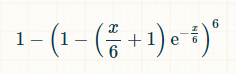
We need to integrate that over all time to find how much time will go by, on average, where the desired goal has not been achieved.
Fortunately, we can use an integral calculator at this point. For the one linked to, put 1- (1 - exp(-x/6)*(1 + x/6))^6 dx = apx. 24.1338692 in the text box following "Calculate the integral of" and under custom, set the bound of integration from 0 to ∞.
The answer is 390968681 / 16200000 = apx. 24.13386919753086
This question is asked and discussed in my forum at Wizard of Vegas.
You start with a fair 6-sided die and roll it six times, recording the results of each roll. You then write these numbers on the six faces of another, unlabeled fair die. For example, if your six rolls were 3, 5, 3, 6, 1 and 2, then your second die wouldn’t have a 4 on it; instead, it would have two 3s.
Next, you roll this second die six times. You take those six numbers and write them on the faces of yet another fair die, and you continue this process of generating a new die from the previous one.
Eventually, you’ll have a die with the same number on all six faces. What is the average number of transitions from one die to another (or total rolls divided by 6) to reach this state?
Let's label the initial die with letters instead of numbers, to avoid confusion. Let's label each possible die state with letters. For example, AAABBC would mean three of one letter, two of another, and one of a third. The initial state would obviously be ABCDEF.
Let E(ABCDEF) be the expected number of rolls from state ABCDEF.
E(ABCDEF) = 1 + [180 × E(AAAAAB) + 450 × E(AAAABB) + 300 × E(AAABBB) + 1800 × E(AAAABC) + 7200 × E(AAABBC) + 1800 × E(AABBCC) + 7200 × E(AAABCD) + 16200 × E(AABBCD) + 10800 × E(AABCDE) + 720 × E(ABCDEF)]/46656Building on the number of combinations of going from one state to another, the following transition matrix shows how many ways there are for going from each initial state (left column) to each new state. This took a few hours to construct properly, by the way.
Transition Matrix A
| State Before |
AAAAAA | AAAAAB | AAAABB | AAABBB | AAAABC | AAABBC | AABBCC | AAABCD | AABBCD | AABCDE | ABCDEF |
|---|---|---|---|---|---|---|---|---|---|---|---|
| AAAAAB | 15,626 | 18,780 | 9,750 | 2,500 | - | - | - | - | - | - | - |
| AAAABB | 4,160 | 13,056 | 19,200 | 10,240 | - | - | - | - | - | - | - |
| AAABBB | 1,458 | 8,748 | 21,870 | 14,580 | - | - | - | - | - | - | - |
| AAAABC | 4,098 | 12,348 | 8,190 | 2,580 | 7,920 | 10,080 | 1,440 | - | - | - | - |
| AAABBC | 794 | 5,172 | 8,670 | 5,020 | 6,480 | 17,280 | 3,240 | - | - | - | - |
| AABBCC | 192 | 2,304 | 5,760 | 3,840 | 5,760 | 23,040 | 5,760 | - | - | - | - |
| AAABCD | 732 | 4,464 | 4,140 | 1,680 | 7,920 | 14,400 | 2,520 | 4,320 | 6,480 | - | - |
| AABBCD | 130 | 1,596 | 3,150 | 1,940 | 5,280 | 16,800 | 3,600 | 4,800 | 9,360 | - | - |
| AABCDE | 68 | 888 | 1,380 | 760 | 3,960 | 11,520 | 2,520 | 7,200 | 14,040 | 4,320 | - |
| ABCDEF | 6 | 180 | 450 | 300 | 1,800 | 7,200 | 1,800 | 7,200 | 16,200 | 10,800 | 720 |
I won't go into a long lecture on matrix algebra, except to say let's say matrix B is as follows:
Matrix B
| State Before |
AAAAAB | AAAABB | AAABBB | AAAABC | AAABBC | AABBCC | AAABCD | AABBCD | AABCDE | ABCDEF |
|---|---|---|---|---|---|---|---|---|---|---|
| AAAAAB | -27876 | 9750 | 2500 | 0 | 0 | 0 | 0 | 0 | 0 | -46656 |
| AAAABB | 13056 | -27456 | 10240 | 0 | 0 | 0 | 0 | 0 | 0 | -46656 |
| AAABBB | 8748 | 21870 | -32076 | 0 | 0 | 0 | 0 | 0 | 0 | -46656 |
| AAAABC | 12348 | 8190 | 2580 | -38736 | 10080 | 1440 | 0 | 0 | 0 | -46656 |
| AAABBC | 5172 | 8670 | 5020 | 6480 | -29376 | 3240 | 0 | 0 | 0 | -46656 |
| AABBCC | 2304 | 5760 | 3840 | 5760 | 23040 | -40896 | 0 | 0 | 0 | -46656 |
| AAABCD | 4464 | 4140 | 1680 | 7920 | 14400 | 2520 | -42336 | 6480 | 0 | -46656 |
| AABBCD | 1596 | 3150 | 1940 | 5280 | 16800 | 3600 | 4800 | -37296 | 0 | -46656 |
| AABCDE | 888 | 1380 | 760 | 3960 | 11520 | 2520 | 7200 | 14040 | -42336 | -46656 |
| ABCDEF | 180 | 450 | 300 | 1800 | 7200 | 1800 | 7200 | 16200 | 10800 | -46656 |
The answer is the determinant of matrix B to that of matrix A:
Determ(A) = 1,461,067,501,120,670,000,000,000,000,000,000,000,000,000,000
Determ(B) = 14,108,055,348,203,100,000,000,000,000,000,000,000,000,000,000
Determ(B) / Determ(A) = apx. 9.65599148388557
The answer could be approximated as expressed 1 - (prob(no 1's) + prob(no 2's) + ... + prob(no 6's)) = 1 - 6*(5/6)^20 = apx. 0.84349568.
However that would double-subtract the situations where two different sides never got rolled. There are combin(6,2)=15 ways to choose two sides out of six. The probability that any two given sides never get rolled is (4/6)^20. We need to add those to the probability, because they got subtracted twice in the previous step. So, now we're at 1 - 6*(5/6)^20 + 15*(4/6)^20 = apx. 0.84800661.
This question is asked and discussed in my forum at Wizard of Vegas.
However, if any group of three sides that had never been rolled would have been triple-subtracted in the first step and triple-added in the second step. We need to subtract them back out as a state where not all six sides were rolled. There are combin(6,3) = 20 ways to choose three sides out of six. The probability that any specific three sides are never rolled is (3/6)^20. So, now we're at 1 - 6*(5/6)^20 + 15*(4/6)^20 - 20*(3/6)^20= apx. 0.847987537.
However, if any group of four sides that had never been rolled would have been quadruple-subtracted in the first step, quadruple-added in the second step, and quadruple subtracted in the third step. We need to add them back in, because each such state was already subtracted out twice. There are combin(6,4) = 15 ways to choose four sides out of six. The probability that any specific four sides are never rolled is (2/6)^20. So, now we're at 1 - 6*(5/6)^20 + 15*(4/6)^20 - 20*(3/6)^20 + 15*(2/6)^20 = apx. 0.84798754089.
However, if all 20 rolls were the same numbers, this situation would have been quintuple-subtracted in the first step, quintuple-added in the first step, quintuple-subtracted in the third step, and quintuple-added in the fourth step. We need to subtracted them back out. So, now we're at 1 - 6*(5/6)^20 + 15*(4/6)^20 - 20*(3/6)^20 + 15*(2/6)^20 - 6*(1/6)^20 = apx. 0.84798754089.
So the answer is 1-6*(5/6)^20+COMBIN(6,4)*(4/6)^20-COMBIN(6,3)*(3/6)^20+COMBIN(6,2)*(2/6)^20-6*(1/6)^20 = apx. 0.84798754089.
You have two cubes. You can number each side of both dice as you wish, as long as each side is an integer and greater or equal to one. You may repeat the same number on the same die and go as high as you wish. Other than creating standard dice, how can you number them so the probability of any given total is the same as standard dice?
Die 1 = 1,2,2,3,3,4.
Die 2 = 1,3,4,5,6,8.
I'm afraid my solution to this one was pretty much trial and error.
One could use a Markov chain to answer this, but I prefer calculus. The key is that the answer is the same if the time between rolls is the exponentially distributed with a mean of one. That said, the answer can be expressed as the integral from 0 to infinity of:
1-(1-exp(-x/36))^2*(1-exp(-x/18))^2*(1-exp(-x/12))^2*(1-exp(-x/9))^2*(1-exp(-5*x/36))^2*(1-exp(-x/6))
You may easily solve such integrals with an integral calculator.
You may also solve any such problem with my Expected Trials Calculator.
Drop Dead is a game played with five standard dice. You begin your turn by rolling all five dice. If none of them are a 2 or 5, you total the dice, add the sum to your point score and roll again. If you do roll any 2s or 5s, your score for the roll is zero. All the dice showing a 2 or 5 are declared dead and set aside. You then roll again with the remaining dice. Play continues with you either scoring points or removing dice. Your turn ends when all your dice are eliminated whereupon you are said to have dropped dead. All your scoring rolls are added together for your final score. High score wins.
What is your expected score for this game?
Let's start with the scenario with one die left and move backwards.
Let the variable a be the expected additional points with one die left.
The average roll that isn't a 2 or 5 is (1+3+4+6)/4 = 7/2.
a = (2/3)×(a + 7/2).
a/3 = 7/3.
a = 7.
Next, let's calculate b, the expected points with two dice left.
b = (2/3)2×(b + 2 × (7/2)) + 2×(2/3)×(1/3)×a.
b = 11.2.
Next, let's calculate c, the expected points with three dice left.
c = (2/3)3×(c + 3× (7/2)) + 3×(2/3)2×(1/3)×b + 3×(2/3)×(1/3)2×b.
c = 1302/95 = 13.705263.
Next, let's calculate d, the expected points with four dice left.
d = (2/3)4×(d + 4× (7/2)) + 4×(2/3)3×(1/3)×c + 6×(2/3)2×(1/3)2×b + 4×(2/3)×(1/3)3×a.
d = 3752/247 = 15.190283.
Finally, let's calculate e, the expected points with five dice left.
e = (2/3)5×(e + 5×(7/2)) + 5×(2/3)4×(1/3)×d + 10×(2/3)3×(1/3)2×c + 10×(2/3)2×(1/3)3×b + 5×(2/3)×(1/3)4×a.
e = 16.064662.
This question is asked and discussed in my forum at Wizard of Vegas.
Roll two dice, a red die and a blue die, over and over. Keep track of the sum of rolls for each die. What is the expected number of roles until these two cumulative totals are equal?
It is hard to explain why the answer is infinity. To make matters more confusing and paradoxical, the probability the totals ever being equal is 1.
The following table shows the probability the totals will be the same for the first time after 1 to 16 rolls.
Probability Equal Totals for First Time
| Rolls | Probability |
|---|---|
| 1 | 0.166667 |
| 2 | 0.112654 |
| 3 | 0.092850 |
| 4 | 0.080944 |
| 5 | 0.072693 |
| 6 | 0.066539 |
| 7 | 0.061722 |
| 8 | 0.057819 |
| 9 | 0.054573 |
| 10 | 0.051819 |
| 11 | 0.049443 |
| 12 | 0.047367 |
| 13 | 0.045532 |
| 14 | 0.043895 |
| 15 | 0.042423 |
| 16 | 0.041089 |
Excel shows a very close fit to this curve is y = 0.1784*x-1.011, where x = number of rolls and y = probability.
The sum of this infinite series is infinity.
This question is asked and discussed in my forum at Wizard of Vegas.
Five red dice and five blue dice are rolled. What is the probability the roll is the same for both dice, without regard to order. For example, both rolls are 1-2-3-3-6.
The following the table shows for any type of roll:
- The number of different ways this roll can be achieved. For example, for a full house, there are six combinations for the three of a kind and five left for the pair, for a total of 30 different full houses.
- The number of orders. For example, for a full house, there are combin(5,3)=10 ways to choose three out of five dice for the three of a kind. The other two must have the pair.
- The number of ways the given hand can be rolled. This is the product for the first two columns. For example, there are 30 * 10 = 300 ways to roll a full house.
- The probability of the hand. For example, for a full house the probability is 300/65 = 0.038580.
- The probability both rolls are the same and of the given hand. This is the probability from column four squared divided by the second column. For example, the probability two rolls are both a full house is 0.0385802. However, the probability they are the same house is 1/30. So, the probability both rolls are the same full house is 0.0385802/30 = 0.00004961.
The lower right cell shows the total probability both rolls are the same is 0.00635324.
Matching Roll
| Type of Roll |
Different Types |
Orders | Total Combinations |
Probability One Roll |
Probability Two Rolls |
|
|---|---|---|---|---|---|---|
| Five of a kind | 6 | 1 | 6 | 0.00077160 | 0.00000010 | |
| Four of a kind | 30 | 5 | 150 | 0.01929012 | 0.00001240 | |
| Full house | 30 | 10 | 300 | 0.03858025 | 0.00004961 | |
| Three of a kind | 60 | 20 | 1,200 | 0.15432099 | 0.00039692 | |
| Two pair | 60 | 30 | 1,800 | 0.23148148 | 0.00089306 | |
| Pair | 60 | 60 | 3,600 | 0.46296296 | 0.00357225 | |
| Five singletons | 6 | 120 | 720 | 0.09259259 | 0.00142890 | |
| Total | 7,776 | 1.00000000 | 0.00635324 |
A six-sided die is rolled until either of the following events happen:
A) Any side has appeared six times.
B) Every side has appeared at least once.
What is the probability event A occurs first?
To answer this one as I did, using calculus, I recommend an integral calculator like the one at integral-calculator.com/.
Here is my solution (PDF).
This problem is asked (in slightly different words) and discussed in my forum at Wizard of Vegas.
You wish to play a game that requires an ordinary six-sided die. Unfortunately, you lost the die. However, you have four index cards, which you may mark any way you like. The player must choose two cards randomly from the four, without replacement, and take the sum of the two cards.
How can you number the cards so that the sum of two different cards represents the roll of a die?
Number them 0, 1, 2, and 4.
There are six ways to draw two out of four cards, as follows.
- 0+1 = 1
- 0+2 = 2
- 1+2 = 3
- 0+4 = 4
- 1+4 = 5
- 2+4 = 6
This question is asked and discussed in my forum at Wizard of Vegas.
A six-sided die is rolled over and over until the sum of rolls is 13 or greater. What is the mean, median and mode of the final total?
Median = 14
Mode = 13
I had to use a Markov Chain for this one. The following table shows the probability of each final total according to the running sum in the left column. Start with the obvious cases for totals of 13 to 18. Then, for running sums of 0 to 12, take the average of the six cells below.
The probabilities for the initial state can be found in the first row for a sum of 0.
Markov Chain
| Sum of Rolls | 13 | 14 | 15 | 16 | 17 | 18 |
|---|---|---|---|---|---|---|
| 0 | 0.279263 | 0.236996 | 0.192313 | 0.145585 | 0.097371 | 0.048472 |
| 1 | 0.290830 | 0.230791 | 0.188524 | 0.143842 | 0.097114 | 0.048899 |
| 2 | 0.293393 | 0.241931 | 0.181893 | 0.139625 | 0.094943 | 0.048215 |
| 3 | 0.289288 | 0.245178 | 0.193717 | 0.133678 | 0.091410 | 0.046728 |
| 4 | 0.280369 | 0.242560 | 0.198450 | 0.146988 | 0.086950 | 0.044682 |
| 5 | 0.268094 | 0.235687 | 0.197878 | 0.153768 | 0.102306 | 0.042267 |
| 6 | 0.253604 | 0.225827 | 0.193419 | 0.155611 | 0.111500 | 0.060039 |
| 7 | 0.360232 | 0.193566 | 0.165788 | 0.133380 | 0.095572 | 0.051462 |
| 8 | 0.308771 | 0.308771 | 0.142104 | 0.114326 | 0.081919 | 0.044110 |
| 9 | 0.264660 | 0.264660 | 0.264660 | 0.097994 | 0.070216 | 0.037809 |
| 10 | 0.226852 | 0.226852 | 0.226852 | 0.226852 | 0.060185 | 0.032407 |
| 11 | 0.194444 | 0.194444 | 0.194444 | 0.194444 | 0.194444 | 0.027778 |
| 12 | 0.166667 | 0.166667 | 0.166667 | 0.166667 | 0.166667 | 0.166667 |
| 13 | 1.000000 | 0.000000 | 0.000000 | 0.000000 | 0.000000 | 0.000000 |
| 14 | 0.000000 | 1.000000 | 0.000000 | 0.000000 | 0.000000 | 0.000000 |
| 15 | 0.000000 | 0.000000 | 1.000000 | 0.000000 | 0.000000 | 0.000000 |
| 16 | 0.000000 | 0.000000 | 0.000000 | 1.000000 | 0.000000 | 0.000000 |
| 17 | 0.000000 | 0.000000 | 0.000000 | 0.000000 | 1.000000 | 0.000000 |
| 18 | 0.000000 | 0.000000 | 0.000000 | 0.000000 | 0.000000 | 1.000000 |
This question is asked and discussed in my forum a Wizard of Vegas.
As you know, the All bet in craps wins if every total from 2 to 12, except 7, is thrown before a 7. How many rolls on average does it take to win this bet, when it does win?
Here is my solution (PDF).
This question is asked and discussed in my forum at Wizard of Vegas.
I see somebody is claiming to have witnesses 18 consecutive yo's (total of 11) in a row at the craps table. How many rolls, on average, would it take to observe that?
Here is my solution (PDF).
A pair of two fair six-sided dice are rolled over and over until one of the following two events occur:
A) A total of 12 is rolled.
B) A total of 7 is rolled two times consecutively.
Which is more likely to happen first?
[spoiler=Solution]
Let:
- p = Probability the 12 is rolled first from the initial state or anytime the previous roll was not a 7.
- q = Probability the 12 is rolled first when the previous roll was a 7.
This is what is known as a Markov Chain problem.
Before we get to that, recall the probability of rolling a total of 7 is 1/6 and that of a 12 is 1/36.
We can define p and q in terms of each other, as follows:
- (1) p = (1/36) + (6/36)q + (29/36)p
- (2) q = (1/36) + (29/36)p
Let's multiply equation (1) by 36:
36p = 1 + 6q + 29p
(3) 7p = 1 + 6q
Let's substitute the value for q in (2) into (3):
7p = 1 + 6*((1/36) + (29/36)p)
7p = 1 + (1/6) + (29/6)p
42p = 6 + 1 + 29p
13p = 7
q = 7/13
So, the probability of rolling the 12 first is 7/13 =~ 53.85%.
The probability of rolling two consecutive 7's first is thus 46.15%.
Thus, it's more likely the total of 12 is rolled first.