
Wizard Recommends
-
 $11000 Welcome Bonus
 -
 $3000 Welcome Bonus
 -
 UP TO $777 BONUS
Other Casino Games - FAQ
I know. I know: Casino War is mindless game. However at Casino Niagara the rules are somewhat different. When there is a tie and you go to war, you place a second wager of equal value to the first and if you win the war you are paid 2-1. If you tie with the dealer after the second cards are dealt you win 3-1. I think these rules reduce the house edge by a good margin. Am I right?
Thanks for pointing out this variation to me. They use different semantics to explain casino war at the Casino Niagara. What they fail to mention is that the original wager always loses if in the event of a tie.
What is really going on is they pay two times the Ante for a win after a tie, and three times the ante for a tie after a tie. The usual rules still pay two times the ante for a tie after a tie. This rule change decreases the house edge from 2.88% to 2.33%.
Your analysis of various side bets like Streak, Pair Square and others was very interesting. Do you know how these new games get invented and established? Do the casinos employ guys like you to compute the probabilities? If so, are the games copyrighted in some way?
I could talk about this all day. Part of my income is derived from analyzing games such as these. The gaming authorities require such analysis before a game can be licensed to play. Usually, these games are invented by an individual. Here in Nevada, after the game owner receives a license, then it must go through a 30-day trial period. If the trial period went well, then the owner can then apply for a permanent license. The entire process is very slow and it is difficult to get a casino to be the guinea pig for the trial period. Casinos are actually quite risk averse in their business decisions. Yes, the game owner will usually seek a copyright to protect others from stealing the idea.
You can find much more information about the business of marketing casino table games in my Game Inventors Corner.
Hey wiz, Great Site. I wondered if you knew the House Odds on a game played at Foxwoods in Connecticut, called "Catch A Wave."
Ask and ye shall receive. Please see my page on Catch a Wave.
How do you win money playing solitaire in Vegas?
I have never seen solitaire played for money in Vegas. I understand in the early days of Vegas people wagered on the standard Klondike variation of solitaire but I don't anything else about it.
In November in Las Vegas, I encountered a table game called "3 Way" in which players went head-to-head with the dealer in high card, blackjack and best five cards poker using the same cards. Have you seen this game? Any odds and/or advice. Enjoy your site!
I saw this at the World Gaming Expo, but have never studied it. After I move to Las Vegas in February I will be better at covering new games such as this.
My question has to do with the House edge and element of risk calculations for Casino War for the Casino Niagara Rules (i.e., 3-1 pay out on raise and lose the original wager). How did you come up with these numbers I am currently trying to calculate them? I am having trouble. Thanks for you help.
Let's let d be the number of decks. The probability of a tie on the first round is (4*d-1)/(52*d-1)= 0.073955. The probability of a tie in the second round is 12*4*d/(52*d-2)*(4*d-1)/(52*d-3)+(4*d-2)/(52*d-2)*(4*d-3)/(52*d-3) = 0.073974. Lets call p1 the probability of a tie in the first round and p2 the probability of a tie in the second round. Then the player return is p1*(2*p2 +(1-p2)/2*(1-2))= -0.023301. Multiply by -1 and you have the house edge of 2.33%. I hope I didn't go over this too quickly.
What casinos have super fun 21 could you give me a list?
I’ve seen it at the Regent, New York New York, and Palace Station. I hear it is also at the Sunset Station and Santa Fe Station.
First, thanks for the great site. Are you going to review "Draw Caribbean Stud" soon. I will be down in Dubuque this weekend and they have it there. I tried it briefly last time, but had no idea as to perfect strategy so I only played a couple of hands (won ten bucks).
Thanks for the compliment. I just saw the game at the California casino here in Las Vegas, but it wasn’t open yet. I got the rule card and will work on when I have the chance. At this time I have no information about it at all.
While at Treasure Island in Las Vegas last week I noticed a game called Triple Shot which consisted of hands of War, Blackjack, and Poker (6 card stud). It looked pretty interesting but I would like to know all the rules and payout schedules. Can you help? Also can you tell me what other Vegas Strip casinos have the game?
I’ve seen it there too, and fortunately took some notes. It is similar to Three Way Action as used to be found at the Las Vegas Club. In Triple Shot the player may make any combination of three bets. The first is a regular blackjack wager. The second is a poker hand. The third is a war bet. I don’t remember if the poker bet is based on the player’s or dealer’s hand but the best five out of six cards are used. If the blackjack hand doesn’t contain six cards then more are added to make six. The following odds table for the poker bet shows the house edge is 3.20%.
Triple Shot
| Hand | Combinations | Probability | Pays | Return |
| Royal flush | 376 | 0.000018 | 100 to 1 | 0.001847 |
| Straight flush | 1468 | 0.000072 | 30 to 1 | 0.002163 |
| Four of a kind | 14664 | 0.000720 | 15 to 1 | 0.010804 |
| Full house | 165984 | 0.008153 | 7 to 1 | 0.057071 |
| Flush | 205792 | 0.010108 | 5 to 1 | 0.050542 |
| Straight | 361620 | 0.017763 | 4 to 1 | 0.071050 |
| Three of a kind | 732160 | 0.035963 | 3 to 1 | 0.107890 |
| Two pair | 2532816 | 0.124411 | 2 to 1 | 0.248821 |
| Pair | 2252472 | 0.110640 | 1 to 1 | 0.110640 |
| Nothing | 14091168 | 0.692151 | -1 to 1 | -0.692151 |
| Total | 20358520 | 1 | -0.031321 |
Finally there is a war game, the player’s first card against the dealer’s up card, highest card win. In the event of a tie the player loses half. The house edge in the war game is 2.94%. I don’t know of any other casinos that have the game. It is probably in trial period and only at the Treasure Island.
What is the house edge in solitaire?
I don’t know. If you find out please tell me. I’m particularly interested because Cryptologic casinos just introduced two versions of Klondike solitaire.
I am just learning how to play Baccarat and since every player can bet on either player and banker and are not really playing each other, I was wondering what game is played in the James Bond movies? For example, In Dr. No it seems as if Bond is against a woman and he is winning her money? Is there something I am missing or is it a different game? Thank you for your time.
Fortunately I am a big James Bond fan and have all the Bond movies on DVD. I checked Dr. No and it seems he is playing Chemin De Fer. The scene was spoken in French, which doesn’t help me. There is a similar scene in For Your Eyes Only. In that movie it looks like Bond is playing baccarat, acting as the banker, but after the player acts he pauses and another character tells Bond, "The odds favor standing pat". This would imply that Bond had free will in whether to take a third card, an option you don’t have in baccarat. As I understand my gambling history, the American version of baccarat is a simplified version of Chemin De Fer, in which the drawing rules are predetermined. Incidentally, according to www.casino-info.com American baccarat originated at the Capri Casino in Havana, Cuba.
What are the odds in Faro?
Please see my faro page for the answer to that question.
Hi. I'm curious about the house edge in a game which, I believe, is played only here in Portugal. The game is called Banca Francesa (in a literal translation, French Bank) and is played with three dice. Players can bet in "Big" (sum of 3 dice is 14, 15 or 16), "Small" (5, 6 or 7) or "Aces" (sum is 3 or one spot in each dice) - the dealer will be re-rolling the dice until one of these results shows up. Big and Small both pay even money while the Aces pay 61 to 1. Thank you for your time.
From my Sic Bo appendix we see the probability of a total of 5 or 16 is 6/216, a 6 or 15 is 10/216, a 7 or 14 is 15/216, and a 3 is 1/216. So on any one throw the probability of "big" winning is 31/216, "small" is 31/216, and "aces" is 1/216. The number of ways any of these could win is 2*31+1=63. So given that one of these events did occur, the probability that it was big is 31/63, small is 31/63, and aces is 1/63. The house edge on all three bets is 1.59%.
I have begun playing 3-card guts online for play money (they do offer live games), my question is.... Where can I find a guide for what would be a medium starting hand in a 10 handed game...9 handed..8 handed , and so on. The hand rankings are the same as three card poker. I have found the probabilities for three card poker on your site. But I do not know how to go deeper to find the medium expected hand. Can you help?
Following is the median high hand according to the number of players. This is based on an assumption of independence between hands, which is not the case, but the table should still be a very close estimate.
Median Hand in Guts
| Players | Median Hand |
| 1 | K,10,2 |
| 2 | A,Q,8 |
| 3 | 5,5,K |
| 4 | 9,9,7 |
| 5 | J,J,Q |
| 6 | K,K,5 |
| 7 | A,A,7 |
| 8 | 8,5,3 flush |
| 9 | 10,8,6 flush |
| 10 | J,10,6 flush |
I’ve been unable to find a risk-of-ruin table for full-pay pick ’em poker or related info about its variance. The $1 full-pay machines clearly have the best returns in the buffalo-niagara region, but i’m uncertain about suggested bankrolls. Any advice would be much appreciated. Thanks.
The standard deviation in Pick ‘em Poker is 3.87. The standard deviation in conventional video poker tends to run from about 4.4 to 6.4. I don’t have any risk of ruin tables for Pick ‘em Poker. So the best advice I can offer is to use the jacks or better table in my video poker appendix 1. Jacks or Better has the lowest standard deviation in that appendix at 4.42, so you can be a little more aggressive than that table calls for.
I have a free bet coupon from the Mohegan Sun, which can be used on baccarat, sic bo, or big six. If I win I get to keep the winnings but win or lose I must give up the coupon. What is the best bet to use it on in each of these games?
Generally speaking, you want to put it on a long shot. This is because you don’t get to keep the coupon on a win, which lowers the value by the probability of winning. The less the probability of winning the less the value is reduced. Following are three tables for the three games listed. You’ll see the best bet is a tie between the 12, 30, 60, triple, and any triple in sic bo.
Free Bet Coupon Value in Baccarat
| Bet | Pays | Probability | Return |
| Banker wins | 0.95 | 0.458597 | 0.481484 |
| Player wins | 1 | 0.446247 | 0.493175 |
| Tie | 8 | 0.095156 | 0.761248 |
Free Bet Coupon Value in Big Six
| Bet | Pays | Probability | Return |
| 1 | 1 | 0.444444 | 0.444444 |
| 2 | 2 | 0.277778 | 0.555556 |
| 5 | 5 | 0.12963 | 0.648148 |
| 10 | 10 | 0.074074 | 0.740741 |
| 20 | 20 | 0.037037 | 0.740741 |
| Joker | 40 | 0.018519 | 0.740741 |
| Logo | 40 | 0.018519 | 0.740741 |
Free Bet Coupon Value in Sic Bo
| Bet | Pays | Probability | Return |
| Small, Big | 1 | 0.486111 | 0.486111 |
| 4, 17 | 60 | 0.013889 | 0.833333 |
| 5, 16 | 30 | 0.027778 | 0.833333 |
| 6, 15 | 17 | 0.046296 | 0.787037 |
| 7, 14 | 12 | 0.069444 | 0.833333 |
| 8, 13 | 8 | 0.097222 | 0.777778 |
| 9, 12 | 6 | 0.115741 | 0.694444 |
| 10, 11 | 6 | 0.125 | 0.75 |
| Triple | 180 | 0.00463 | 0.833333 |
| Any triple | 30 | 0.027778 | 0.833333 |
| Double | 10 | 0.074074 | 0.740741 |
I noticed you recently changed what you think is the house advantage for pontoon. It used to be .17% making it a very attractive game. Now its .38%, making it not nearly very attractive. As far as I know for many years your website has always said .17% and now it says .38%. Was there a screw-up you just didn’t catch until now? What happened exactly that had you changing the HA so dramatically?
I must confess that my 0.17% figure was an error. I discovered the flaw in my analysis when I recently updated it for the Microgaming rules. To all those who played it because of my 0.17% figure, I apologize.
In the game of Chinese poker, four players are dealt 13 cards each. What are the chances that one player is dealt the Dragon (a hand with no pairs)?
The probability that any given player will have a dragon is 413/combin(52,13) = 0.000106. The probability that exactly one player is dealt a Dragon could be closely approximated as 4*0.000106*(1-0.000106)3 = 0.000424, or 1 in 2,359.
The bonus package for Mohegan Sun includes two ten dollar bets in coupon form. These are not match play. A ten dollar bet on an even money proposition e.g. the one at the Big Six wheel will return ten dollars. The house keeps coupons wagered win or lose. The player does not have to add any money of his own. The only games that can be played are the Big Six wheel or Sic Bo . Where are the best places to use these coupons. I have bet high and low in sic bo only losing if a triple shows. I have also bet the one and two on the wheel (same spin).
Usually these free bet coupons are limited to even money bets, so this is an interesting case. My advice is to use the free bet on a long-shot, to minimize the effect of the rule that you lose the free bet, even if you win. The biggest long-shot in Big Six is the joker/logo, with a probability of winning of 1/54. I’m not sure whether the Mohegan Sun pays 40 or 45 on the joker, but assuming 45 the value of the free bet is (1/54)×45 = 83.33% of face value. In Sic Bo the biggest long-shots are on the six triples. I’m also not sure what they pay for a specific triple, but I would guess 180. In that case the value of any one of the six triple bets would be (1/216)×180 = 83.33% of expected value. So, we have a tie in terms of expected value. In that case I would go for the bet with the greater probability of winning, the joker/logo in Big Six, but that is up to you.
I was reading your section on the difference between the element of risk and house edge. Firstly, I assume that the element of risk is based on the correct strategy according to house advantage. I have an argument that the correct strategy for some games would be different if you are trying to minimize the element of risk. In Texas Hold 'Em Bonus, surely you should play hands like 5/2 off-suit. My intuition would think that if you played every hand you could reduce the element of risk below the quoted amount of 0.53%.
You're right, you can lower the element of risk by deviating from my strategy, and raising on hands with expected values of slightly less than -1. In your example, 5/2 has an expected value of -1.019987, under the Las Vegas rules. That means if you raise on that bet on average, then you can expected to lose about 1.02 times your original bet by the time the hand is over. After the initial raise, and possible additional raises after the flop and turn, the average wager on that hand will be 3.627374 units. The way I would look at it, making the raise bet is worth -0.0109987 units to the player, over 2.627374 additional units bet. The ratio of marginal additional win to marginal additional bets, by raising, is -0.0109987/2.627374 = -0.00761. That is less than the overall expected value of the game of -2.04%. So, if your goal is to minimize money lost to total money bet, including raises, then, yes, you should deviate from my basic strategy and raise on that hand. Other examples could be made in lots of games that involve raising.
To summarize, if you are trying to minimize money lost per hand, then you should follow the house edge minimizing strategies on this site. If you are trying to minimize money lost per total amount wagered, then you should opt to bet more on very borderline plays.
Hi, In Australia we have Lotto, where the major cash prize is paid if your six numbers are drawn from a possible 45 numbers (1-45) A lot of people purchase a "Slik Pik," where you get 12 games, each of six, allegedly random, random picks. My friends and I are always amazed that in the 12 games, the same number may appear up to 6 or 7 times out of the 12 games. Surely this is not random!!! My question is what is the expected number of times any number will repeat 6 or 7 times, assuming the selection is random?
The expected number of times any number will appear exactly n times in 12 games is combin (12,n)×(6/45)n×(39/45)n-12. The following table shows the expected number of occurrences from 0 to 12.
Expected number of repeat numbers
| Repeats | Expected |
|---|---|
| 0 | 8.0804888027 |
| 1 | 14.9178254818 |
| 2 | 12.6227754077 |
| 3 | 6.4732181578 |
| 4 | 2.2407293623 |
| 5 | 0.5515641507 |
| 6 | 0.0989986937 |
| 7 | 0.0130547728 |
| 8 | 0.0012552666 |
| 9 | 0.0000858302 |
| 10 | 0.0000039614 |
| 11 | 0.0000001108 |
| 12 | 0.0000000014 |
| Total | 45 |
So, to answer your question, you will see the same number exactly six times about 0.099 times per set of cards, or about once every 10.1 times. The same number appearing exactly seven times will happen 0.0131 times per set of cards, or once every 76.6 times.
Can you explain the rules to the "guts" game, as played in the movie Lucky You?
I hope you're happy; I watched this scene over and over for at least an hour, trying to make sense of the rules. I’ve played guts lots of times, over many years and locations, and have never seen it played as was done in that movie. Let’s call the first player to act Player 1, and the second player to act (the dealer) Player 2. Here is my understanding of how they played.
- Both players ante (or re-ante).
- Each player gets two cards.
- Player 1 must declare “in” or “check.” If he checks, go to rule 4. If he goes in, go to rule 7.
- Player 2 must declare in or check. If he checks, go to rule 5. If he goes in, go to rule 6.
- Although two checks never happened in the movie, I assume both players would start over from step 1.
- The action goes back to player 1, who must declare in or fold. If he goes in go to rule 8. If he folds, go to rule 9.
- Player 2 must declare “in” or “fold.” If he goes in go to rule 8. If he folds, go to rule 9.
- The two hands are compared; and the higher hand wins. The winner collects the pot, and the loser must match it, creating a new pot. This is equivalent to the loser just paying the winner the amount of the pot. Although there was never a tie in the movie, I assume no money would move. Next, go to rule 10.
- When a player folds, the other player collects the pot. Then repeat with a new hand from step 1.
- An additional card is given to each player, to add to his existing 2-card hand, making a 3-card hand. The third card is dealt face down, on top of the face-up two card hand. I do not know whether straights or flushes counted at the 3-card stage. I prefer to play where they do count (but not at the 2-card stage).
- Steps 3 to 9 repeat. If both playes go "in," then go to rule 12.
- An additional two cards are given to each player, to add to his existing 3-card hand, making a 5-card hand. The fourth and fifth cards are dealt face down, on top of the face-up three card hand.
- Steps 3 to 9 repeat. Then start over at step 1.
If you watch the movie carefully, Huck should have lost $11,000 in total, when he had $10,000 to begin with. I watched the scene lots of times to try to find this missing $1,000. My best guess is that when he went in on the last two-card hand, he should have matched the $4,000 pot, but had only $3,000 left. I assume that, much as in regular poker, he could only stand to win what he was risking. In the last hand, Huck folded. I’m not sure if this was because his three-card hand couldn’t beat his father’s two-card hand on the table, or if he was forced to fold, because he didn't have the money to match the pot if he lost.
If my understanding of the rules or analysis of the scene is in error, I welcome correction.
At the Borgata casino in Atlantic City, I noticed a new Pair Plus pay table. 100-1 Mini Royal, 50-1 Straight Flush, 40-1 Three of a kind, 6-1 Straight, 3-1 flush, 1-1 pair. What is the house edge for this pay table?
The house edge under that pay table is a comparatively low 1.85%. Kudos to the Borgata, assuming your information is correct.
Based on viewer feedback, the Borgata lowered the win on a three of a kind to 30 to 1 sometime during 2008.
In Super Pan 9, using 8 decks, is a tie payout of 8 to 1 a player advantage bet? My crude analysis gives the player approximately a 2.5% edge.
My Super Pan 9 page shows the probability of a tie is 11.3314%. So if a tie paid 8 to 1, the expected return would be 9×0.113314 − 1 = 0.019826. Although a 1.98% player advantage is less than your figure, it is still a great bet. Where can I play it?
What happened to the card game 3-5-7 in Las Vegas? I cannot find it anywhere.
I'm told that game had to be pulled out of the U.S. casinos, because the game of patent infringement. According to the Fourth Quarter 2008 Statistical Report of the Nevada Gaming Control Board, the following are the table game counts in Clark County.
Clark County Table Game Count
| Game | Tables |
|---|---|
| 21 | 2537 |
| Roulette | 405 |
| Craps | 334 |
| Other | 243 |
| Baccarat | 233 |
| Three Card Poker | 208 |
| Pai Gow Poker | 194 |
| Mini baccarat | 143 |
| Let It Ride | 98 |
| Pai Gow | 80 |
| Wheel of Fortune (Big Six) | 37 |
| Caribbean Stud Poker | 22 |
| Sic Bo | 1 |
| Chuck-a-Luck | 1 |
Unfortunately, they don't say what the 243 "other" games are, so this isn't of much help to answer your question, but it is still worth mentioning.
Last week I was in Las Vegas playing Casino War. I was the only one at the table, with my girlfriend standing behind me watching. I was thinking about how much to bet, but I hadn’t placed a bet down yet, and the dealer started to deal my card. He then realized I had not put a bet down, and jerked it back, but did not burn it. I saw that it was a Jack, but I don’t think he realized I saw it. I was confused for a few seconds, waiting for him to burn it, and I was afraid of getting in trouble if I made a big bet, so I placed the minimum $10 and won the hand with the Jack over his lower card. In a situation such as this, a Jack isn’t a sure win, but would it have been legal/morally correct/with-in the rules of the casino to place a big bet down and keep the winnings? I wished I had placed a big bet down because the chances of winning with a jack are pretty high, but was afraid of getting some heat from a manager or security if I won a huge hand (no one was watching us though). What would you have done, or recommend to do in such a case?
Not that you asked, but you have a 43.4% advantage if your first card is a jack. It is the dealer’s fault for flashing the card. Contrary to what some members of the casino staff, especially in security, incorrectly believe, you are legally allowed to make use of whatever information made available to you under normal playing conditions.
Morally, you should follow your own conscience. You have to live your own life. That said, I think most players, including me, would be okay with increasing the bet in that situation. For one thing, game security is not the player’s job. For another, the casinos take advantage of, if not rely on, player mistakes. For example, consider the big 6/8 bet in craps. The casinos have no compunction about accepting a bet on that, when the place bet on 6 or 8 pays on exactly the same thing, but has better odds. See if you are offered forgiveness if you foul your hand in pai gow poker, even if the correct setting is totally obvious.
If it happens again, don’t get too greedy, and act nonchalant. If you suddenly go from a $10 to a $500 bet, it will set off all kinds of red flags. A good dealer would realize why, and ultimately the bet would not be accepted, or a card would be burned.
I have come across a variation of Oasis Poker, played in the Baltics and Russia, called Royal Poker. Here are the rules in English. There have been various scenarios added for all sorts of added bets, and from what I’ve seen at the casinos, it turns players into suckers. They buy cards trying to turn even the most pathetic hands into monsters etc. Do you think you can come up with an algorithm to simulate some results and come up with the house edge and strategy for this game? Thanks!
I’m getting asked about this more and more frequently. Unfortunately, the number of combinations in this game would be an unholy gigantic figure. A brute-force looping program might take thousands of years to finish. However, a good programmer can find short cuts. Weighing the costs and benefits, I don’t find this project to be a good use of my time. If I lived in Russia or the Baltics, I would likely feel differently.
For the benefit of other readers, Royal Poker is like Caribbean Stud Poker, with the following added options. It is my understanding that the player may invoke any or all of these options, except he may not invoke options 2 and 3 both.
- If the player can make two paying hands, which both beat the dealer, and neither hand is entirely within the other, then both are paid. I am not sure whether the ante and/or raise are paid twice. For example, if the player had six cards and could make a straight and a flush, then the player could be paid for both hands.
- The player may switch one to five cards for the price of the Ante.
- The player may buy a sixth card for the price of the Ante.
- The player may buy "insurance" before the dealer turns over his four face-down cards. The insurance bet pays even money if the dealer does not qualify.
- The player may force the dealer to switch his highest card for the next one in the deck for the price of the Ante wager.
- There is an "AA Bonus" side bet, which pays 7 to 1 if the player’s first five cards are a pair of aces or higher.
I can say that the AA Bonus side bet and Insurance Option should never be taken, and thus are not worth anything. The house edge on the AA Bonus is 12.99%. The following table shows the house edge on insurance to range from 8.57% to 33.57%, depending on the dealer’s up card.
Insurance in Russian Poker
| Dealer’s Up Card | Combinations | Probability | Exp. Value |
| A | 132804 | 0.335714 | -0.328571 |
| K | 132804 | 0.335714 | -0.328571 |
| Q | 108528 | 0.457143 | -0.085714 |
| J | 108732 | 0.456122 | -0.087755 |
| 10 | 108936 | 0.455102 | -0.089796 |
| 9 | 109140 | 0.454082 | -0.091837 |
| 8 | 109140 | 0.454082 | -0.091837 |
| 7 | 109140 | 0.454082 | -0.091837 |
| 6 | 109140 | 0.454082 | -0.091837 |
| 5 | 109140 | 0.454082 | -0.091837 |
| 4 | 108936 | 0.455102 | -0.089796 |
| 3 | 108732 | 0.456122 | -0.087755 |
| 2 | 108528 | 0.457143 | -0.085714 |
I also know from my page on Oasis Poker that just the option to switch cards lowers the house edge from 5.22% to 1.04%. I tend to think the rule about being double-paid, getting to keep the sixth card (as opposed to switching), and forcing the dealer to switch a card will get the game to a worthwhile player advantage, if you knew the proper strategy. Sorry to pull a Fermat on you, but that is that best I can do at this time.
P.S. I have heard some casinos add a rule that if the player wins, then the ante bet only pushes. This would work significantly in the casino’s favor, I think wiping out any advantage.
I played 66 hands of Pick ’Em Poker in Missouri and never had a made winner (pair of nines or better) on the deal. What are the odds of that?
For those unfamiliar with the rules, in Pick ’Em Poker the player is dealt two cards, plus the choice of one of two more. The game then gives the player two more cards to complete a five-card poker hand. The question at hand is what is the probability of having at least a pair of nines on the deal. Let’s call the players initial two cards that he must keep the "pocket," and the other two cards the "field." This could be accomplished the following ways:
- Four of a kind: 13 combinations
- High (9-A) three of a kind: 1,152 combinations
- Low (2-8) three of a kind with the singleton in the field: 672 combinations
- Two high pairs: 540 combinations
- One high pair, one low pair, with at least one high card in the pocket: 1,260 combinations
- High pair, with at least one in the pocket: 31,680 combinations
Some of the casinos in Cambodia offer a suited tie bet in Dragon Tiger. It pays 50 to 1 if the Dragon and Tiger cards match in both rank and suit. What are the odds on that side bet?
Assuming eight decks, the probability of winning is 52*combin(8,2)/combin(52*8,2) = 1,456/86,320 = 1.69%. The house edge is 13.98%.
At the Sky City casino in Auckland, New Zealand, both the player and dealer must make use of both his hole cards in Ultimate Texas Hold 'Em. How does this effect the odds compared to the usual rules where any five cards can be used?
That rule increases the house edge from 2.19% to 7.97% and the Element of Risk from 0.53% to 1.90%. This is because the dealer won't qualify more often and it will be harder to win on the Blind bet, which requires a straight or better.
For more details of my analysis, please see my new page on the Auckland variant of Ultimate Texas Hold 'Em.
For discussion about this question, please see the thread ULTIMATE IN NEW ZEALAND in my forum at Wizard of Vegas.
That game Flip It at the Rio looks countable. Do you have any advice on which bet is the most vulnerable?
The red and black bets seem the most vulnerable. I would do a simple red/black count, as follows:
- Let C = count (where red cards are +1 and black cards are -1)
- J = count of jokers left in the shoe
- if J-C < 0 then bet on black
- If J+C < 0 then bet on red
For example, if after some play cards played are:
red = 100black = 75
jokers = 10
The remaining cards would be:
red = 108black =133
jokers = 14
The count would be +25. Jokers remaining - C = 14-25 = -9. Because that is less than zero, bet on black, because there are more good cards left (133) than bad cards (122) on the black bet.
If I'm betting $50 on the Ante in Ultimate Texas Hold 'Em I should win $50 × 500 = $25,000 on a winning Blind bet. However, the casino caps the win at $5,000. How much does that cost me on average?
The probability of a winning royal flush is 1 in 32,487. Each time this happens you are shortchanged $20,000, or 400 Ante bets. That is a cost of 400/32,487 = 1.23% of all money bet on the Ante. That increases the house edge (as measured relative to the Ante bet) from 2.185% to 3.416%.
This question is asked in discussed in my forum at Wizard of Vegas.
On the September 18, 2019 episode of Jeopardy there was a category titled "Describe the Casino Game." One of the clues was "Dressed and playing to the 9's; Banker's hours; What brings you to Monaco, Mr. Bond?"
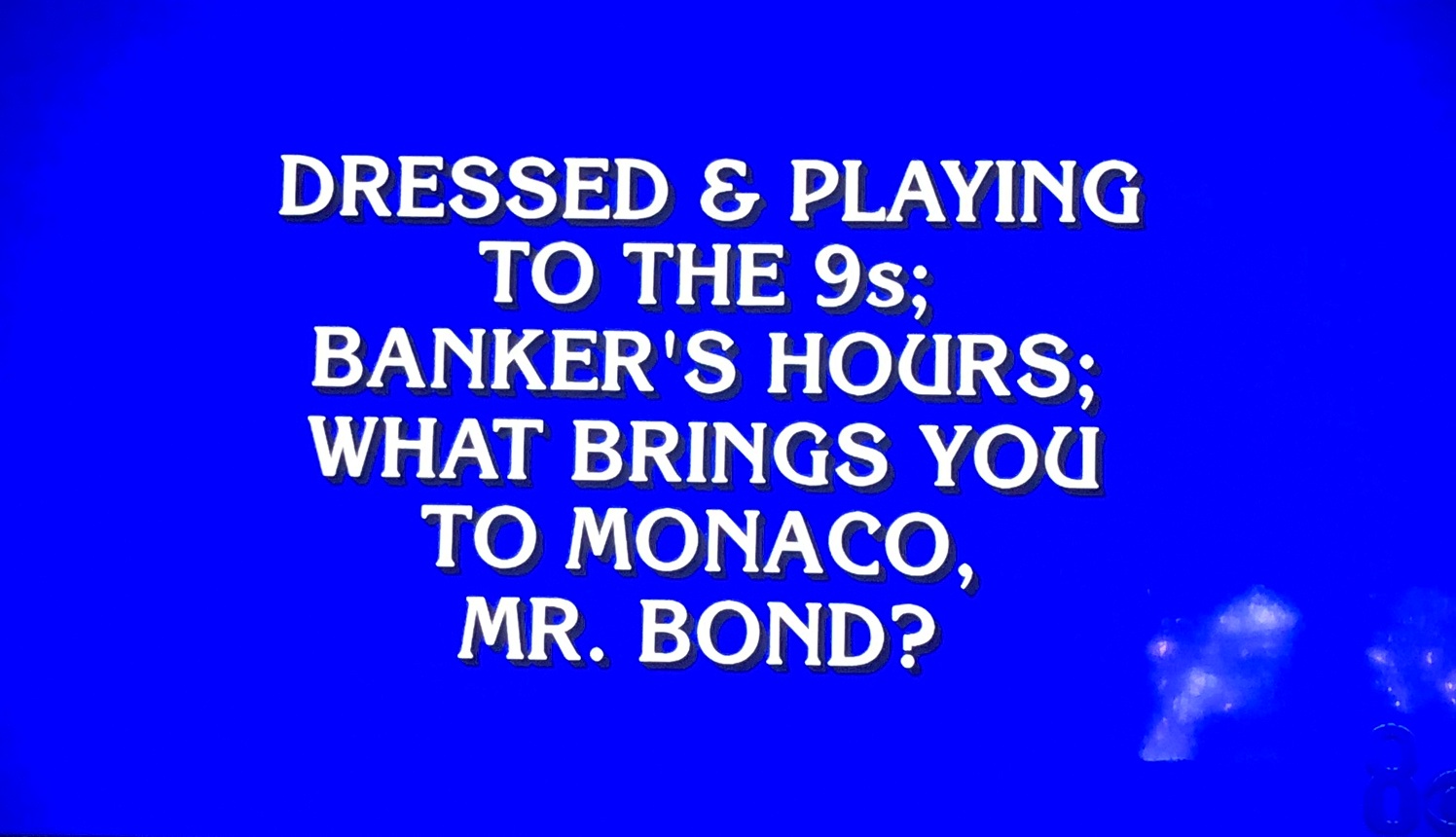
The answer provided was "baccarat," which was judged as being correct. Wasn't Bond playing chemin de fer?
Yes, indeed Bond was playing Chemin de fer, not baccarat. As a reminder, the main differences are:
- The turn to bank rotates around the table. The banking player automatically assumes the Banker* hand.
- Both Player* and Banker have free will to draw a third card, as long as neither has a two-card natural 8 or 9.
Note:
As usual, when writing about baccarat or chemin de fer, I capitalize the names of the bets, to avoid confusion with the players playing the game.
That said, the first such scene is in the Dr. No clip below, where not only does the bank rotate, player's have free will in the third card, but Bond actually refers to the game verbally as "chemin de fer" in the 2:11 point in the video:
The next video shows three chemin de fer scenes from three different movies.
Here are the starting points of each scene:
- 2:09 — Thunderball
- 4:19 — On Her Majesty's Secret Service
- 7:30 — For Your Eyes Only
In all three we see the players banking and free will in the third card decision, especially in For Your Eyes Only, where the odds are discussed.
Finally, below is the scene from Goldeneye.
Here we again see the turn to bank going back and forth and free will in drawing a third card. However, the female character does refer to the game as "baccarat" at the 0:45 point. I would file this under "character error."
In closing, there can be no doubt Bond was playing chemin de fer in every movie. Technically, I think the judges were incorrect to accept "baccarat" as a correct answer. However, I don't blame them. Even by Jeopardy standards, expecting the average player to know baccarat from chemin de fer would be too much. As shown by accepting an answer of "The Mooch," in lieu of Anthony Scaramucci, shows they are getting more lenient.
This question is asked and discussed in my forum at Wizard of Vegas.
Assuming proper strategy, what is the probability of winning given a 4x raise in Ultimate Texas Hold 'Em? I recorded 96 4x hands. Not counting pushes, I had 66 wins and 30 losses. How does that compare to expectations?
Assuming correct 4x raising strategy, there is the probability of each outcome, given a 4x raise:
- Win: 58.82%
- Loss: 38.47%
- Tie: 2.72%
If we factor out the ties, the probability of winning is 60.46%. In 96 hands resolved, the expected number of 4x wins is 58.04. So, 66 wins is ahead of expectations, but not significantly.
This question is asked and discussed in my forum at Wizard of Vegas.
What is the player advantage in Ultimate Texas Hold 'Em if the player is not required to make a Blind bet?
This is a good question because some dealers have been known to not enforce the Blind bet rule. The Blind bet has a huge house advantage, so not having to make it would be very beneficial to the player.
Assuming the player follows optimal strategy based on the correct rules (required a Blind bet), then the player advantage would be 29.28%. It would be even higher following a strategy based on no Blind bet being required.
How much do maximum payouts increase the house edge in Mississippi Stud?
Good question. Mississippi Stud players definitely should be aware that maximum payouts may reduce what they win on a royal flush, which serves to increase the house edge.
The top pay in Mississippi Stud is 500 to 1 for a royal flush and it applies to all bets. The player has two chances to raise up to 3x his Ante, so his final bet can be up to 7x his Ante. If the player has hope for a Royal, he should be maxing the maximum raises.
The most the player should bet on the Ante in Mississippi Stud, without being affected by a payout cap, is the maximum payout/3500. For example, if the maximum payout is $80,000, then the most I advise betting on the Ante is $22.86. I would round that down to $20.
The following table shows the house edge at various bets and common maximum wins. The table assumes optimal player strategy with no cap on wins. Note how the house edge increases as bet size increases and the cap decreases.
House Edge with Payout Cap
| Bet | $50,000 Cap | $80,000 Cap | $100,000 Cap |
|---|---|---|---|
| $15 | 5.02% | 4.91% | 4.91% |
| $20 | 5.15% | 4.91% | 4.91% |
| $25 | 5.22% | 5.04% | 4.91% |
| $50 | 5.38% | 5.28% | 5.22% |
| $75 | 5.49% | 5.37% | 5.33% |
| $100 | 5.64% | 5.41% | 5.38% |
This question is asked and discussed in my forum at Wizard of Vegas.
What is the probability of a tie in Three Card Poker?
The exact answer is 450528/407170400 =~ 0.001106485 =~ 1/904.
The following table shows the number of ways to make each type of initial hand and the number of combinations that tie in the second hand. With straights and trash hands it matters whether there are two or three suits represented in the first hand.
The bottom right cell shows there are 450,528 ways to tie in Three Card Poker. The total number of combinations for two hands is combin(52,3)*combin(49,3) = 407170400. Thus, the answer is 450528/407170400.
Three Card Poker Tie
| Hand | Hand 1 | Hand 2 | Product |
|---|---|---|---|
| Three of a kind | 52 | 0 | 0 |
| Straight flush | 48 | 3 | 144 |
| Straight (three suits) | 288 | 26 | 7,488 |
| Straight (two suits) | 432 | 25 | 10,800 |
| Flush | 1,096 | 3 | 3,288 |
| Pair | 3,744 | 3 | 11,232 |
| Junk (three suits) | 6,576 | 26 | 170,976 |
| Junk (two suits) | 9,864 | 25 | 246,600 |
| Total | 22,100 | 450,528 |