
Wizard Recommends
-
 $11000 Welcome Bonus
 -
 $3000 Welcome Bonus
 -
 UP TO $777 BONUS
Ask The Wizard #119
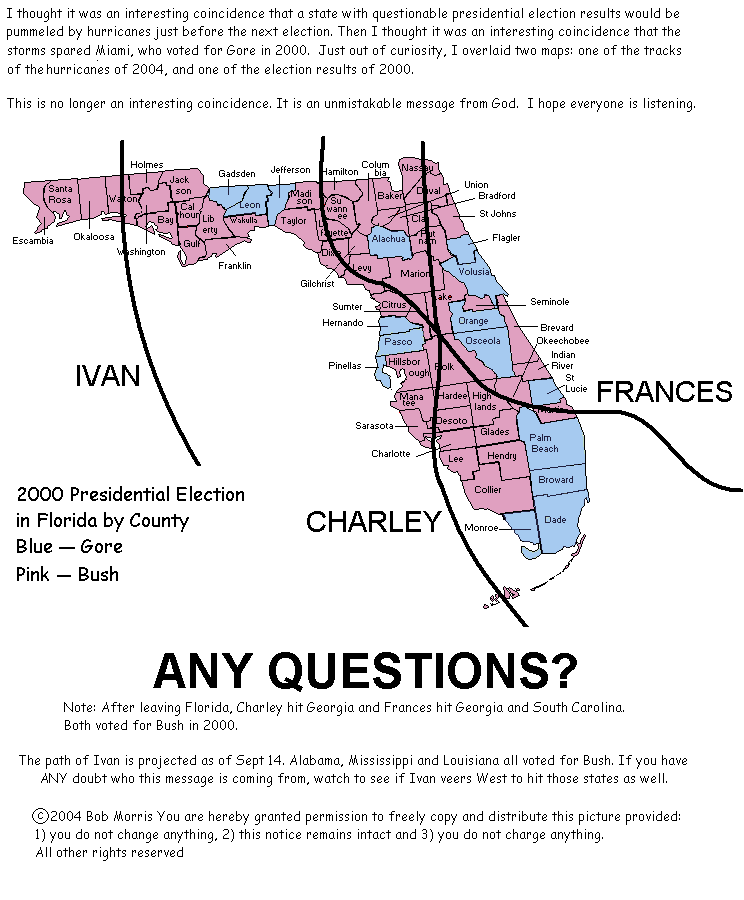
Follow-up (November 13, 2004): Another reader pointed out that this map started out as a joke but turned into an urban legend. As this link points out the hurricane paths in the graphic were simply not accurate and the actual hurricanes hit many Gore counties. It just goes to show you shouldn’t believe everything you read, especially on the Internet.
Thanks for trying to help us out but save your clicking, because it just wastes your time and doesn't help us any. Our advertisers pay us a flat rate per month so we get the same amount of money whether you click or not. But even if we did get paid on a per-click basis, we still wouldn't ask you to click on ads gratuitously, because that wouldn't be fair to the advertisers. Advertisers who pay for clicks are expecting to get business from those clicks, and it hurts them when people click with no intention of buying. Wherever you are on the Internet, if you know the advertiser is paying by the click, then it’s kind of mean to click their ad if you know you’re not really interested in checking out what they have to offer.
We’re unusual in that we charge advertisers by the month. Most ads for online casinos are affiliate programs, where the webmaster gets a percentage (35% or so) of what the players lose, after they click over and open an account. It’s actually of questionable legality for U.S. webmasters to run ads as an affiliate, which is one reason we don't. Another reason is that our players tend to be a little more educated and less likely to lose, which would cut into our affiliate commissions. So the big reason we don't do affiliate programs is that we don't have to -- as one of the premier gambling sites on the net, we're able to sell ads on our own terms because so many online casinos fall all over themselves trying to pay us for some of our limited adspace. It's good to be on top. :)
- How do you feel about "Position"? Example: Do you think there are really hands that are profitable from late position but should never be played from early position?
- What about "Pot Odds"? I understand the concept, but I've laid down a lot of hands that would have been winners, simply because I didn't have the correct odds to stay in and draw.... The charts on your website suggest that the strongest starting hands have a certain "Expected Value" if never folded. Do you recommend seeing these hands through to the river unless it's obvious that you're beaten (regardless of pot odds)?
Thank you for your time.
Pot odds is an important concept. As in any form of gambling the value of a bet depends on your probability of winning, the amount of the bet, and the amount of the win. The following table shows some common situations. The probability column shows the probability of making a straight or flush. The pot odds column shows the minimum number of bet units already in the pot for betting to be a good bet, assuming you will definitely win if you make your hand (unless you have the nut flush this is a big if).
Frequent Draws
| Hand | After | Probability of Making Hand |
Pot Odds |
|---|---|---|---|
| 4 to a flush | Flop | 34.97% | 1.86 |
| 4 to an outside straight | Flop | 31.45% | 2.18 |
| 4 to an inside straight | Flop | 16.47% | 5.07 |
| 4 to a flush | Turn | 19.57% | 4.11 |
| 4 to an outside straight | Turn | 17.39% | 4.75 |
| 4 to an inside straight | Turn | 8.70% | 10.50 |
There are lots of other factors to consider. One could write an entire book about it, and in fact many people have. Personally I recommend Get the Edge at Low-Limit Texas Hold 'em by Bill Burton as a introductory book on hold 'em. About my charts, no, definitely do not trust in a good starting hand the entire way through. There will be lots of times when you should fold a pair of aces. My tables are meant to only help the player bet before the flop. After the flop the expected value of your hand will likely change substantially.
w=1-(1-p)n
1-w = (1-p)n
log(1-w) = log((1-p)n)
log(1-w) = n*log(1-p)
n= log(1-w)/log(1-p)
So in your example n = log(1-.5) / log(1-(1/36)) = log(0.5) / log(35/36) = 24.6051. So if the probability of success is 50% in 24.6 rolls it must be slightly less in 24 rolls.