
Wizard Recommends
-
 $11000 Welcome Bonus
 -
 $3000 Welcome Bonus
 -
 UP TO $777 BONUS
Bingo - FAQ
Consider a bingo game with 75 random cards. Draw 12 random numbers, according to standard bingo rules. Is the probability of a bingo 75 * 0.00199521? (I got the 0.00199521 from your table of bingo probabilities for a standard occurring within 12 numbers called) If not, what is the probability that a bingo will occur? You have a great page.
You're right, according to my table of my probabilities in bingo the probability of any one person getting a bingo within 12 numbers drawn is 0.00199521.
Normally, if the probability of an event happening is p the probability that it will happen at least once in n times is 1-(1-p)n. In this case the probability that at least one person will get a bingo is 1 - 0.0019952175 = 1 - .9980048 75 = 1 -.8608886 = .1391114.
However, in bingo we can't use the method above because all cards go against the same draw of balls. It is hard to explain, but because the cards are arranged in five columns of 15 possible numbers each, the expected number of balls is correlated. It would take a random simulation to properly answer your question. Without doing that, 13.9% is a good rough guess.
Hi, I'm doing a project on Bingo and I would like to know how to find the probability of Bingo. The probability of getting a line, horizontally, diagonally and vertically, a coverall, and the four corners. I have already seen your probability table and i wanted to know the formula you used.
The probability of getting a bingo (5 in a row) is complicated to explain, mainly due to the free square. I used a computer to do it. Four corners is much easier. The probability of having 4 corners, given x marks on the card, is combin(20,x-4)/combin(24,x). In other words, it is number of ways to put 4 of the marks in the corners and the rest anywhere else divided by the number of ways to put all x anywhere on the card. The probability of getting four corners within y calls is the sum for i=4 to y of the product of the probability that given y calls there will be x marks on the card and the probability that these x marks will form four corners (above). The probability of getting x marks in y calls is combin(24,x)*combin(51,y-x)/combin(75,y). Following this logic, you should be able to see the math for a coverall.
In your bingo section you specify the probabilities of getting bingo in a particular round, but what is the expected number of drawn numbers before someone gets bingo?
Following is the expected number of calls before somebody gets a bingo according to the number of players.
1 player: 41.37
10 players: 25.51
50 players: 18.28
100 players: 15.88
200 players: 13.82
500 players: 11.56
1000 players: 10.13
What is the probability that out of 600 bingo cards at least one will get a coverall within 54 calls?
The probability that any given card will have a coverall with 54 calls is combin(51,30)/combin(75,54) = 114456658306760/2103535234151140000 =~ 1 in 18738. The probability of 600 cards not winning are (1-1/18738)^600 =~ 96.79%. So the probability that at least one of the 600 players will hit is are 3.21%.
At bingogala.com they offer a $500 prize for a coverall within 54 calls. You told me earlier that the probability of that at least 1 card in 600 will get a coverall in 54 calls is 3.21%. So in 380 days (to date) at 8 sessions per day they should have 97.58 $500 winners, right? However I counted only 76 winners on their home page. When I brought up my question about this in chat my husband and I were both banned from the site which really sent my antenna up? Sorry to be a pest but if they are running an unscrupulous site I want to know how to figure it out so that I can shout it far and wide with facts. Thank you for any help you can give me in this matter.
First let me explain that this is a rather old question that I put on the back burner, bingogala has now been in operation for two years according to their home page. The probability of a coverall within 54 calls for a single card is COMBIN(75-24,54-24)/COMBIN(75,54) = 0.000054. The probability at least one card in 600 will get a coverall in 54 call is 1-(1-.000054)600 = 0.032121. The expected number of winners over 380 days at 8 sessions per day is 97.65. The standard deviation is (380*8*0.032121*(1-0.032121))1/2 = 9.72. So this is (97.58-76)/9.72 = 2.23 standard deviations south of expectations. The probability of 76 or fewer winners in a fair game is 1.30%. So this could either be explained by bad luck on the part of the players, or fewer than 600 players on average. Perhaps they didn’t get as many in the early days. So the evidence doesn't warrant an accusation of foul play in my opinion.
Dear wiz: The horserace track that I attend is introducing video lottery machines. Can you tell me anything about them? Are they the same as slots? Any info you can give would be helpful and appreciated.
Another Mike S., what are the odds? Lots of racetracks permit what is called "class 2" gaming, which must be lottery or bingo based. The way to offer slots under this rule is to have a lottery or bingo game going on behind the scenes and the outcome is displayed in the form of a slot machine win. For example if the lottery game determines that you win 20 times your bet it will display whatever slot machine symbols pay 20. So it is a clever illusion.
I live in Oklahoma and I have heard that the slot machines here are not really slot machines but you are playing bingo against other players. What is the actually going on?
Oklahoma, and various other Indian casinos, have what is called "class 2" slots. The outcome is actually determined by the draw of bingo balls. Players at different various different slot machines are linked together, each player has different cards but the draw of the balls is common to all players connected via the network. There is generally a "game ending pattern" in which if some player completes it then balls quit drawing for all the other players. However with most manufacturers these game ending patterns are very hard to achieve so the element of competition is negligible. Unless the game ending pattern is achieved a certain number of balls are drawn, your cards are automatically daubed, and you are paid according the highest paying pattern you cover, and there are hundreds of patterns. A video representation of a slot machine is only to illustrate how much you have won. If done well, and they often are not, the games play almost just like a Vegas slot machine.
Always, great site. I am hoping that you can settle an argument between myself and a friend of mine concerning online Bingo. The web-site allows you to buy bingo cards for 10 cents a piece. Assuming one has 5.00 to spend, my friend believes you have are better off buying 50 cards and playing one time instead of buying a single card each game at .50 and playing 10 times. I disagree and believe that since no matter how many cards you buy, they are .10 cents a piece, it makes no difference if you play them all at once or spread them out?
Thanks for the compliment. The answer depends on how the jackpot is determined by the bingo site. If it is a percentage of total cards sold, which is usually the case, then it wouldn’t make any difference. However, if there is a fixed prize for the winner, then it would be better to play one game at a time, lest you compete against yourself.
In Oklahoma we play at the Indian casinos. I understand we are actually playing bingo. If this is true do they have same payback as Vegas machines with the random number generators?
Yes, that is true. In some states like Oklahoma traditional “class 3” slots are illegal. A way to get around that law is to have a machine pick bingo cards and balls at random. Certain patterns will be mapped to certain wins and the outcome will be displayed to the player like a slot machine win. If done properly, and often they aren’t, the games play just like those in Vegas. If I recall correctly I saw some popular Williams slots like Reel ‘em In when I was at a casino in Tulsa, with just a little bingo card in the corner of the screen. Otherwise they looked the same to me. I don’t know what return they set their slots to in Oklahoma so I can’t help you with that question.
What is the probability that two bingo cards have no number in common? What is the probability they have every number in common?
The probability two bingo cards have no numbers in common is (combin(10,5)/combin(15,5))4×(combin(11,4)/combin(15,4)) = 1 in 83,414. The probability two bingo cards have all 24 numbers the same is (1/combin(15,5))4×(1/combin(15,4)) = 1 in 111,007,923,832,371,000.
In the Station casinos, there is the "Big 3" game in their bingo rooms. You must get 3 of the first 4 numbers to win a progressive jackpot. What are the odds of that? Thank you.
For the benefit of other readers, the Big 3 is a bingo side bet at all the Station Casinos and the Fiesta Rancho. The player is given a ticket, either paper or loaded into an electronic unit, with three random bingo numbers out of the 75 possible. If the first four bingo numbers called in that session contain all three of the player’s numbers, then the player will win a progressive jackpot. The jackpot starts at $1000 at grows by $200 a day until somebody wins. Every session, and property, has an independent jackpot.
The number of winning combinations is 72, because three of the balls must match, and the fourth can be any one of the other 72 balls. There are combin(75,4) = 1,215,450 possible combinations. Thus, the probability of winning is 72/1,215,450 = 0.000059. The player can buy 48 tickets for $10, thus the cost per ticket is 10/48 = 0.208333 dollars. The breakeven meter, where there is zero house edge, is (10/48)/(72/1,215,450) = $3,516.93.
Station Casinos indicate the Big 3 Jackpots on their Jumbo Bingo web site. There you will see the meter often will exceed $3517. When I answered this question on August 30, 2007, two of the eight properties had a player advantage, the Palace Station and Fiesta Rancho. This is one of the few bets in Las Vegas that often have a player advantage. Unfortunately, they limit the number of cards you can buy, making it not worth the bother to most people, including me, to make a special trip.
How many traditional bingo cards would have to be in play to achieve a coverall in 40 numbers or less, statistically speaking?
The cards are randomly printed, so if you purchased enough, you would get repeats. So there is no number where you would be assured of winning. The probability of each card winning is 0.00000000243814, or 1 in 410,148,569. Suppose you would be happy with a probability of winning of p, the number of cards you purchased is n, and the probability of winning per card is c. Let’s solve for n:
P = 1-(1-c)n
1-p = (1-c)n
ln(1-p) = n×ln(1-c)
n=ln(1-p)/ln(1-c)
For example, to have a 90% chance of winning you would need to buy ln(1-.9)/ln(1-0.00000000243814) cards, which equals 944,401,974.
Station Casinos offer free "Mini X" bingo cards to their bingo players, according to how much they spend, as follows:
Spend $1-$19 = 1 free card
Spend $20-$29 = 2 free card
Spend $30-$39 = 3 free card
Spend $40-$49 = 4 free card
Spend $50-$59 = 5 free cards
Spend $60+ = 6 free cards
Each card has five numbers, one for each letter in BINGO. The prizes are as follows:
Cover card in 5 numbers = $10,000
Cover card in 6 numbers = $3,000
Cover card in 7 numbers = $500
If nobody covers in 7 or less numbers, a consolation prize of $50 is paid to the first player to cover.
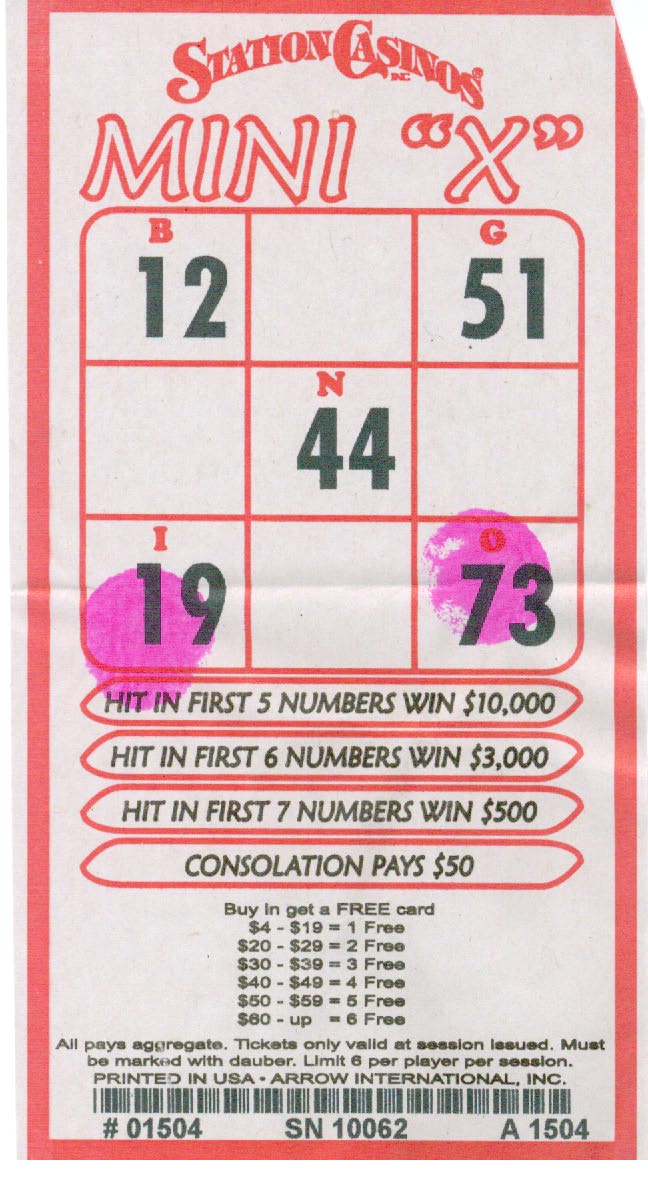
The following table shows the value of the base prizes to be 1/5 of one cent per card.
Expected Value of Mini X Card
| Calls | Pays | Probability | Return |
| 5 | 10000 | 0.00000006 | 0.00057939 |
| 6 | 3000 | 0.00000029 | 0.00086909 |
| 7 | 500 | 0.00000087 | 0.00043455 |
| Total | 0.00000122 | 0.00188303 |
The value of the consolation prize per card is 50/n, where n is the number of competing cards. For example, if there were 1000 competing cards, then the value of the consolation prize per card would be 5 cents.
What is the probability of two bingo cards in play in the same session being identical?
It depends on how many cards there are in play. Assuming c cards in play, a good approximation for the probability for at least one set of identical cards is 1-e(-c/471,000,000). For example, with 10,000 cards in play, which I think is about right for a Vegas bingo session, the odds of at least one set of identical cards are about 1 in 47,000. To have a 50/50 chance of at least one set of identical cards, you would need to have about 330 million cards in play.
I won four jackpots in six bingo games. The requirement to hit the jackpot was a coverall within 50 balls. The casino then refused to pay, claiming there was a malfunction, and threatened to take my $100 deposit money too. This doesn't seem fair. What is your opinion?
The probability of a coverall within 50 balls on any given game is 1 in 212,085. The probability of getting one four out of six games is 1 in 134,882,670,482,530,000,000. That sounds like a malfunction if there ever was one. I think the casino has a legitimate case to decline the jackpots, as the games obviously didn't perform properly. However, I think it is just thievery to take your deposit money. I also have to question the integrity of the game, if it could gaff a win like this. Makes me suspect the draw may not be fully random.
This question is raised and discussed in my forum at Wizard of Vegas.
The casino in Milwaukee, which started as a bingo hall, had a record 290 bingos in one game this week. The pattern was the letter I, either up and down (3 on top and bottom and all the Ns) or sideways (3 Bs and Os with the middle). It took 43 calls for the first G ball to be called, resulting in mass winners. Each person got $25.
Here is an article about it: Bingo! Record set at Potawatomi for number of winners in single game.
My question is what are the odds of going 43 calls without calling any numbers of a particular letter?
I've been in similar situations where most people were waiting on a particular letter, but the most winners I've ever seen at once is around 25.
I show the probability of going 44 calls and avoiding any one letter (not just G) is 1 in 1,517,276. Here is a formula to that probability: 5*combin(60,44)/combin(75,44) - combin(5,2)*combin(45,44)/combin(75,44)
In the document titled bingo pattern probabilities (PDF) on your site, you indicate the expected number of calls to find a winner, assuming 300 cards in play, is as follows:
- Four corners: 8.43
- Small diamond: 11.833
Both patterns require four marks only and have only one way to win. Why are the expected number of balls to find a winner different?
This is a difficult answer to explain. Let me start by saying that expected number of calls in a single-card game would be the same. However, there is a correlation effect with more than one card.
It's hard to give a quick answer to this one, but if forced, it's because the four corner pattern requires a concentration of balls in the B and O columns. The small diamond pattern is more likely to be hit with a flatter distribution of balls over the B, N, and O columns.
Let's simplify the game to one where there are an infinite number of cards in play and the balls are drawn WITH replacement. Here is the number of balls required to get a winner in both games:
- Four corners: 2.5+2.5+((1/2)*10+(1/2)*(2.5+5)) = 13.75
- Small diamond: =(5/3)+((1/3)*((5/3)+(5/2)+5)+(2/3)*((5/2)+((1/2)*((5/2)+5)+(1/2)*(5+5)))) = 12 + 2/9
This shows that the four corners takes 1.53 more balls.
Running this through a simultion under normal bingo rules, assuming infinite cards, here are the results:
- Four corners: 12.8289
- Diamond: 11.3645
This time a different of 1.46 balls.
What I hope to have shown is patterns are more likely to be covered quicker if the marks are distributed over more columns. For this reason, I think that in a single-bingo game you usually see the winning bingo is horizontal.
This question is asked in discussed in my forum at Wizard of Vegas.
What is the expected number of marks on a single bingo card to form various common winning patterns?
Here is the average number of marks needed on a card for common winning patterns:
- Single bingo — 13.60808351
- Double bingo — 16.37193746
- Triple bingo — 18.02284989
- Single hardway — 15.29273554
- Double hardway — 18.09327842
- Triple hardway — 19.79294406
- Six pack — 14.62449358
- Nine pack — 18.97212394