
Wizard Recommends
-
 $11000 Welcome Bonus
 -
 $3000 Welcome Bonus
 -
 UP TO $777 BONUS
Ask The Wizard #230
In the news today, a woman in Atlantic City rolled 154 times consecutively before sevening out at the Borgata. That means she rolled two dice 154 times, with no sevens. So I took (30/36)154, and came up with odds of over 1.5 trillion to 1. One is about 9,000 times more likely to win the Mega Millions lottery than to pull off a 154-consecutive non-seven dice roll marathon. Given how astronomically unlikely this is, and given that people are convicted on DNA evidence that is mere billions to one against being a false match, how much would you suspect cheating, and would you offer to consult the Borgata about this? I already called them, and gave them my name, and told them to do what they want with it. I’m curious as to your thoughts.
First of all, she rolled the dice a total of 154 times, with the 154th roll being a seven out (Source: NJ.com). However, that does not mean she never rolled a seven in the first 153 rolls. She could have rolled lots of them on come out rolls. As I show in my May 3, 2003 column, the probability of making it to the 154th roll is 1 in 5.6 billion. The odds of winning Mega Millions are 1 in combin(56,5)*46 = 175,711,536. So going 154 rolls or more is about 32 times as hard. Given enough time and tables, which I think exist, something like this was bound to happen sooner or later. So, I wouldn't suspect cheating. I roughly estimate the probability that this happens any given year to be about 1%.
Also see my solution, expressed in matrices, at mathproblems.info, problem 204.
Station Casinos offer free "Mini X" bingo cards to their bingo players, according to how much they spend, as follows:
Spend $1-$19 = 1 free card
Spend $20-$29 = 2 free card
Spend $30-$39 = 3 free card
Spend $40-$49 = 4 free card
Spend $50-$59 = 5 free cards
Spend $60+ = 6 free cards
Each card has five numbers, one for each letter in BINGO. The prizes are as follows:
Cover card in 5 numbers = $10,000
Cover card in 6 numbers = $3,000
Cover card in 7 numbers = $500
If nobody covers in 7 or less numbers, a consolation prize of $50 is paid to the first player to cover.
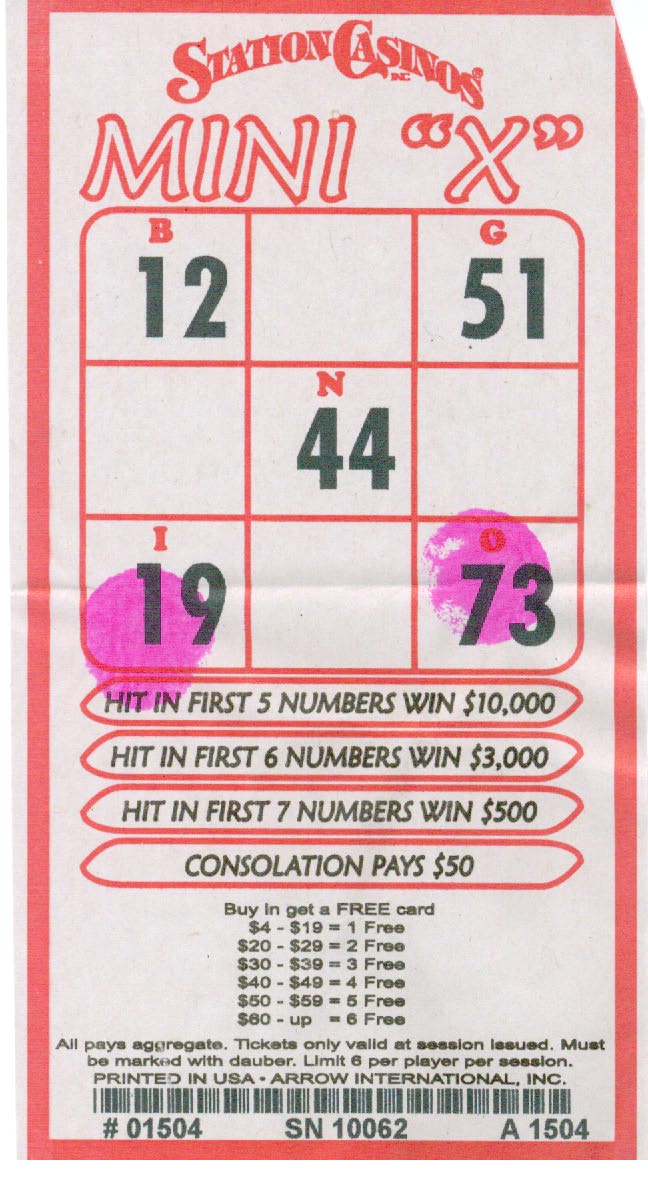
The following table shows the value of the base prizes to be 1/5 of one cent per card.
Expected Value of Mini X Card
| Calls | Pays | Probability | Return |
| 5 | 10000 | 0.00000006 | 0.00057939 |
| 6 | 3000 | 0.00000029 | 0.00086909 |
| 7 | 500 | 0.00000087 | 0.00043455 |
| Total | 0.00000122 | 0.00188303 |
The value of the consolation prize per card is 50/n, where n is the number of competing cards. For example, if there were 1000 competing cards, then the value of the consolation prize per card would be 5 cents.
On your video poker double double bonus poker strategy page, you state that if your are dealt 5 6 7 8 9
 , that it is correct to hold the straight. It just seems counter-intuitive to me, but if you could explain in a little more detail about why going for the straight flush is poor strategy, I would be grateful.
In double double bonus a straight flush pays 50, a flush pays 6, and a straight pays 4. The probability of making the straight flush is 2/47, of a flush is 7/47, and of a straight is 5/47. So, the expected return of discarding the 9 is (2/47)×50 + (7/47)×6 + (5/47)×4 = 3.4468. The expected return of the straight at 4 is much more.
What happened to the card game 3-5-7 in Las Vegas? I cannot find it anywhere.
I'm told that game had to be pulled out of the U.S. casinos, because the game of patent infringement. According to the Fourth Quarter 2008 Statistical Report of the Nevada Gaming Control Board, the following are the table game counts in Clark County.
Clark County Table Game Count
| Game | Tables |
|---|---|
| 21 | 2537 |
| Roulette | 405 |
| Craps | 334 |
| Other | 243 |
| Baccarat | 233 |
| Three Card Poker | 208 |
| Pai Gow Poker | 194 |
| Mini baccarat | 143 |
| Let It Ride | 98 |
| Pai Gow | 80 |
| Wheel of Fortune (Big Six) | 37 |
| Caribbean Stud Poker | 22 |
| Sic Bo | 1 |
| Chuck-a-Luck | 1 |
Unfortunately, they don't say what the 243 "other" games are, so this isn't of much help to answer your question, but it is still worth mentioning.
Dear sir, I "clocked" an automated single-zero roulette game for 8672 games. My predetermined number came up an amazing 278 times. I chose the number because of the wear and tear of the pocket. How sure am I that this number has higher probability than 1/37?
If my terminology is correct, "clocking a wheel" means to predict where the ball will land judging by the ball speed, ball location, and wheel speed. It sounds like what you are doing is exploiting a biased wheel, which is a different advantage play. As long as we’re on the topic, a third advantage play is exploiting "dealer signature," where the croupier is so consistent that the ball and wheel speed are nearly the same every spin. This allows the player to predict where the ball will land based on ball location and past results.
To answer your question, the expected number of times you should have hit your number is 8672/37=234.38. The variance is 8672×(1/37)×(36/37)=228.04. The standard deviation is the square root of the variance, or 15.10. You had 278-234.38=43.62 more hits than expected. That is (43.62-0.5)/15.10 = 2.8556 standard deviations. The reason for subtracting 0.5 is hard to explain. Suffice it to say it is an adjustment factor for using a continuous function to estimate a discrete function. Doing a Gaussian approximation, the probability of hitting your number that many times, or more, is 0.21%. So, there is a good chance you found a biased wheel. However, there is still a 1 in 466 chance it was just good luck.