
On this page
Texas Hold'em
On this page
Rules

- A single 52-card deck is used. All cards count as its poker value. Aces may be high or low.
- One player is designated as the dealer, usually with a laminated marker. This person does not have to physically deal the game. However it is important that a symbolic dealer position rotate around the table.
- The player to the dealer's left must make a "small blind" bet. The player to the left of the small blind must make a "big blind" bet. The amounts of both blinds should be specified in advance. The purpose of the blinds is to get the ball rolling with some money in the pot.
- Two cards shall be dealt down to each player, starting with the person to the dealer's left.
- The player to the left of the big blind must either call or raise the big blind bet. The play in turn will go around the table according to normal poker rules, which I assume the reader already knows. Table rules will specify any limits on the size or number of allowed raises.
- The small blind may also raise the big blind. If nobody raises the big blind the player making the big blind has the option to raise his own bet. The term for this is the "big blind option."
- Three community cards will be dealt face up in the center of the table. This is called the "flop."
- Another round of betting will ensue, starting with the player to the dealer's left.
- A fourth community card will be dealt face up in the center of the table. This card is called the "turn."
- Another round of betting will ensue, starting with the player to the dealer's left. Generally the minimum bet is double the first two rounds of betting.
- A fifth and final community card will be dealt face up in the center of the table. This card is called the "river."
- Another round of betting will ensue, starting with the player to the dealer's left. The minimum bet is generally the same as the previous round.
-
Each player still in the game at the end will determine the highest poker value among his own two cards and the five community cards. It is NOT a requirement that the player use both of his own cards. The player with the hand of highest poker value shall win. Following are the hand rankings.
- Straight flush: Five consecutive and suited cards. For example 5
 , 6, 7, 8, 9.
 - Four of a kind: Four cards of the same rank, plus any fifth card. For example Q, Q
 , Q
, Q , Q
, Q ,4.
,4. - Full house: Three of a kind and a pair. For example 6, 6, 6, J , J.
- Flush: Any five cards of the same suit, except for a higher ranking straight flush. For example A, Q, 8, 4 , 3.
- Straight: Five consecutive cards, except for a higher ranking straight flush. For example 8, 9, 10, J, Q.
- Three of a kind: Three cards of the same rank, plus any other two cards. For example 5, 5, 5, Q ,2 .
- Two pair: Two pairs, plus any fifth card. For example 8, 8, 2, 2 ,Q .
- Pair: A pair and any other three cards. For example 7, 7, 2, 5 ,A .
- ? High: Any five cards that do not form any higher poker hand. A king high hand for example might be K, Q, 7, 5 ,4 .
- Straight flush: Five consecutive and suited cards. For example 5
- If two or more players have poker values of the same rank then the individual cards will be used to break the tie. If necessary all five cards will be considered.
- I get asked a lot whether the two unused cards in a player's hand are used to break a tie. The answer is a firm NO. The two unused cards do not matter.
- If a new player arrives at the table he should either wait for the big blind position or put up an amount equal to the big blind, amounting to a call of the big blind.
- If a bet is made after another player runs out of money, then a separate pot is created. The player that ran out of money is not eligible to win the second pot. If more than one player runs out of money then multiple separate pots can be created.
- In formal games players may not bet with cash or buy chips with cash in the middle of a hand.
- There are numerous rules of etiquette, which I won't get into.
- There house may set the betting rules. There are three main types. A "structured" game features raises of specified amounts. For example a "3/6 game" would mean that raises after the deal and flop are $3, and after the turn and river are $6. There is usually a limit to the number of raises a player may make, typically three. A "pot limit" game has structured minimum raises but the maximum raise may be anything up to the amount in the pot at the time the raise is made. A "no limit" game also has structured minimum raises but there is no maximum raise.
 Ohio Recommended Online Poker Rooms
View All



Rules to Betting
The following rules to betting are common to most forms of poker.
- There is a positional advantage to acting late around the table. To make it fair, a lamer saying “dealer” will rotate around the table clockwise one position per hand.
- It does not matter who deals the cards, but the player with the dealer lamer will enjoy a position advantage of acting last that round.
- The player immediately to the left of the dealer lamer must act first and then clockwise around the table.
- There is usually a mandatory small blind and big blind in the first round of betting. These are fixed amounts, like a small blind of $1 and a big blind of $3. The player immediately to the left of the dealer makes the small blind wager and the player to the left of him makes the big blind wager. After that, all other players may fold if they wish.
- If a player raises, any re-raises must be at least the amount of the previous raise. For example, if player A raises $10 and player B wishes to reraise, his wager must be at least $20.
Betting Limit Terminology
- Structured: In structured betting, raises may be only specified amounts. There are usually two numbers, one for the early rounds of betting and the other for the later rounds. For example, a $5/$10 game would mean that in the early rounds of betting raises must be exactly $5 and $10 in the later rounds. In games with four rounds of betting, like Texas Hold ‘Em, the first two rounds go by the first number and the second two by the larger number. Also, the small blind is equal to the lower number.
- Pot Limit: In pot limit games, there are minimum raise rules, as in structured games. However, the maximum raise would be the amount in the pot prior to the raise. For example, in a $5/$10 game with $80 in the pot, in the first two rounds of betting the minimum raise would be $5 and the maximum would be $80.
- No Limit: In no limit games, there are the same minimum raise rules as in structured games. However, there is no maximum raise, other than the maximum stack of all opponents at the game.
Poker Etiquette
- The biggest infraction of poker etiquette is probably the string bet. Bets are supposed to be in a simple single action. Adding to a bet already made or a bet not matching a declaration is a string bet.
- If you wish to raise, you should declare that before your action.
- If you declare your action, it should contain only one verb. For example, “I bet $20” or “I raise $10.” If you say something like “I call and raise,” then it will be the first verb stated that counts and you must only call.
- Check raising is absolutely allowed. This means to check and then make a re-raise in the same round. This used to be considered bad etiquette and even banned at some tables. However, it is now a proper tool in strategy to prevent players in late position from stealing the pot after a round of checking.
Betting Limit Terminology
- Structured: In structured betting, raises may be only specified amounts. There are usually two numbers, one for the early rounds of betting and the other for the later rounds. For example, a $5/$10 game would mean that in the early rounds of betting raises must be exactly $5 and $10 in the later rounds. In games with four rounds of betting, like Texas Hold ‘Em, the first two rounds go by the first number and the second two by the larger number. Also, the small blind is equal to the lower number.
- Pot Limit: In pot limit games, there are minimum raise rules, as in structured games. However, the maximum raise would be the amount in the pot prior to the raise. For example, in a $5/$10 game with $80 in the pot, in the first two rounds of betting the minimum raise would be $5 and the maximum would be $80.
- No Limit: In no limit games, there are the same minimum raise rules as in structured games. However, there is no maximum raise, other than the maximum stack of all opponents at the game.
Poker Etiquette
- The biggest infraction of poker etiquette is probably the string bet. Bets are supposed to be in a simple single action. Adding to a bet already made or a bet not matching a declaration is a string bet.
- If you wish to raise, you should declare that before your action.
- If you declare your action, it should contain only one verb. For example, “I bet $20” or “I raise $10.” If you say something like “I call and raise,” then it will be the first verb stated that counts and you must only call.
- Check raising is absolutely allowed. This means to check and then make a re-raise in the same round. This used to be considered bad etiquette and even banned at some tables. However, it is now a proper tool in strategy to prevent players in late position from stealing the pot after a round of checking.
Examples
Example 1
Board: A, 2, 4, 5, 6
Player 1: J, 6
Player 2: 7, Q
Player 1 wins. Both have an ace high flush, so the second highest card is considered. Player 1's jack beats player 2's 7. The only way to have a flush tie is if the flush is entirely on the board and no hole cards are higher than the lowest card on the board in the same suit.
Example 2
Board: J, A, 7, 5, 6
Player 1: 2, J
Player 2: 10, J
Player 2 wins. Both have a pair of jacks so the singletons are considered. High highet singleton in both hands is an ace so the second highest singleton is considered. Player 1's second highest singleton is a 7, compared to player 2's 10. A 10 beats a 7 so player 2 wins.
Example 3
Board: A, A, K, Q, J
Player 1: Q, J
Player 2: Q, 2
Tie. Both have a two pair of aces and queens, with a king singleton. Some people incorrectly believe that in such cases the unused cards are considered, in this case player 1's pair of jacks beating player 2's jack/2. Only the top five cards matter. The jacks and deuce are irrelevant.
Hole Card Strategy
One of the most important aspects of Texas Hold'em is the value of each two-card hand before the flop. The decision of how to play your first two cards is something you face every hand, and the value of your first two cards is highly correlated to your probability of winning.
The following table shows my power rating for each initial 2-card hand in a 10-player game. The numbers are on a 0 to 40 scale. Basically, you should only play hands that are dark green, blue, or purple. Of course you should be more be more liberal in late position and picky in early position. If forced I would say you should need 10 points in late position and 19 points in early position to call the big blind. If your table is loose, as if often the case online, you can play a bit looser yourself.
Use the top table if you have a pair, the middle table if your cards are suited, and the bottom table if your cards are unsuited. Except for a pair,look up your high card along the left and your low card along the top.
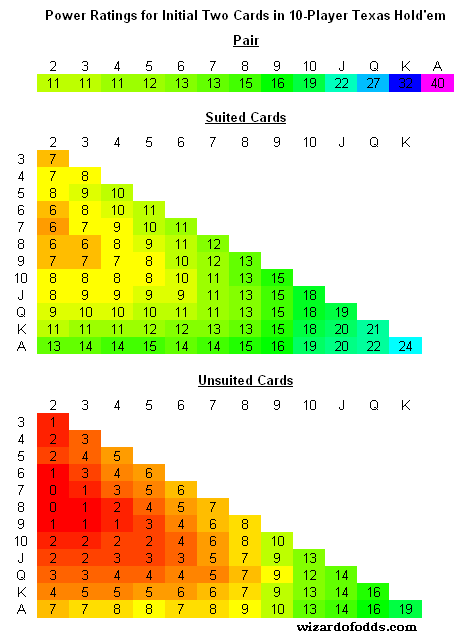
Following are the links to my tables of the value of each intial hand according to the number of players. The 10-player section explains the methodology for creating the table table.
Top 6 Online Poker Bonuses View All




Pot Odds
The following table shows the probability of making various hands after the flop and the correct "pot odds." The pot odds are the breakeven ratio of money in the pot to the amount you have to bet for the player to be indifferent about calling, assuming the player would definitely win if he makes the hand (a big if) and there are no additional bets (another big if). This table is a good starting point the player should make mental adjustments for the probability of winning without making the hand, losing with making the hand, and expected future bets. The odds of a two pair improving to a full house are the same as those for four to an inside straight.
Pot Odds — After Flop
| Hand | Probability of Making Hand |
Pot Odds |
|---|---|---|
| Four to a flush | 34.97% | 1.86 |
| Four to an outside straight | 31.45% | 2.18 |
| Four to an inside straight | 16.47% | 5.07 |
The next table shows the pot odds after the turn.
Pot Odds — After Turn
| Hand | Probability of Making Hand |
Pot Odds |
|---|---|---|
| 4 to a flush | 19.57% | 4.11 |
| 4 to an outside straight | 17.39% | 4.75 |
| 4 to an inside straight | 8.70% | 10.50 |
Hand Strength Calculator
I'm proud to present my new and improved Poker Odds Calculator. Enter any situation in Texas Hold 'Em, and it will tell you the probability of each possible outcome.
Poker Tournament Calculator
My Poker Tournament Calculator will determine each player's probability, for up to nine players, of finishing in each place, and his expected share of any prize pool, assuming equal skill among all players. It produces the same results as what is known as the Independent Chip Model.
Scam - Chip Dumping
Internal Links
- Pinapple — Strategy and analysis of which card to discard before the flop.
- Bad Beat Jackpots: What is the Probability of Hitting one?
- Texas Hold 'Em Dominated Hand Probabilities: What is the probability one of your opponents has similar, and better, hole cards than yours?
- Internet Poker Rake Survey