





On this page
Pontoon (Real Time Gaming version)
Introduction
Pontoon is sometimes said to be an early version of blackjack. Today Pontoon is offered by Real Time Gaming, Playtech, Microgaming, Betsoft, Galewind Software, Nucleus and Cryptologic Internet casinos. In Pontoon, any five-card hand or a pontoon (same thing as a blackjack) pay 2 to 1, including after splitting. However there is no dealer up card and the dealer wins on ties. There are several other rule changes from blackjack so read carefully before playing.
Australian Pontoon, which is what Americans call Spanish 21, is a completely separate game, and is addressed on my page on Australian Pontoon.
Rules
Following are the usual rules.
- The game is played with eight 52-card decks, or two decks at Bovada.
- All cards have the same value as in blackjack.
- The ranking value of hands in pontoon is as follows:
- A pontoon, which is defined as an ace and any 10-point card, including after splitting
- A five-card trick, which is defined as any 5-card hand that has not busted. All five-card tricks are of the same value, the point total does not matter.
- A non-busted hand of 21 points of less with 4 or less cards. Hands will be ranked within this group according to the total number of points.
- A busted hand of 22 points or more.
- The dealer will deal each player two cards face up and two cards face down to the dealer.
- The dealer will peek at his cards for a pontoon. If the dealer has a pontoon he will immediately turn it over and collect all wagers and cards.
- The player may stand on any total greater or equal to 15, or on any 5-card hand.
- The player may hit at any point, including after doubling.
- The player may double on 2 to 4 cards, but only once per hand. The option includes after splitting, and once for each split hand.
- The player may split two cards of equal rank. The player may resplit once, up to a total of three hands, including aces. When the player splits the first card dealt to each hand shall be automatic.
- Player may draw and double after splitting aces.
- The 2-card 21 after splitting aces counts as a pontoon.
- If the player busts he immediately loses and forfeits his cards and total wager.
- After all players have played out their hands the dealer shall expose his two cards. Then the dealer shall continue to draw cards until he has a total of 17 points or more, except the dealer shall hit a soft 17. The dealer will also stop with any five-card hand.
- The dealer shall compare his hand to each player hand. A winning player pontoon or five-card hand shall pay 2 to 1. All other player wins shall pay 1 to 1 (even money).
- Ties lose.
Strategy
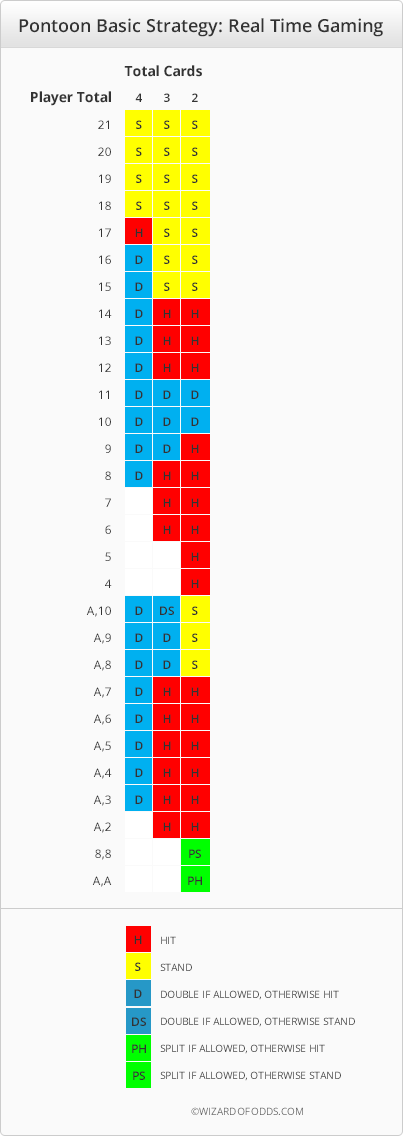
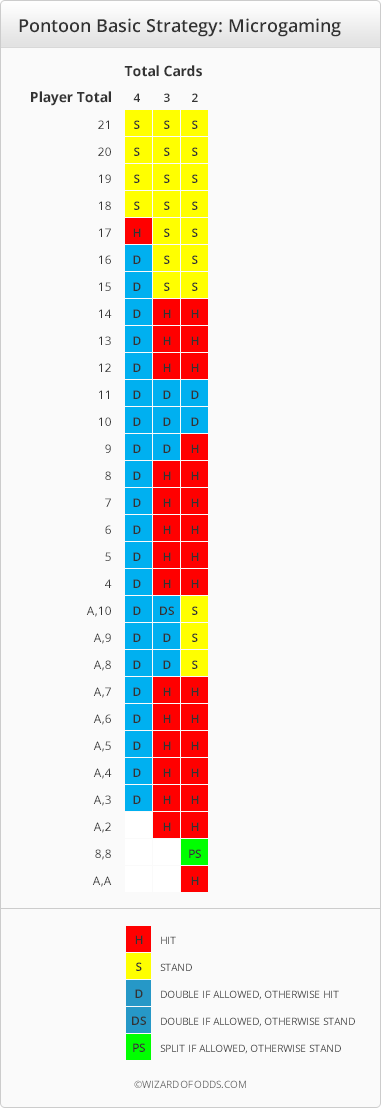
The following tables show the basic strategy for Pontoon under RTG, Playtech, Galewind, Betsoft and Cryptologic rules. Betsoft does not state the number of decks used, but they use six in all their standard blackjack games.
To use the strategy look up the player's hand along the left and across the number of cards along the top. The top of the strategy is for hard totals and the bottom for soft hands. The player should always split eights. The player should split aces under the liberal ace splitting rules above, but not under the Microgaming rules, or hypothetically if an ace and 10 after splitting aces was not a pontoon.
The first chart is appropriate for Real Time Gaming, Playtech, Galewind Software, and Cryptologic rules.
The next table shows the strategy under Microgaming rules.
House Edge
The house edge is 0.38% under the default rules listed above. These rules are followed by Real Time Gaming, Playtech, Galewind Software, and Cryptologic.
At Microgaming casinos the rules are the same except split aces get one card each and the dealer stands on soft 17, in which case the house edge is 0.39%.
Rule Variations
Following are some alternative rules and the effect on the house edge.
- Aces and 10 after splitting aces is 21 points (not a pontoon): House edge increased by 0.49%.
- No draw to split aces (split aces get one card each): House edge increased by 0.49%.
- Dealer stands on soft 17: House edge lowered by 0.47%.
- Two decks (as opposed to eight): House edge increased by 0.35%. That is not a mistake. In Pontoon the more the decks the lower the house edge. I believe this is because it is easier to make 5-card tricks with more decks.
It is not a coincidence that both restrictions on split aces increase the house edge by the same amount, because if either rule is in effect the player should hit a soft 12.
Screenshots
Playtech
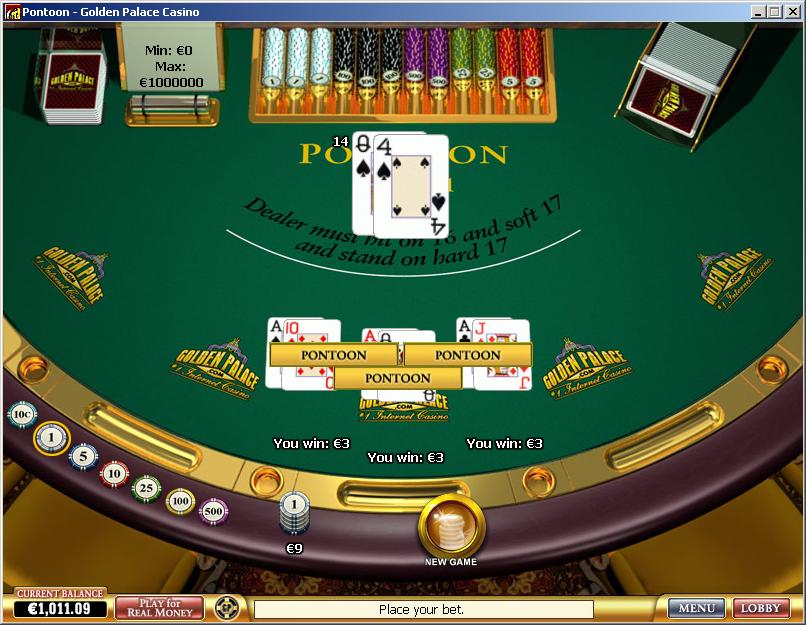
Click on image for larger version
Acknowledgements
I would like to thank Microgaming and Yechezkel Zilber for their contributions to this analysis.