




On this page
Mah Jong Pai Gow
Introduction
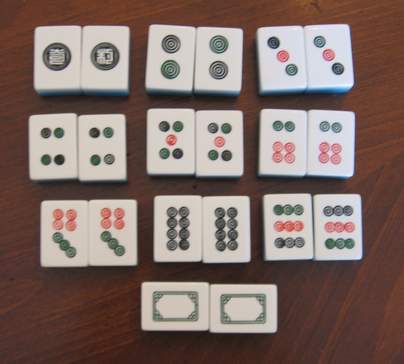
Mah Jong Pai Gow is a table game found at a few of the older casinos in Macau. It is played with 20 Mah Jong tiles as pictured below. Following are the rules.
- Of the 20 tiles, there are two tiles each numbered with 1 to 9 dots. The last two are called the "window" tile, and are equivalent to a ten-dot tile.
- Each player will make a wager against a designated banker, chosen on a rotating basis among the players at the table. A player may choose not to bank on his turn, in which case the option will rotate to the next player.
- The dealer does not play, but takes a 5% commission from all winning wagers.
- After all players have made their bets, and the banker has shown funds to pay all bets should he lose, the dealer will give each player and the banker two tiles each.
- The highest hands are matching pairs. The highest pair is a pair of tens (windows), then 9s, 8s, etc., with 1s as the lowest pair.
- If the pair of tiles do not form a matching pair then the number of dots will be added, ignoring the window tile, and the tens digit dropped (as in baccarat). So the highest number of points is 9 and the lowest 0.
- If both the player and banker have the same number of points then the higher tile in each hand will be used to break the tie; the higher tile wins. For example, if the player had 9 and 6, and the banker had 8 and 7, then player would win, because both hands are five points, and the player's 9 tile beats the banker's 8 tile.
- All 0-point hands are equally bad (as in pai gow tiles).
- In the event of an exact tie, or both hands are zero points, the tie will go to the banker.
- The dealer will collect a 5% commission from all winning bets. I assume the commission is based on the net win of the banker, but on this I am not certain.
The following table shows the possible outcomes when banking against a single player. The lower right cell shows a house edge of 1.25%.
Mah Jong Pai Gow — Banking Return Table
| Event | Pays | Combinations | Probability | Return |
|---|---|---|---|---|
| Banker Wins | 0.95 | 14721 | 0.506398 | 0.481078 |
| Player Wins | -1 | 14349 | 0.493602 | -0.493602 |
| Total | 29070 | 1 | -0.012523 |
The next table shows the possible outcomes when playing against a banking player. The lower right cell shows a house edge of 3.75%.
Mah Jong Pai Gow — Not Banking Return Table
| Event | Pays | Combinations | Probability | Return |
|---|---|---|---|---|
| Banker Wins | -1 | 14721 | 0.506398 | -0.506398 |
| Player Wins | 0.95 | 14349 | 0.493602 | 0.468922 |
| Total | 29070 | 1 | -0.037477 |
Acknowledgments
Kathi M. for finding the rules, and having them translated from Portuguese to English.