
Wizard Recommends
-
 $11000 Welcome Bonus
 -
 $3000 Welcome Bonus
 -
 UP TO $777 BONUS
Slots - Payback Percentages
Is there a particular time of the day or night that's better to play slots and a time that's best to avoid?
No, the odds are the same regardless of the time of day.
Which are the best slots to play and is it better to play three coins all the time or rotate from 2-3 coins.
Most slot machines usually offer an incentive to play the maximum coins. For example two coins may pay 2,000 on the jackpot but three coins will pay 5,000. So if there an economy of scale incentive, then the return is higher with a max-coin bet. However, I should mention that most casinos tend to increase the theoretical return on their slots as they go up in denomination. So, you may be better off betting one coin on a $1 machine than four coins on a quarter machine.
My advice on slot selection is to play a simple smaller game. Nothing with fancy signage or a huge screen. Ultimately, it is the players that pay for that in the form of a lower return.
I recently went to the Couer d' Alene Tribal Casino in Worley, Idaho. It was late at night and they were retrieving money from the video slot machines. When they shut down the machines, a screen pops up with all kinds of information regarding coins in, coins paid, etc. I noticed that the "hit rate" was set to 37% on the bank of machines that I was playing. This seems really low! Not knowing exactly what I was seeing, I thought best to ask the Wizard!
Interesting question. I'm sure that didn't refer to the payback percentage, 37% would be way too low. The "hit frequency" is the probability that the player wins anything.
Do casinos have the right to change minor prize odds on multi-casino progressive-linked games, such as Megabucks or Wheel of Fortune, or are the odds set the same for all casinos. The prizes I'm referring to are the bar, double bar, and triple bar hits. Also do the video poker games such as triple play poker have the same odds for all casinos or does each casino have the right to vary their own odds for the game.
I'm pretty sure that the odds on Megabucks are the same everywhere. It is a "proprietary game," meaning the casino and slot maker (IGT) share in the profits. As I understand it, such propriety games are generally set to a return of about 88% by the slot maker, and the casinos do not have the option for a looser or tighter version.
The Wheel of Fortune game, with the big jackpot, I believe is also a proprietary game.
Video poker odds are dictated by the pay table. For example, a 9-6 Jacks or Better game will pay 99.54%, assuming optimal strategy and an infinite amount of play, regardless of where the machine is or number of number of hands the player gets on the draw.
I know this will be almost impossible for you to figure out, but I'm curious to know approximately how many people play Cash Splash on a daily basis and some idea of the odds against me. I am especially curious to know if online progressive slots offer better chances of hitting that jackpot than land-based progressives.
You're right, it is impossible for me to know without Microgaming giving me the details on how their reels are weighted. I have asked some of the major software companies for such information, but thus far nobody has volunteered anything. However, I can tell you that the average payback for all slots at the Golden Palace for the month of March 2000 was 95.67%. This information is available at the Golden Palace web site, click on the Price Waterhouse Coopers monthly payout review.
Concerning the Cash Splash progressive slot game played on Microgaming sites... Is the jackpot paid by all participating casinos? If so, does each casino have the same payout percentage set for these machines or is it set by each casino individually? What about mid-level payouts on these Cash Splash machines? Thank you very much.
I would assume that the odds are the same at all Microgaming casinos. All casinos probably contribute money to the same account from which the jackpot is paid. This way, the individual casino from which the jackpot was hit does not have to reach into their own pocket when somebody wins. Mid-level payouts are probably paid by the casino itself.
When a local gaming authority sets a minimum payout for slots does that minimum apply to each individual machine or a casino average payout? I know some games are set from the manufacturer higher than other and some lower. For example, if the minimum is 87%, then can one machine be set to 60% and another set to 120% for and average of 90% thus exceeding the minimum, or does each machine must pay at least 87%.
The minimum applies to every machine. Someone with the Gaming Control Board in Carson City, Nevada, told me that every machine in the state must meet minimum payback percentages. The only exception, he said, are on some antique machines in Virginia City.
Lets say you have a slot machine like sizzling sevens that pays a top prize of 60 coins for one coin played 500 for 2 coins and the progressive for the 3rd coin. Let's say the machine is played only by one coin players receiving only 60 coins max prize. In other words they excluded themselves from the progressive and 500 coin hits. How does a manufacturer program the machine to satisfy local gaming regulations if this machine will never pay out a jackpot higher than 60 coins. Obviously the machine doesn't return the same amount to one coin players as it does for three coin players. Doesn't this violate the minimum payout requirement or does the machine compensate for this?
Unlike most slots, this game has different types of wins according to the number of coins bet. The first coin enables the player to win the small frequent "bar" wins, from 2 to 60. The second coin enables larger "seven" wins from 100 to 500. The third coin doubles the wins for sevens, except it also qualified the player for the progressive jackpot for three sizzling sevens.
The ways these games are programmed is to give the player a slightly higher return on each additional coin bet. For example, the first coin might have a return of 92%, the second 93%, and the third 94%. You seem to think the return for one coin would be very low, due to the small wins, but those wins happen more often than the wins for sevens.
In Nevada, regulations require slots to theoretically pay at least 75%. Even the games at the airport, which are very tight, still pay at least 85% or so. I'm quite sure that the return for any number of coins bet in Blazing Sevens conforms to industry norms.
Are Indian Casinos held to the same standards as non-Indian? Is the pay out regulated as overall per month or regulated per machine? If payout is overall, couldn't a casino adjust payouts for any machine at any time of day or week?
When walking into one of these "Indian" casinos, I can stand for five minutes, listen to the bells and tunes, and know if it will be a good day. Take 300 slot machines with fixed payouts and listen, given the same number of players should produce the same frequency of sounds. It doesn't. I think all of the new machines are networked and changed based on overall psychological factors of the players.
In general Indian casinos are self-regulated. There is generally a tribal commission that will hear disputes, but ultimately the members of the commission know which side of their bread gets buttered.
Don't assume any kind of minimum return on the slot machines. However, ultimately economics would dictate that a return too low would be sensed by players, who would be unlikely to return if they consistently lost too much money too quickly. It would also be bad business, and time consuming, to loosen and tighten the slots like a yo-yo.
Your sound level hypothesis sounds interesting, I never thought of that.
How is it possible for casinos to program their slot machines to pay out a regulated percentage if the slot machines run off a random number generator? It would seem there is no way to know what number or combination (winning or losing) is next.
The casinos don't actually program the casinos to pay a certain percentage, but determine the weighting of the reels so that the theoretical return is whatever they wish. In the short run, the actual return can be either much higher or lower than the theoretical return. However, the laws of mathematics dictate that the actual return will get closer to the theoretical return the greater the number of trials.
I've noticed some new video slot machines (Money to burn, High Bid, Money for nothing, Who Dun it, etc) that differ from the normal three-reel slots in the following ways -- first they have five reels. You can typically bet on 1 to 9 pay-lines (even though some have as many as 15 different pay lines), and multiple coins per line; thus, with nine pay-lines and five coins played per line, you would have a total bet of 45 coins (even in nickles, this can start to add up!). Most payoffs are multiples of the line bet, even though there are some "bonus" wins that pay multiples of the total amount bet. Is it best to always pay all possible pay lines, or is there an optimum combination of pay lines to play to achieve the best return? I suspect that getting a winning combination on any particular pay line is the same for all, but wondered if you have any better insight to share.
Each frame in these video slots is weighted equally. Any given line is equally likely to produce any given combination. Thus, the return is the same regardless of the number of coins played.
I looked over your expected payouts for the various deuces wild pay schedules, but I did not find the particular schedule I was looking for. Could you tell me the expected payout for a deuces wild with the following schedule:
Royal flush - 840
Four deuces - 200
Wild Royal - 20
Five of a kind - 12
Straight flush - 9
Four of a kind - 5
Full house - 3
Flush - 2
Straight - 2
Three of a kind - 1
I would do this myself, but I am unable to use the necessary software, as I am not a windows user.
The return is 99.0251%.
Do casinos have the ability to change the slot payout percent (or really take percentage) at any time after receiving the machine? I always thought that was set at the manufacturer and that the RNG was not changeable.
Physically all you have to do to change the return of the slot machine is change the EPROM chip inside. Assuming the casino manager had all the EPROM chips, which I think they sometimes do, they could make the change themselves. However in a major jurisdiction the change would have to be reported to the gaming authorities, not to mention internal paperwork. The random number generator is constant, it is what the program does with the random numbers that determines the return.
Do the five ten and twenty-five dollar machines pay off just a little better i seem to have a little better luck on them rather than the quarter machines which seem to swallow up a twenty fast?
In general the higher the coinage the better the rate of return is. However in my own research I have seen plenty of exceptions, notably dollar machines that paid less than quarters.
Did old slot machines, that were not computer operated have greater chances of winning? If so, how did they work?
I don’t know whether the chances of winning were better or not. They worked the same way as they do now except each stop on each reel had an equal chance. The very early ones didn’t pay money but chewing gum, which explains the bar symbols (sticks of gum) and fruits (flavors) on some modern slot machines.
Have you calculated any of the odds for the slot machines at Harrah’s Cherokee Casino? NC law requires games of skill. As a result of this law all of the common slots such as Double Diamond, Red-White-Blue, etc were installed with a two spin option. After the first spin you may hold or respin any of the three rows to obtain final results. Charts are available on every machine to show the total number of each symbol and blanks in each row. Since these machines are IGT machines I assume that the symbols are weighted and randomly selected as posted. If this is true then the payback % can be calculated just as it is in video poker. Just curious if you had any info.
I’ve been asked about these North Carolina slot machines so many times I’m tempted to fly there just to see them for myself. Yes, if they did give the probability of each symbol for each reel then an optimal strategy and a return could be fairly easily calculated. However I have never actually seen such a table and have never worked out the odds.
To begin, I am not a mathematician but I am a casino player. I have followed some of your articles in Casino Player magazine and I subscribe to your on-line newsletter. By the way, I hope you had a wonderful time with your family and friends in Seattle.
I just had an eye-opening experience at Casino Windsor. No where do they publish their percent payback on slots. However, that aside, I was going to play quarter (my comfort level) video poker. I was really taken aback when I put up the paytable. They were 5/4 machines. I am talking Jacks or better was only 5 coins on a full house and 4 coins on a flush. I looked at about 20 machines and only found one that paid any better and that was a 6/4 machine.
As I stated, I am not a mathematician but I think that payback percentage must be in the very low 70s. Needless to say I didn’t play video poker there because I know that the longer I would have played the greater the loss I could have expected with the house taking approximately $30.00 from every $100.00 put through the machine. That is not a gamble with some expectation of winning, it is a sure loss for players. On the Detroit side of the river, MGM Grand has their machines at 7/5. Not really great but a whole lot better than 5/4.
Could you please tell me the exact percentage payback on the 5/4 and 7/5 machines. Since none of the area casinos post their average payback on slots I am (and this is dangerous) assuming that their reel slots payback the same percentages. Best regards.
Actually with perfect play the 5/4 pay table return 92.78%. Still one of the worst pay tables I have ever heard of. Have you tried the Greektown casino in Detroit? I don't know what games they have but I do know they have had security remove several winning video poker players from the building, including a old lady who hit a royal on a machine with a 97% pay table. They must have something good enough to warrant throwing winners out for.
How does the RNG logic interact with the "hold %"? I believe that most machine are set to hold X% and that over time that number will be reached. It would seem that that "hold" number must have some influence on the odds a machine will pay or not. I realize that a newly installed machine that has never been played can hit the royal on the first play, however, it is my belief that over time, the hold % will met by that machine. I have also heard the term "cycle". I slot tech at a casino told me that a machine was on a 365-day cycle. What does that mean?
First lets clear up what the term "hold" means. For purposes of electronic games it is the theoretical return the game is set to. In both video poker and slots each play is random and independent of all past plays. The laws of mathematics dictate that even with independent trials the as the sample size gets larger the actual return will tend to get closer to the theoretical mean, or the hold. So contrary to popular belief a machine never goes hot or cold to get back in balance. Never mind the term "cycle." It is a poorly named industry term for the number of possible outcomes of the random number generators inside the machine. Unfortunately the term has trickled down only to confuse low level employees and players alike. Contrary to popular myth there are no cycles and again each play is equally random and independent of all other plays.
How often does a casino change the percentage on a slot machine?
Not often. Contrary to popular myth the casinos don’t tighten the machines on weekends or whenever it is busy. Here in Las Vegas the casinos have to fill out a form every time they change the percentage on each game. Most slot managers I have spoken with have a policy on what coinage is set to what return. I tend to think the most likely reason to change the percentage would a change in ownership and/or management, which do not happen often.
Very simple question on the online gaming side. Casino states that their RNG gives back for example 96.7. We’re all aware that payment companies charge them as a merchant, let’s say an industry avg. 3.5% transaction fee on the drop (not on the take). So where is the operator making all their money or are the RNG’s all playing with us?
The 96.7% applies to total money bet and transaction fees generally only apply to deposits and/or withdrawals. Players generally circulate through the same money and thus bet much more than they deposit. As I discussed in the September 18, 2005, column a player could bet through about 1.5 million dollars with a $10,000 bankroll and betting $5 at a time in blackjack. In this case the casino would make their profit based on 1.5 million in bets but pay expenses based only on $10,000.
Wizard, what do you think about the new "server based" slot machines currently being tested at Barona Valley Ranch? Apparently this technology allows the casino to instantly change the machines from their back offices - including the games offered, denominations, and.....the payouts! I think this is going a bit far. I mean what’s to stop the house from targeting certain players (like the drunk high roller) and making it tougher for that player to win? We all know the casinos can pretty much keep an eye on any player they want any time. Between the surveillance and now this technology it seems to give the house too much of an edge. Suppose a table player has a heated disagreement with a dealer or pit boss over a hand (which occasionally happens); now this same player goes to the slots and the house can extract revenge by making his machine pay out less??!! Of course they could "favor" certain players too...which could be just as dangerous. I’m all for allowing the games and denominations to be changed, but shouldn’t the regulators be involved when it comes to payout percentages???
From what I hear anything you can configure at the machine you can configure remotely through the server. This would include the theoretical return percentage. However most casinos report that changing the theoretical return of a slot machine necessitates a lot of paperwork.
Even if it were effortless to move the slot machine return up and down, it strikes me as a conspiracy theory to think the casinos would do that on a player by player basis. Living here in Vegas, I hear all kinds of theories about the lengths the casinos go to in order to win, like pumping in oxygen and playing a subsonic mantra that says "lose lose lose." These are just urban legends. Most casinos correctly believe that if you give the player a good experience and a fair gamble then he will keep coming back. As they say, you can only slaughter a sheep only once, but you can shear it many times. (My webmaster, Michael Bluejay, who is a vegetarian, tried to get me to use this analogy instead: "You can seize all of a sheep’s money only once, but you can force it to take you bowling many times.")
If a bank slot machines has signage that says "97.4% Return" what does that mean?
According to the Nevada Gaming Control Boards that means that every slot machine in that bank must be set to a theoretical return of at least 97.4%. Popular opinion has it that only one machine must be set to 97.4%, or that the overall average must be 97.4%. However, I am taking a firm stand that both notions are wrong, at least here in Nevada.
When the house awards me free play on a slot machine, ex. $100, how much does it actually cost them?
It depends. If the slot play may be used in any machine in the casino, including video poker, then it can be worth 99 cents on the dollar or more, depending on the video poker offerings. For example, the MGM Mirage casinos award $1 in free slot play for every one point earned. It can be used in any machine in any casino connected to the MGM Mirage player card. Most MGM Mirage properties offer 9/6 Jacks or better, so the value of $1 in free slot play is worth 99.54 cents, with correct strategy.
However, sometimes free slot play must be done on particular promotional machines that don’t accept money. The value of this kind of free play is hard to estimate closely, but generally very little. For example, the Las Vegas World used to sell “$1000” vacation packages for $400. Of the alleged $1000 value $600 was in promotional slot machine play. In his book “Million Dollar Video Poker,” Bob Dancer writes that he did this deal numerous times over, and estimates the value of the free slot play to be about ten cents on the dollar.
If a multi-game video poker machine is set up with 12 games having theoretical returns from 97% to 99.5%, and I only play the game with the best return, what will the casino’s player tracking system show for my play? Will it show the theoretical return for the specific game I play, or the average return of all games available on the machine?
It will show the specific return of the game you played.
Is there a statistical test to check that a slot machine’s payout is correct? For example, the casino claims 93% payout, but a test shows 91% payout in 10,000 games. I think statistically, this may be okay, but I don’t know how the math would work.
Let’s assume 10.8 for the standard deviation, which I get from the Red, White, and Blue game described in my slot machine page. The standard deviation of the mean over n spins is standard deviation per bet divided by the square root of n. In this case, 10.8/10,0000.5 = 0.108. The difference between 93% and 91% over 10,000 spins is just 18.5% of one standard deviation. To get the standard deviation of the mean to just 2% you would need a sample size of 291,600 spins. The standard deviation in slots will vary substantially, so take these figures with a grain of salt.
Do you know if there is any way to get the probability payout schedules for slot machines in Nevada? I called gaming and they told me it was confidential information. I am curious because at some point when playing a progressive slot machine, it must tilt into the players favor. And as a follow-up, what is the law on disclosure of probability tables. Thanks for the help in advance.
No, there isn’t. I don’t like it any more than you do. I think the player should be allowed to know the rules and/or the odds about what he is gambling on. Others have asked me if invoking the state Freedom of Information Act. I tend to doubt it would help or apply. As far as I know, the only place with such a right to know might be Holland. I’m told in Amsterdam information about the virtual reel stripping is indicated in little cards on the machines. You could in theory calculate the odds with that information and the pay table.
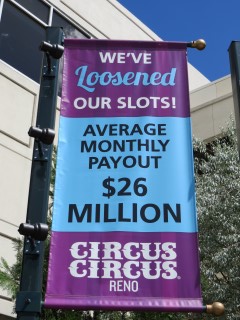
On a recent trip to Reno I noticed these two signs.
 |
 |
How does the total amount paid out or won correlate to how loose the slots are? In other words, should I prefer to play at the Circus Circus and Reno airport because their slots allegedly pay out so much?
No. To get an estimate of how loose a casino's slots are you would want to know the ratio of money returned to money bet. This ratio would typically be about 92%. Telling you only the amount paid out is not useful at all. Consider the Circus Circus claim of paying out $26 million a month. They don't disclose how much players bet to get that $26 million. What if they bet $35 million? That would be a return of 71.43%, which would be awful.
In conclusion, I don't know whether to be angry over what I consider to be deceptive advertising or depressed that people fall for it.