




Ask The Wizard #238
This pertains to the aggregate payout in Let in Ride and how the $1 side bet is affected. When a table posts an aggregate payout of say $50,000, is this just for the standard three bets that you make to start the game OR does this actually include the $1 side bet as well? Over the years I have heard conflicting info.
I asked two Las Vegas casino executives about this. The first one said their policy on all games with a jackpot-based side bet is to first pay the primary bets (i.e. not the side bets) to the full odds. The aggregate cap only applies to the side bets. In the event the side bet wins exceed the aggregate maximum, then winners are paid on a pro-rata basis, according to their win. For example, if the aggregate is $50,000, player 1 won $50,000, player 2 won $10,000, and player 3 won $100, then each player would get paid $50,000/($50,000+$10,000+$100)=83.19% of what he would get without the limit. The second casino executive, with another company, said the same thing except they pay the side bets in full and pro-rate the primary bets.
In the game of hearts, each player is given 13 cards. The suit with the most cards out of the 13 is called the "long suit," which can have 4 to 13 cards. What is the probability for each of these totals?
Probabilities for Long Suit in Hearts
| Cards | Combinations | Probability |
| 4 | 222766089260 | 0.35080524800183 |
| 5 | 281562853572 | 0.44339660045899 |
| 6 | 105080049360 | 0.16547685914958 |
| 7 | 22394644272 | 0.03526640326564 |
| 8 | 2963997036 | 0.00466761219692 |
| 9 | 235237860 | 0.00037044541245 |
| 10 | 10455016 | 0.00001646424055 |
| 11 | 231192 | 0.00000036407412 |
| 12 | 2028 | 0.00000000319363 |
| 13 | 4 | 0.00000000000630 |
| Total | 635013559600 | 1 |
Do you have any information on video blackjack? Do the rules/payoffs vary, and where are the best games in Vegas?
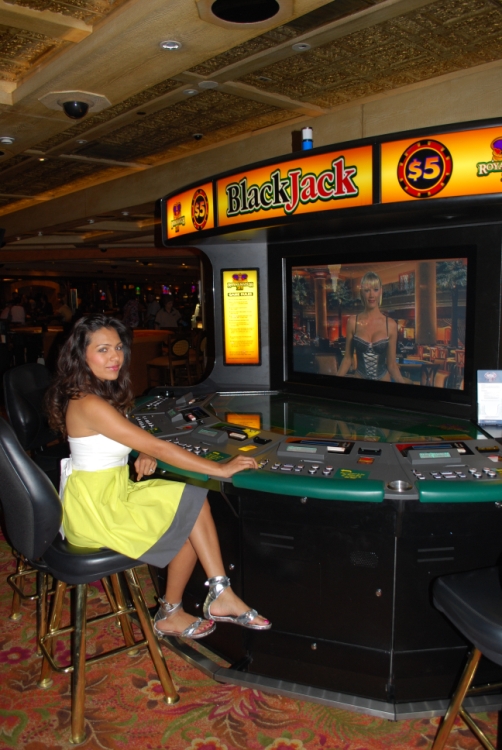
I think your odds are best with the big Table Master units with big video screens housing attractive dealers. These are getting easier and easier to find, but I don’t know of any specific list of them. Your odds of finding them will be better in low-roller casinos. Some pay 3 to 2 on blackjack, and some only pay 6 to 5. An an example, the unit at the Riviera has the following rules:
- 6 decks (shuffled after four decks)
- Blackjack pays 3 to 2
- Dealer hits soft 17
- Double after split allowed
- Double on any two cards allowed
- Surrender allowed
- Split to two hands only
- Seven Card Charlie (un-busted hands of 7 cards automatically win)
- Bet range: $2-$200
The house edge under these rules is 0.68%. If you play an even-money game, the house edge will be 1.4% to 2.0%, depending on the other rules. Be sure to use a player card to earn whatever cash, free play, or comps the casino offers.
The picture below shows one of these products.
While playing your free blackjack game on this site, I noticed that when the count got to, i.e. -7 or lower, I was winning as much if not more than when the count was say +10 or higher. Is this just a fluke, or is there some advantage to the player when the count is a high negative number?
The game shuffles after every hand, so the count is always zero at the start of the hand. However, when there is a cut card, a negative count tends to be very slightly correlated to positive results since the start of the shoe. That is because the negative count means that more good cards than bad have already been played, which would have been good for the player.
I was playing "live" poker for the first time recently, not a tournament. Myself and everyone was tipping for a win. Before putting the tip into the toke box, the dealer would loudly "tap" the toke on top of the metal box, making a loud noise. After I thought about it, I remember blackjack dealers doing this as well. Is this some kind of procedure? The only reasons I can think of to do this is to alert the pit boss/floor manager that a toke is going into the box. I can’t see how it would make a difference to the eye.
I asked the Bone Man of NextShooter.com about this one. He said there are two reasons for the tap. The first is a way of thanking the player for the tip. A good dealer will verbally thank the player making the tip while making the tap. The second is a measure to keep the dealers honest. It has happened many times where dealers pocketed tips in casinos where tips are supposed to be put in a pool. Game security is not my strong point, but procedures like this are put there to make it harder to cheat, and easier to get caught if you do.